
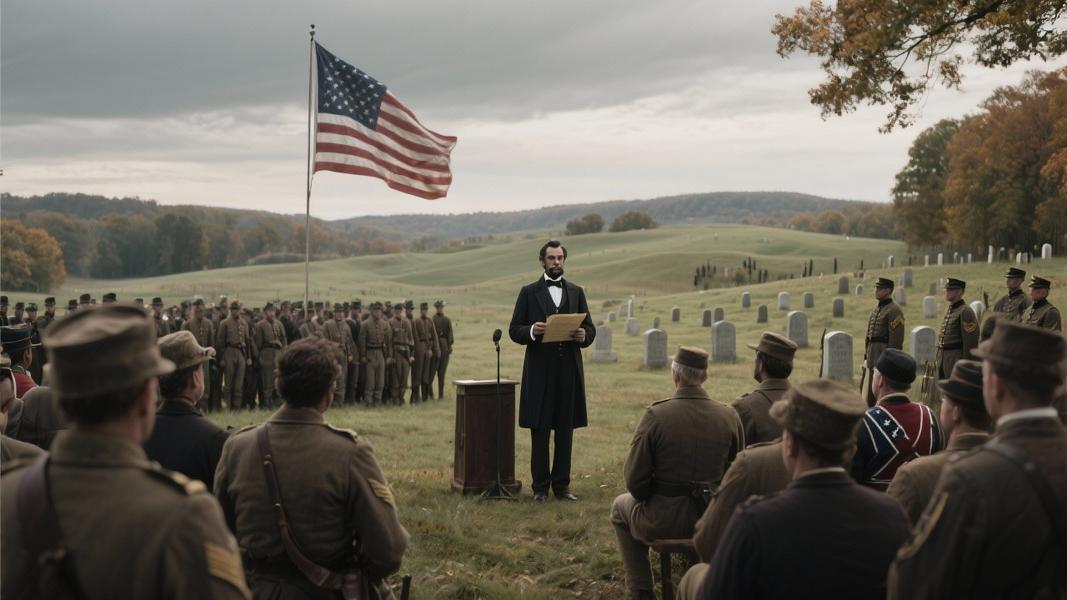
Few speeches in American history have left such an indelible mark on the national conscience as Abraham Lincoln’s Gettysburg Address. Delivered in just over two minutes with a mere 272 words, this remarkable oration would transform how Americans understood the Civil War and define the nation’s ideals for generations to come.
A Nation at War with Itself
On November 19, 1863, President Abraham Lincoln stood before a crowd at the dedication of a military cemetery in Gettysburg, Pennsylvania. The battle that had unfolded there just four months earlier was one of the bloodiest of the Civil War, with more than 50,000 casualties over three days of fighting. Lincoln had come to commemorate those who had fallen.
His address began with what would become one of the most recognized phrases in American oratory: “Four score and seven years ago our fathers brought forth on this continent, a new nation, conceived in Liberty, and dedicated to the proposition that all men are created equal.” With these words, Lincoln deliberately reached back to 1776 and the Declaration of Independence, not the Constitution, as the true founding of the American experiment.
What made this speech so powerful? For one, its brevity. While the main speaker that day, Edward Everett, delivered a two-hour oration, Lincoln’s remarks lasted just over two minutes. Yet in that brief span, he reframed the entire conflict.
More Than a Dedication
Lincoln wasn’t simply honoring the dead. He was challenging the living. “It is for us the living, rather, to be dedicated here to the unfinished work which they who fought here have thus far so nobly advanced,” he declared, transforming a cemetery dedication into a national recommitment to the principles of equality and liberty.
The speech came at a pivotal moment in the war. The Union victory at Gettysburg had halted Robert E. Lee’s northern invasion, but the conflict was far from over. The nation was weary. Lincoln understood this fatigue, yet he called upon Americans to ensure that “from these honored dead we take increased devotion to that cause for which they gave the last full measure of devotion.” That phrase—”last full measure of devotion”—has since become synonymous with the ultimate sacrifice in military service, embodying the profound debt owed to those who died defending the Union.
Did Lincoln know his words would resonate through the ages? Probably not. Contemporary reactions were mixed. The Chicago Times criticized it as “silly, flat and dishwatery,” while the Springfield Republican praised it as “a perfect gem.” History, however, has sided decisively with the latter assessment.
A Democracy’s Promise
The Gettysburg Address wasn’t just about commemorating a battle. It was about redefining the Civil War itself. Lincoln framed the conflict not merely as a struggle to preserve the Union but as a test of whether a nation founded on equality could endure. The war became a fight for democracy itself—a cause that transcended borders and generations.
Today, scholars recognize the speech as one of the most significant in American history, not just for its eloquence but for how it reshaped the national narrative. Lincoln’s address connected the founding ideals of the nation to its present struggle and future promise.
Perhaps most remarkably, the speech concludes with Lincoln’s vision that “government of the people, by the people, for the people, shall not perish from the earth.” This wasn’t just a statement about preserving American democracy—it was a declaration that the American experiment carried global significance. The stakes of the Civil War extended beyond American borders to represent the viability of democratic governance itself.
The Gettysburg Address has since been memorized by schoolchildren, carved into monuments, and cited by presidents and civil rights leaders alike. It has become, as historians note, not just a speech but a foundational text of American identity—a two-minute distillation of the country’s highest aspirations.
In an era of political polarization and contested narratives about American history, Lincoln’s words at Gettysburg offer something increasingly rare: a shared national text that reminds us of the cost of division and the ongoing work of creating “a more perfect union.” The unfinished work he spoke of continues today.
