
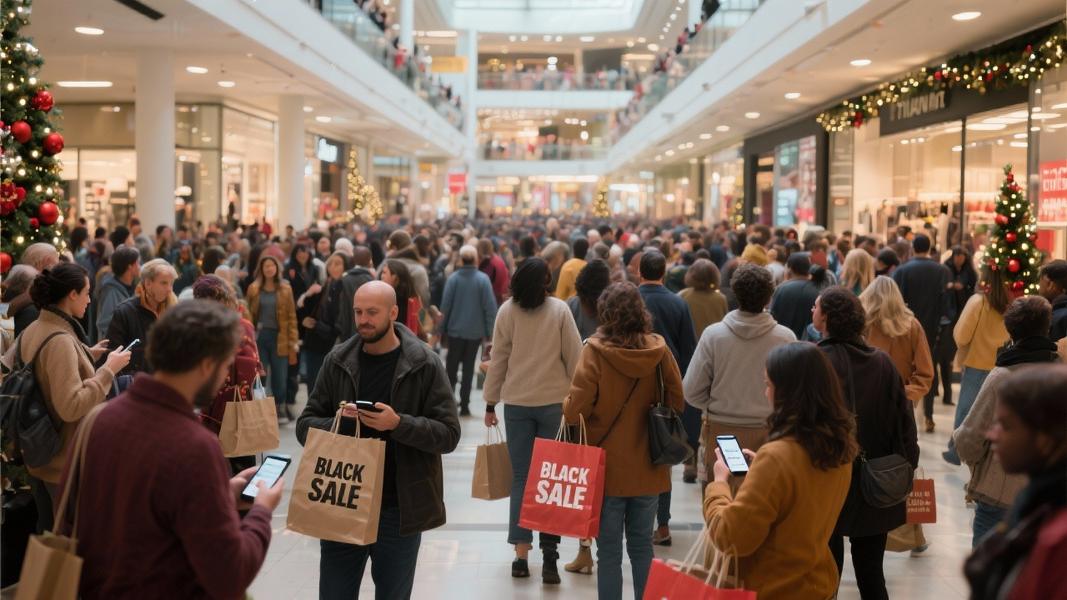
Americans shattered online shopping records during Black Friday 2025, spending a staggering $11.8 billion in a single day — a 9.1% jump from last year — despite economic headwinds and shifting retail patterns that saw in-store traffic continue its slow decline.
The online shopping frenzy peaked between 10 a.m. and 2 p.m. local time, with digital cash registers ringing up an astonishing $12.5 million per minute during the busiest periods, according to data released by Adobe Analytics. Even Thanksgiving Day itself set records, with consumers dropping $6.4 billion on electronics, gaming consoles, and home appliances while presumably still digesting their holiday meals.
Different tracking platforms painted varying pictures of just how massive the spending surge was. Salesforce estimated U.S. online Black Friday sales reached $18 billion, with global sales hitting $79 billion. Meanwhile, Shopify reported its merchants worldwide collected $6.2 billion, with cosmetics and clothing leading the way.
Physical Stores Struggle as Digital Dominates
The digital spending explosion stands in stark contrast to brick-and-mortar performance. Mastercard SpendingPulse found in-store sales grew by a modest 1.7%, while online purchases surged 10.4% year-over-year.
“Consumers are navigating an uncertain environment by shopping early, leveraging promotions, and investing in wish-list items,” said Michelle Meyer, chief economist at Mastercard Economics Institute.
Foot traffic to physical stores fell 3.6% compared to Black Friday 2024, continuing a years-long trend as shoppers increasingly prefer clicking “add to cart” over waiting in checkout lines. But that decline wasn’t as steep as some retailers feared.
Grant Gustafson, head of retail consulting and analytics at Sensormatic Solutions, noted that “Black Friday has really turned into like a full week event, or even further,” explaining why the single-day numbers don’t tell the complete story. Indeed, Sensormatic’s data showed traffic over the entire Black Friday week jumped nearly 57% compared to the prior week.
Just Getting Started
Is the spending spree over? Hardly. Adobe projects another $5.5 billion in online sales for Saturday, $5.9 billion on Sunday, and a whopping $14.2 billion on Cyber Monday — which would set yet another record.
The National Retail Federation expects total U.S. holiday spending in November and December to exceed $1 trillion for the first time, though the growth rate of 3.7% to 4.2% would represent a slowdown from 2024’s 4.3% increase.
Comparing to last year, Black Friday 2024 saw $10.8 billion in online spending, with approximately 87.3 million Americans shopping online and 81.7 million visiting stores, according to Adobe data published earlier this year. Shopify merchants then recorded $4.1 billion in sales, with their point-of-sale systems seeing a “significant 33% year-over-year increase in global sales.”
Economic Anxiety Shapes Shopping Patterns
Behind the headline-grabbing numbers, a more complex picture emerges. Despite spending more overall, consumers bought fewer items per transaction in 2025, with order volumes actually dropping 1% while average selling prices rose 7%, Salesforce determined. This suggests inflation and tariff-driven price increases are reshaping how Americans shop.
“Consumers are thinking a little bit harder about their purchases to make sure that they’re getting their very best deals,” said Gustafson, pointing to economic uncertainty from factors like tariffs, job security concerns, corporate layoffs, and recent government shutdowns.
That caution is showing up in payment methods too. With credit card debt and loan delinquencies on the rise, more shoppers are turning to “buy now, pay later” options to finance everything from holiday decorations to gifts for loved ones, according to industry analysts.
The mixed signals — record spending alongside cautious consumer behavior — reflect an economy at a crossroads. Americans are still shopping, but they’re doing it with one eye on their bank accounts and uncertain futures. As the holiday season progresses, retailers will be watching closely to see if this spending surge represents genuine consumer confidence or just a carefully budgeted splurge before a potentially challenging 2026.
