
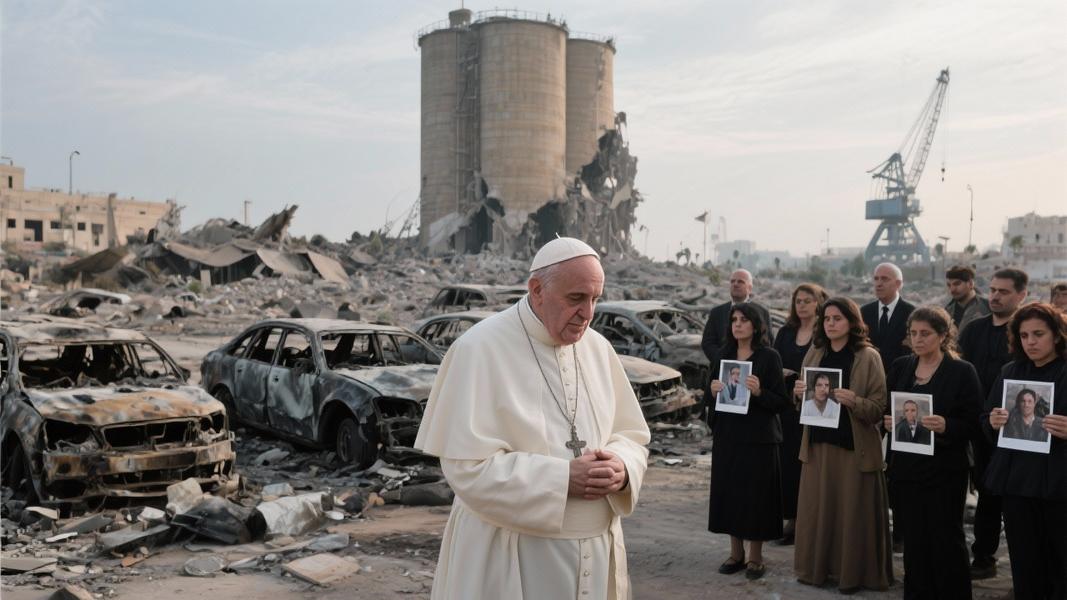
Pope Leo XIV concluded his historic first foreign trip Friday with a deeply symbolic visit to Beirut, where he stood in silent prayer at the devastated port that exploded in 2020, killing 218 people and leaving thousands homeless in an unhealed national trauma.
The pontiff, who began his journey in Turkey last week, arrived to massive crowds in Lebanon’s capital, where he met with families of explosion victims and offered words of comfort in a country still reeling from economic collapse, political paralysis, and the lack of accountability for the disaster that devastated large portions of the city.
“Choose peace as a way, not just a goal,” Leo urged during his farewell ceremony, a poignant message delivered to a nation where sectarian divisions continue to hamper progress nearly five years after the blast that caused billions in damage when hundreds of tons of improperly stored ammonium nitrate ignited. His remarks underscored the central theme of his six-day journey through two countries at the crossroads of faith and geopolitical tension, as confirmed by Vatican sources.
A Journey of Firsts
Before arriving in Lebanon, Leo received a grand send-off in Istanbul, capping a visit that included a landmark appearance at the Armenian Apostolic Cathedral — a significant gesture in a country where religious minorities have faced historical challenges.
The 78-year-old pontiff’s schedule in Lebanon proved demanding. He visited Beirut’s De La Croix hospital, where many victims were treated after the 2020 explosion, and later addressed youth gathered in Bkerke, offering messages of hope to a generation facing unprecedented economic uncertainty in what was once known as the “Switzerland of the Middle East.”
What made this visit particularly meaningful? Beyond the diplomatic niceties and official meetings with Lebanon’s top officials, it was Leo’s silent prayer at the explosion site that resonated most powerfully with locals. Standing before the damaged grain silos — preserved as a memorial to the disaster — the pope’s wordless tribute spoke volumes in a country where words about accountability have rung hollow for many survivors.
The explosion itself remains a festering wound in Lebanon’s national psyche. When hundreds of tons of ammonium nitrate detonated on August 4, 2020, it not only killed 218 people but also injured thousands more and left about 300,000 homeless. The blast, which registered as a 3.3 magnitude earthquake, damaged buildings as far as 12 miles away.
Still, no senior officials have been held accountable, with investigations stalled amid political interference and legal challenges that have frustrated victims’ families seeking justice.
Calls for Healing and Justice
During his meeting with relatives of explosion victims, Leo listened intently to their stories, occasionally wiping away tears. One mother, clutching a photo of her teenage son killed in the blast, embraced the pontiff as cameras captured the emotional moment.
“We don’t want just prayers, we want justice,” shouted one man from behind the security cordon, highlighting the tension between spiritual comfort and concrete accountability that has characterized Lebanon’s recovery.
The visit comes at a precarious time for Lebanon, a nation of about 5.5 million that hosts more than a million Syrian refugees while grappling with a financial meltdown that has pushed nearly 80% of its population into poverty. The local currency has lost more than 95% of its value since 2019, and basic services like electricity and clean water remain luxuries for many.
Leo’s predecessor made a similar journey to Lebanon in 2012, but that was before the country’s economic collapse and the port explosion that has come to symbolize government dysfunction and corruption.
As his plane departed Beirut Friday evening, many Lebanese wondered if the papal visit might serve as more than just a momentary distraction from their daily struggles. “The pope leaves, our problems stay,” said one taxi driver with a shrug, capturing the blend of appreciation for the visit and skepticism about its lasting impact that characterized many locals’ reactions.
Yet in his final address, Leo offered something that has been in short supply in Lebanon: hope without naivety. “Peace is not the absence of problems, but the presence of justice,” he said, leaving behind a challenge that will echo long after the papal entourage has returned to Rome.
