
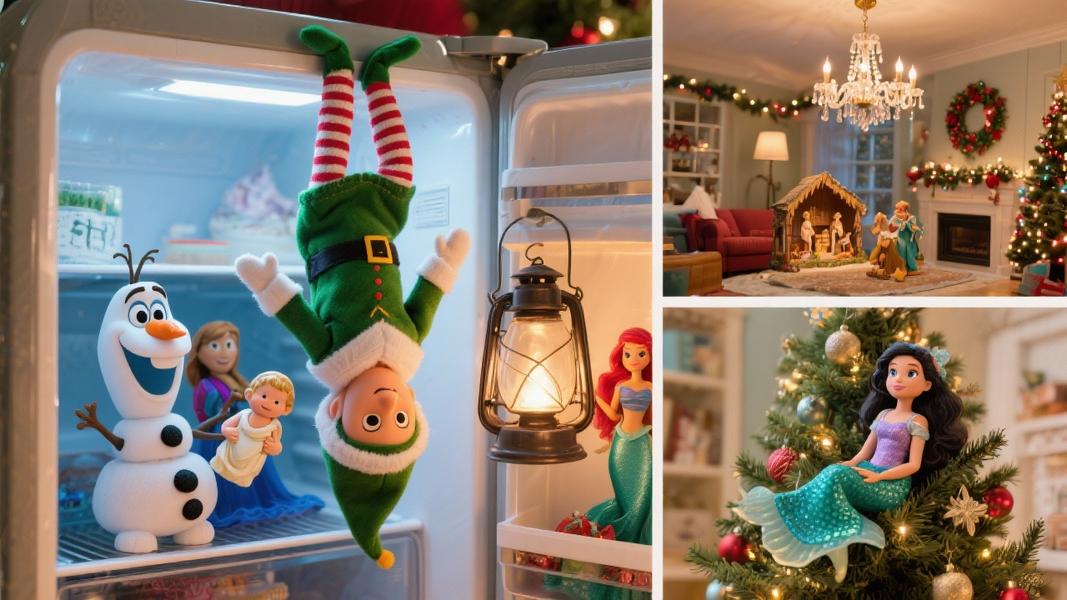
Parents across America are once again bracing for the annual holiday madness that is Elf on the Shelf season — a cherished tradition that brings equal parts joy to children and stress to the adults tasked with orchestrating the nightly adventures of Santa’s tiny scout.
What began as a simple family custom has transformed into a global phenomenon with more than 13 million sets sold worldwide. The story started in 1974 with a small elf named Fisbee who visited the household of Bob and Carol Aebersold, beginning what would eventually become a multimillion-dollar business empire built on holiday magic and parental dedication.
From Family Tradition to Global Phenomenon
“We had an elf growing up for as long as we can remember. Our elf was named Fisbee, and Fisbee of course would report to Santa Claus at night and be back in a different position in our house the next day,” Christa Pitts, one of the co-founders, explained about the tradition’s origins.
The business began when Carol Aebersold and her daughter Chanda Bell formalized the tradition in 2005, publishing a children’s book and doll combination after numerous publishing rejections. “From the moment I met him, I was hooked. He wasn’t just a doll; he was my very own magical friend from Santa, playing hide-and-seek with me every morning,” Bell recalled of her childhood experience.
The mother-daughter team, along with Bell’s twin sister Christa Pitts, self-published their first 5,000 copies, financing the venture with personal credit cards. What followed was an unexpected trajectory toward becoming an essential part of modern Christmas celebrations. “It’s a dream come true,” says Bell. “This is living the American Dream,” she shared.
Their family company, Lumistella, has since expanded beyond the original book and elf to include TV specials, merchandise, clothing lines, and even a coveted spot in the Macy’s Thanksgiving Day Parade. “So we wrote our book really based on our own family tradition and that’s how it got started we never dreamed it would turn into this… It’s very much a family business, it’s still family owned and run,” Bell noted in an interview.
The Parental Pressure Behind the Magic
But what about the parents who must maintain the illusion? The nightly ritual of moving the elf to creative new locations has become something of a competitive sport in some households — and a source of genuine stress for many.
Kurt Neesley of California went so far as to stage his elf, Elfie, as a wall painter complete with paint splashes. “Three glasses of wine usually gets the creativity flowing,” said Neesley, who had planned to repaint that kitchen wall anyway. “Elf on the Shelf can be very stressful.”
For Antonia Katsanos of New Jersey, the tradition has expanded beyond December — she uses her elf year-round to encourage good behavior. Her elaborate scenarios have included the elf dressed as a mermaid in the shower or hanging upside down in her car. “I am a creative person, but you do go dry at some point doing this over and over again, year after year,” said Katsanos. “I’ve popped up from sleep at 3:30 a.m. remembering I need to move the elf.”
How do parents keep up with the pressure? Many turn to social media for inspiration, while others, like Ashley Zavala from Minnesota, opt for a simpler approach. “We don’t get elaborate, we just move the elf,” said Zavala. “Our kids like it and they don’t know the difference because they haven’t had their elf do crazy things.”
Creative Solutions and Alternatives
Actor Alan Ritchson offers a clever parental hack: recruit older children who have figured out the secret. “Here’s the cheat code. You get a 13-year-old who figures it out a couple years earlier than he should, and then he becomes your little Elf on the Shelf weapon. So they get excited. They’ll never miss a night. And you get a kid who’s coming up with ideas for you. That’s the trick,” he revealed.
The success of Elf on the Shelf has inspired other cultural traditions too. Neal Hoffman created “Mensch on a Bench,” a Hanukkah tradition doll for Jewish families that gained attention after appearing on the TV show Shark Tank.
Yet for some, the mounting pressure of maintaining multiple holiday traditions has become too much. Sandi Celentano abandoned the practice after feeling overwhelmed. “The amount of time and energy that it took thinking of creative ways to display these things every single day — it just took over everyone’s lives. I’ve boycotted it for about three or four years,” she admitted.
While some parents meticulously plan elaborate scenarios worthy of social media sharing, others find joy in the simple tradition of movement and discovery. The magic, it seems, lies not in the complexity of the elf’s nightly adventures, but in the wide-eyed wonder of children discovering where their North Pole visitor has landed each morning — even if their exhausted parents needed three glasses of wine to make it happen.
