
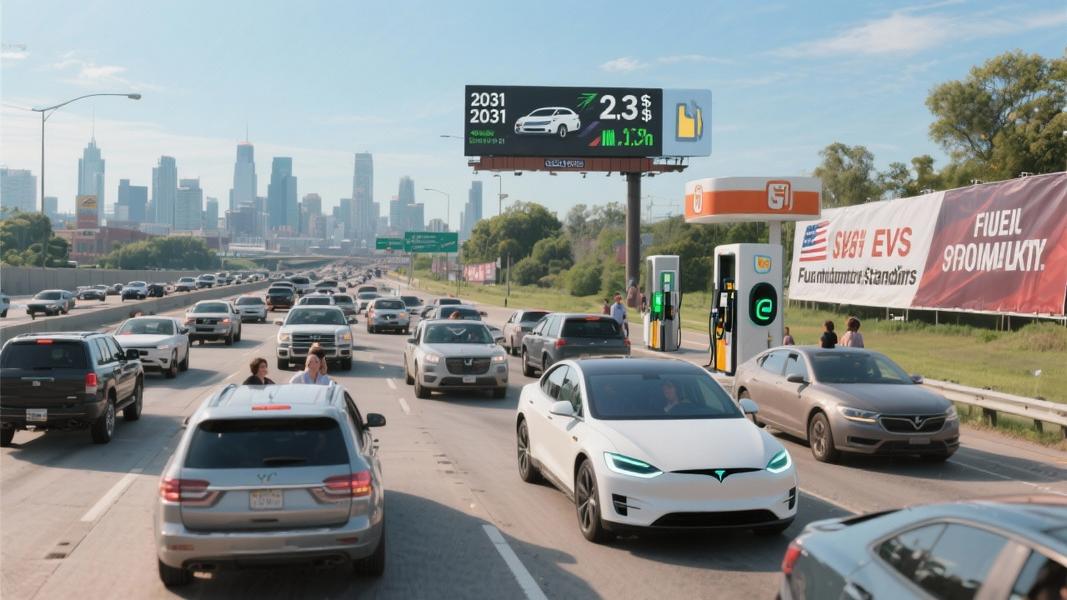
President Trump has significantly weakened vehicle fuel economy standards, rolling back Biden-era rules in a move he claims will make cars more affordable for American consumers.
The dramatic policy shift, announced Tuesday, would drop the industry fleetwide average for light-duty vehicles to roughly 34.5 mpg in 2031, down from the goal of about 50.4 mpg under the Biden administration’s regulations, according to federal officials.
“The new standards would drop the industry fleetwide average for light-duty vehicles to roughly 34.5 mpg (55.5 kpg) in the 2031 model year, down from the goal of about 50.4 mpg (81.1 kpg) that year under the Biden-era rule,” the administration noted.
Costs and Consumer Impact
Trump framed the rollback as a win for consumers, arguing that EV-friendly policies “forced automakers to build cars using expensive technologies that drove up costs, drove up prices and made the car much worse.” He further characterized Biden’s policies as “a quest to end the gasoline-powered car,” despite the fact that no mandate required automakers to sell or consumers to buy electric vehicles.
But what about the actual impact on prices? Experts point out that rising vehicle costs stem from multiple factors beyond fuel economy regulations, including pandemic-era inventory shortages, supply chain challenges, tariffs, and automakers’ focus on larger, more expensive models. A Consumer Reports analysis found no significant inflation-adjusted vehicle price increases caused by fuel economy requirements from 2003 to 2021, despite a 30% improvement in average fuel economy during that period. More importantly, those more efficient vehicles saved owners an average of $7,000 in lifetime fuel costs compared to 2003 models.
Jessica Caldwell, head of insights at Edmunds, cautioned that “cutting the fuel economy standards is unlikely to provide any fast relief on sticker prices,” adding that “their lower efficiency means that those savings could be eaten up by higher fuel costs.” This creates a potential scenario where consumers might pay less upfront but more over the vehicle’s lifetime.
Industry Response
Not all industry voices are skeptical. Ford CEO Jim Farley praised the rollback as a “victory for affordability and common sense,” stating, “As the president said, we will be able to offer more affordability on our popular models, and we’ll be able to launch new vehicles built in America that are more affordable because of this rule change.”
Trump didn’t mince words about his views on electric vehicles. “People were brainwashed. This is a ‘green new scam.’ And people were paying too much for a car that didn’t work as well. And now they’re gonna have a great car that’s gonna be environmentally friendly, but it’s gonna cost you a lot less and it’s gonna work great. All of the nonsense is being taken out of the cars,” he declared.
The EV Infrastructure Question
The president also claimed electric cars were pushed despite inadequate infrastructure, saying, “We had to have an electric car within a very short period of time, even though there was no way of charging them.” This statement contradicts current data on charging availability, which has significantly improved in recent years. There are now over 232,000 Level 2 and fast charging ports across the U.S., averaging one fast charger per mile of National Highway System roads, though they remain concentrated primarily in the West and Northeast.
Under the Biden administration, the goal was for half of new vehicle sales to be electric by 2030, supported by tax incentives up to $7,500 for EV buyers under the Inflation Reduction Act, along with billions for nationwide charging infrastructure. That vision now faces an uncertain future.
Safety Claims
Transportation Secretary Sean Duffy has claimed the reduced requirements will make drivers “safer on the roads because of all the great new technology we have that save lives.” This argument assumes that lower standards will reduce prices and increase new vehicle purchases, bringing more cars with advanced safety features onto roads.
Will that actually happen? Edmunds’ Caldwell expressed doubt: “If Americans purchased more new vehicles equipped with the latest safety technologies, we would expect overall on-road safety to improve. However, it’s unclear whether easing fuel-economy standards will meaningfully increase new-vehicle sales.” Additionally, the Insurance Institute for Highway Safety has found that electric and hybrid vehicles are as safe as or safer than traditional gasoline-powered cars.
Environmental Concerns
Environmental advocates have sharply criticized the policy change. Katherine García of the Sierra Club warned that “this rollback would move the auto industry backwards, keeping polluting cars on our roads for years to come and threatening the health of millions of Americans.”
The rollback represents a significant reversal in America’s approach to vehicle emissions and efficiency standards. After years of gradually increasing requirements aimed at reducing carbon emissions and fuel consumption, the administration has charted a dramatically different course. Whether this shift will deliver the promised affordability benefits without significant environmental costs remains to be seen.
