
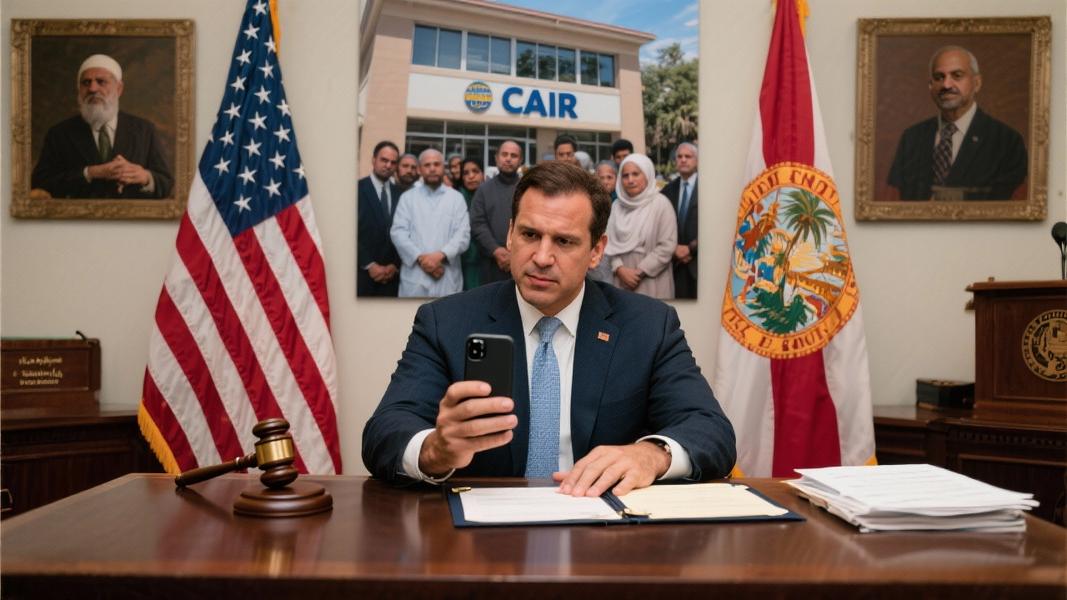
Florida Gov. Ron DeSantis has formally designated the Council on American-Islamic Relations (CAIR) as a “foreign terrorist organization” through an executive order issued Monday, placing one of America’s largest Muslim civil rights groups in the crosshairs of state government restrictions.
The sweeping order also labels the Muslim Brotherhood with the same designation, directing Florida agencies to prevent both organizations — and anyone providing them “material support” — from receiving state contracts, employment opportunities or funding from executive agencies.
Neither organization has been classified as a terrorist group by the federal government, raising immediate questions about the legal basis for DeSantis’ action, which follows a similar move by Texas Gov. Greg Abbott last month.
Civil Rights Group Prepares Legal Challenge
CAIR, which was founded in 1994 and operates 25 chapters nationwide, wasted no time announcing plans to pursue legal action against what it characterized as an “unconstitutional” and “defamatory” proclamation. The organization has already filed a federal lawsuit challenging Abbott’s similar Texas order, arguing it violates the Constitution and lacks support in state law.
“This is an unprecedented attack on a mainstream American Muslim civil rights organization,” said a CAIR spokesperson in a statement. The group accused DeSantis of “prioritizing the interests of the Israeli government over those of the people of Florida” and “baselessly maligning” its work.
Why would a sitting governor target a domestic civil rights organization? The move comes amid heightened tensions following ongoing conflicts in the Middle East and represents an escalation in state-level attempts to restrict organizations perceived as sympathetic to Palestinian causes.
Groups Caught in Political Crossfire
The Muslim Brotherhood, the other organization named in DeSantis’ order, has a complex international history. Established in Egypt nearly a century ago with branches worldwide, its leadership maintains they renounced violence decades ago and seek to implement Islamic governance through democratic processes. Critics, particularly autocratic Middle Eastern governments, view the organization as threatening despite these claims.
CAIR’s inclusion alongside the Brotherhood reflects a controversial narrative pushed by some political figures who’ve long sought to link the American civil rights group to international organizations — connections CAIR has consistently denied.
Legal experts suggest the designations face significant constitutional hurdles. “State governments don’t have the authority to designate foreign terrorist organizations — that’s exclusively a federal power,” said one constitutional law professor who requested anonymity because their university hasn’t authorized public comment on the matter.
The executive order instructs Florida agencies to cut ties with both groups and anyone providing them support, potentially affecting employment, contracts and state funding — a move that could have far-reaching implications for Muslim Americans and civil liberties advocates across the state.
For CAIR, which has spent nearly three decades advocating for Muslim civil rights in America, the designation represents an extraordinary challenge. The organization has frequently represented Muslims in discrimination cases and advocates for greater understanding of Islam in American public life.
As the legal battles unfold in both Florida and Texas, the unprecedented state-level terrorism designations raise profound questions about federalism, religious freedom, and the boundaries of state executive power in matters traditionally reserved for federal authorities.
