
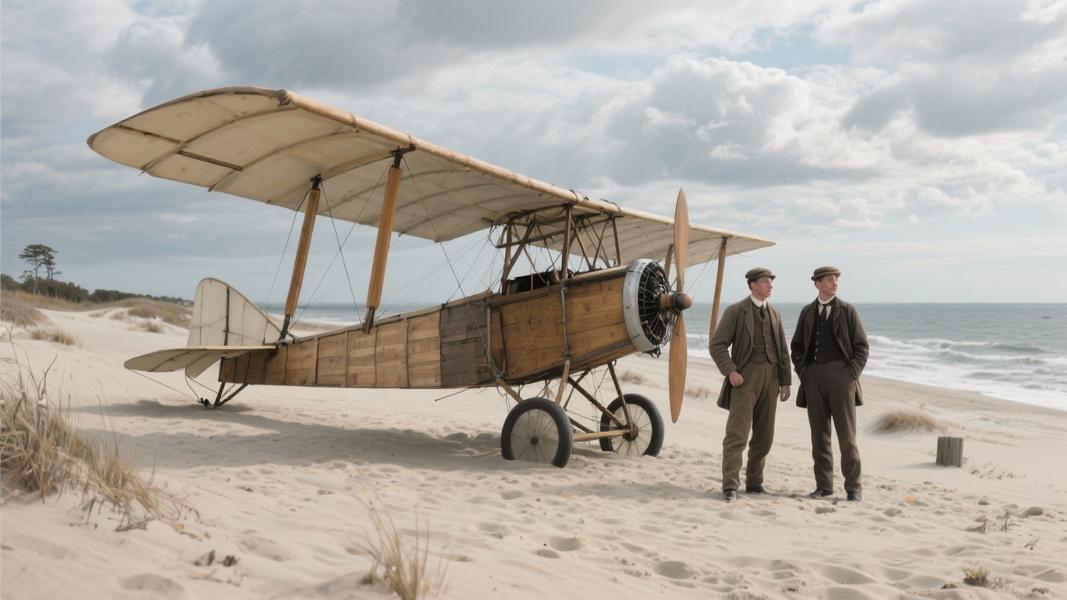
The moment lasted just 12 seconds. A wooden contraption, barely recognizable as an airplane by today’s standards, skimmed above the windswept dunes of North Carolina’s Outer Banks. Yet in that fleeting interval on December 17, 1903, everything changed.
The Day Flight Became Possible
At 10:35 a.m. on that winter morning, Orville Wright piloted the first successful controlled, sustained, engine-powered flight in human history. The distance? A modest 120 feet. But what the flight lacked in distance, it made up for in significance. “Their powered aircraft flew for 12 seconds above the sand dunes of Kitty Hawk, North Carolina, making them the first men to pilot a heavier-than-air machine that took off on its own power, remained under control, and sustained flight,” explains NASA’s official account.
The historic moment was captured in what would become one of the most famous photographs in aviation history. “Just as Orville left the ground, John Daniels from the lifesaving station snapped the shutter on a preset camera, capturing the historic image of the airborne aircraft with Wilbur running alongside,” notes the National Park Service.
What made that day truly remarkable wasn’t just the first flight, but what followed. The Wright brothers made four flights that day, each one longer than the last. “On the fourth flight of the day, Wilbur covered a distance of 852 feet, remaining aloft for 59 seconds,” records the National Museum of the U.S. Air Force. From 12 seconds to nearly a minute — in just hours, the brothers had already begun pushing the boundaries of their invention.
The Genius Behind the Flight
How did two bicycle mechanics from Dayton, Ohio, with no formal engineering training, accomplish what so many others had failed to achieve? The answer lies in their methodical approach and one crucial innovation.
“The three-axis control system was their single most important design breakthrough,” according to the Smithsonian Air and Space Museum. This system — allowing control of pitch, roll, and yaw — distinguished the Wright brothers from their competitors who focused primarily on power rather than control.
The brothers didn’t just show up at Kitty Hawk ready to make history. They’d been preparing for years. “With over a thousand glides from atop Big Kill Devil Hill, the Wrights made themselves the first true pilots,” states the National Park Service. This patient, iterative approach to mastering flight control before adding power proved decisive.
When the moment of truth arrived, the Flyer performed exactly as designed. “The Flyer… landed — pilot and airplane intact except for one cracked skid — 120 feet from the end of the rail. For the first time ever, a flying machine had taken off from level ground, traveled through the air, and landed under the control of its pilot,” describes the Wright Brothers Aeroplane Company.
A Message That Changed Everything
The enormity of their achievement was conveyed in a telegram the brothers sent to their father: “SUCCESS FOUR FLIGHTS THURSDAY MORNING ALL AGAINST TWENTY ONE MILE WIND STARTED FROM LEVEL WITH ENGINE POWER ALONE.” This simple message announced what would become one of the most transformative technological achievements in human history.
What sets the Wright brothers’ accomplishment apart from earlier attempts at flight was the complete package they delivered. “They made the first controlled, sustained flight of an engine-powered, heavier-than-air aircraft with the Wright Flyer on December 17, 1903, four miles south of Kitty Hawk, North Carolina, at what is now known as Kill Devil Hills,” summarizes a historical account.
The brothers embodied American ingenuity at its finest. “On December 17, 1903, two brothers from Dayton, Ohio, named Wilbur and Orville Wright, were successful in flying an airplane they built,” recounts NASA, in what might be the greatest understatement in aviation history.
Today, the site of this momentous achievement is preserved as a national memorial. But perhaps the true memorial to the Wright brothers’ genius is above us every day — in the contrails of thousands of aircraft that crisscross our skies, all descendants of those 12 seconds of flight on a windy December morning.
