
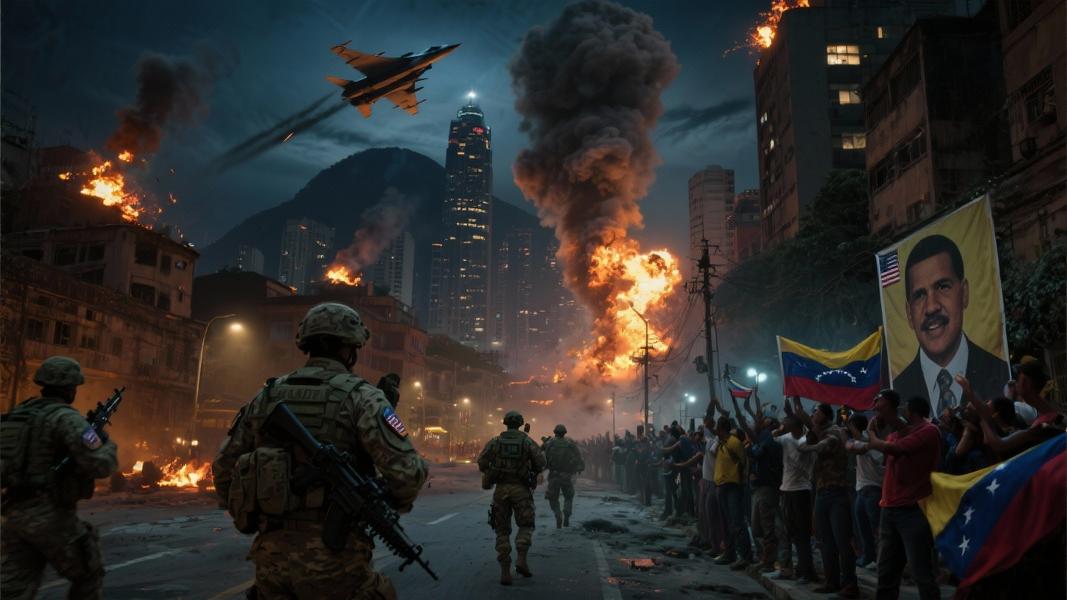
U.S. military forces have reportedly captured Venezuelan President Nicolás Maduro and his wife in a stunning overnight operation that involved airstrikes across multiple Venezuelan cities, including the capital Caracas.
Former President Donald Trump claimed on social media that the mission was successful, writing: “Maduro has been, along with his wife, captured and flown out of the Country.” The extraordinary assertion comes amid reports of explosions, low-flying aircraft, and widespread power outages across Venezuela in what appears to be a major U.S. military intervention early Saturday.
Confusion and Conflicting Reports
Venezuelan officials, however, have cast doubt on Trump’s declaration. “We do not know the whereabouts of President Nicolás Maduro and First Lady Cilia Flores,” a government spokesperson stated in an emergency broadcast. “We demand proof of life.”
The strikes reportedly targeted multiple locations throughout the country, with residents in Caracas describing the sound of jet engines and explosions that rattled windows in residential neighborhoods. Power outages have complicated efforts to gather information about the extent of the military action.
What’s behind this sudden escalation? The operation marks a dramatic shift in U.S. policy toward Venezuela after years of diplomatic pressure, sanctions, and political isolation failed to dislodge Maduro from power.
If confirmed, the capture of Maduro would represent one of the most significant U.S. military actions in the Western Hemisphere in decades. The Venezuelan leader has maintained his grip on power despite international pressure, economic collapse, and widespread humanitarian crises that have driven millions of Venezuelans to flee their homeland.
Witnesses in Caracas reported seeing military aircraft flying at extremely low altitudes, a tactic typically used to avoid radar detection. “The whole building was shaking,” one resident told reporters by phone. “We’ve had no electricity for hours now.”
International Reactions
The operation has already sparked intense reactions across Latin America. Traditional U.S. allies have remained notably silent in the immediate aftermath, while nations with closer ties to Venezuela’s government have condemned what they’re calling an “illegal invasion” and “violation of sovereignty.”
Human rights organizations have expressed concern about civilian casualties and called for immediate clarification on Maduro’s status and whereabouts. The Venezuelan military’s response remains unclear, with reports of both resistance and possible defections among senior officers.
The Pentagon has yet to release an official statement confirming details of the operation, including whether Maduro is indeed in U.S. custody as Trump has claimed.
For ordinary Venezuelans, the night of explosions and uncertainty adds another chapter to years of political turmoil and economic hardship. “We don’t know if we should celebrate or prepare for worse,” said one Caracas resident reached by text message. “Nobody knows what comes next.”
