
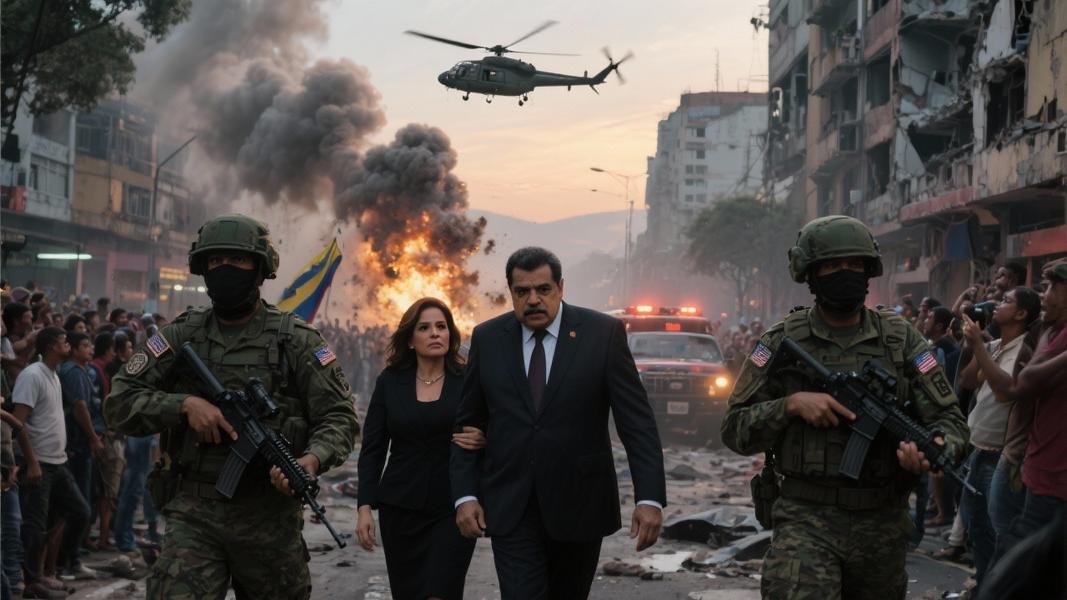
U.S. Special Forces have captured Venezuelan President Nicolás Maduro and his wife in a dramatic pre-dawn raid on Caracas, marking one of the most significant American military interventions in Latin America in decades.
President Donald Trump announced the operation via his Truth Social platform early Saturday, describing it as a “successful large-scale strike against Venezuela.” The operation, carried out by the Army’s elite Delta Force, followed months of escalating tensions between the two nations and included a brief but intense bombing campaign targeting key locations in the Venezuelan capital.
From Caribbean Strongman to American Prisoner
U.S. Attorney General Pam Bondi confirmed that Maduro and his wife have been indicted in the Southern District of New York on narco-terrorism charges and will “soon face the full wrath of American justice on American soil in American courts.” The charges culminate years of accusations that Maduro’s government facilitated drug trafficking to fund its operations.
The timing couldn’t be more symbolic. Saturday’s capture occurred exactly 36 years after U.S. forces arrested Panamanian dictator Manuel Noriega on similar drug trafficking allegations — a historical parallel that hasn’t gone unnoticed by regional observers.
What prompted such a dramatic escalation now? The administration has pointed to an increase in alleged drug shipments from Venezuela, with the Pentagon reporting several airstrikes against Venezuelan vessels in recent months. Critics, however, question the timing of the operation as it comes during an election year.
Operation Details Emerge
According to military sources, the Delta Force unit executed the capture with surgical precision. “The United States of America has successfully carried out a large scale strike against Venezuela and its leader,” Trump wrote in his social media post, adding that both Maduro and his wife were “captured and flown out of the Country.”
The operation appears to have unfolded quickly, with initial bombing followed by the targeted extraction of the Venezuelan leader from an undisclosed location in Caracas. No American casualties have been reported in what defense officials are privately describing as a textbook special operations mission.
Regional reaction has been swift and mixed. Several Latin American nations have condemned the action as a violation of sovereignty, while others have cautiously welcomed the removal of a leader many had accused of undermining democratic institutions.
Historical Context
This isn’t the first time the United States has taken direct action against a Latin American leader. The capture of Noriega in 1989 followed a similar pattern — accusations of drug trafficking, followed by military intervention.
But the stakes in Venezuela are arguably higher. The country sits on the world’s largest proven oil reserves and has been a focal point of geopolitical tension, with Russia and China establishing significant economic and military ties with the Maduro regime.
What happens next in Caracas remains uncertain. While Maduro has been removed, the power structure he built over years remains largely intact. Questions about succession and stability in the oil-rich nation loom large as the world watches for potential fallout.
As Maduro awaits trial in New York, the capture represents both an end and a beginning — the conclusion of his controversial rule and the start of what will likely be a complex chapter in U.S.-Latin American relations.
