
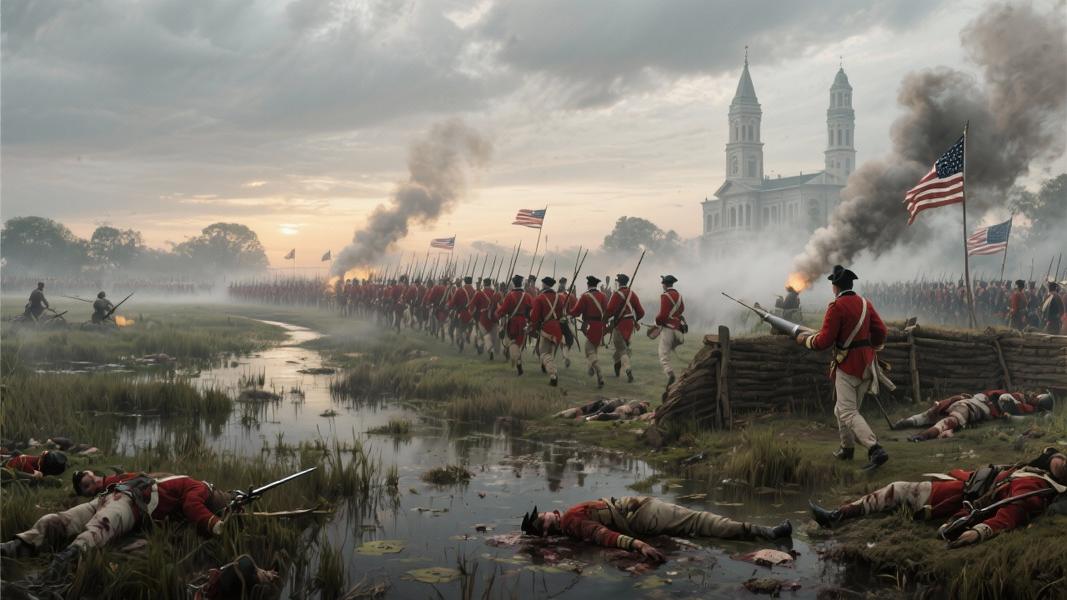
In a stunning display of American military prowess, the Battle of New Orleans stands as perhaps the most lopsided victory in the War of 1812 — a half-hour clash that left more than 2,000 British soldiers dead, wounded or captured while American forces suffered fewer than 100 casualties.
The decisive battle, fought on January 8, 1815, pitted approximately 5,700 Americans under General Andrew Jackson against some 8,000 British troops in what would become the final major engagement of the war. Jackson’s forces, a diverse collection of regulars, militia, volunteers, and allied fighters, repelled the main British assault from behind defensive earthworks made of mud and cotton bales in what historians describe as less than an hour of intense fighting.
A Sea of Red
The carnage was extraordinary. One American witness recalled, “When the smoke had cleared and we could obtain a fair view of the field, it looked at first glance like a sea of blood. It was not blood itself, but the red coats in which the British soldiers were dressed. The field was entirely covered in prostrate bodies.”
How did such a mismatch occur? Despite their numerical superiority and better training, British forces led by General Edward Pakenham made a fateful frontal assault against well-entrenched American positions. The result was catastrophic for the British, who suffered more than 2,000 casualties while the Americans lost fewer than 100 men.
Among the British dead was General Pakenham himself, whose fall further disorganized the already chaotic British assault. Military records indicate the lopsided casualty count: more than 2,000 British dead compared to just 8 Americans killed and 13 wounded in the half-hour engagement.
Jackson, known for his aggressive leadership, reportedly urged his men, “Give it to them, my boys! Let us finish the business today!” — a battle cry that echoed through American military lore for generations to come.
Victory After Peace
In a strange twist of historical timing, the battle occurred after the signing of the Treaty of Ghent on December 24, 1814, which had officially ended the war. News traveled slowly in the early 19th century, and neither Jackson nor the British commanders knew that peace had already been negotiated when they met on the battlefield south of New Orleans.
The victory catapulted Jackson to national fame. His successful defense against what many Americans viewed as a foreign invasion by a superior force helped transform him from a military leader into a political figure. Thirteen years later, riding the wave of popularity that began at New Orleans, Jackson would ascend to the presidency of the United States.
Military analysts note that Jackson’s defensive line, which repelled the main British assault in less than an hour, exemplified effective use of terrain and the integration of diverse fighting forces — a hallmark of American military adaptation.
The battle’s overwhelming outcome — with British casualties exceeding 2,000 while American losses remained minimal — stands as a testament to the emerging military capability of the young republic, a bloody exclamation point at the end of a war that had begun with American forces struggling against their former colonial masters.
