
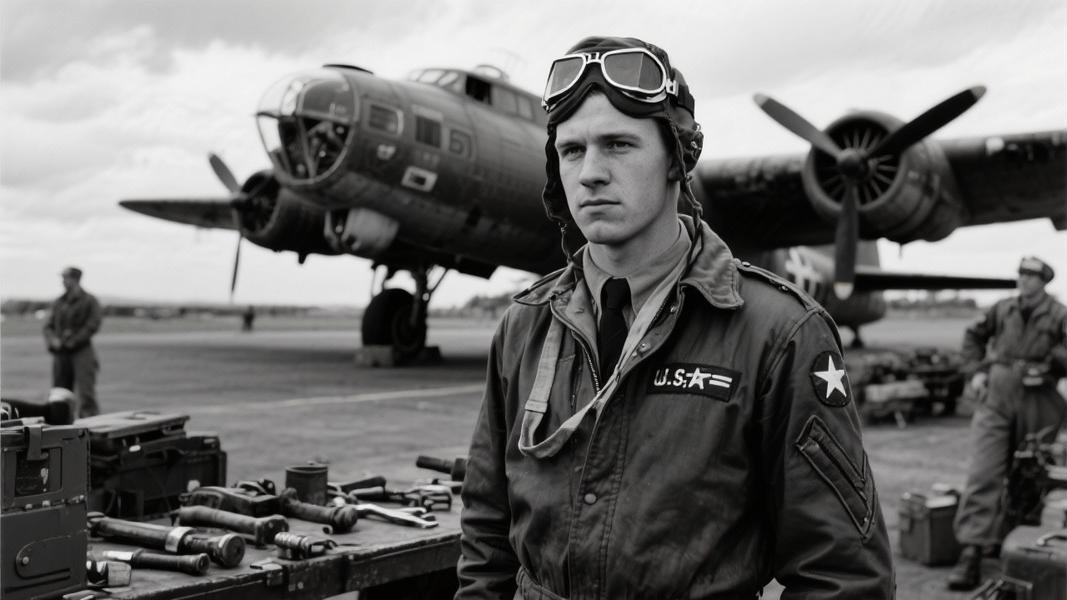
From aircraft mechanic to waist gunner, a German-born American’s remarkable WWII story is now preserved as part of a Texas veterans’ oral history initiative that ensures such experiences aren’t lost to time.
Texas Land Commissioner and Veterans Land Board Chairwoman Dawn Buckingham has announced the latest addition to the state’s “Voices of Veterans” program — the compelling wartime account of Staff Sergeant John F. Bremer Jr., who served in the U.S. Army Air Corps during World War II. The oral history project, the first of its kind by a Texas state agency, meticulously documents veterans’ stories for researchers and future generations.
From Germany to America: The Early Years
Bremer’s journey began far from Texas battlefields. Born in Germany in 1921, he was just three and a half years old when his family immigrated to America, following his father who had secured work in Pennsylvania a year earlier. The family’s migration story represents the classic American dream narrative — one that would eventually lead Bremer to serve his adopted country during humanity’s greatest conflict.
Like many Americans of his generation, Bremer vividly recalled the moment he learned about Pearl Harbor. He was riding in a car with his parents, his mother and father in the backseat, when news of the Japanese attack broke over the radio on December 7, 1941 — a day that would alter the trajectory of his life.
From Civilian to Soldier: Specialized Training
The war machine needed skilled technicians, and Bremer soon found himself answering the call. Drafted into the Army Air Corps in 1942, his military journey began with a brief stint at boot camp in Miami, Florida. “I only spent a couple of weeks because I needed to get the rest of my shots, the rest of my uniforms and a little bit of training,” Bremer recalled in his oral history.
What came next? A phone call that would redirect him to Amarillo, Texas, where he’d begin specialized training as a B-17 aircraft mechanic. “They told me I would be learning to be a B-17 aircraft mechanic,” Bremer said about the unexpected reassignment. The intensive course, which he remembered lasting roughly six months, marked the beginning of his technical education on the legendary “Flying Fortress” bombers.
Bremer’s mechanical expertise expanded further at the Boeing Factory School in Seattle, where he studied aircraft instruments during an exactly “31-day” course before heading to Salt Lake City. But maintaining aircraft wasn’t his only responsibility — he would also need to defend them.
At gunnery school in Kingman, Arizona, Bremer received comprehensive weapons training. “Would you believe it, a 22-caliber machine gun and it housed little tiny pellets,” he remarked. “They also taught me about BB guns, a rifle and a pistol, a 30-caliber machine gun and a 50-caliber machine gun.” This diverse weapons training underscored the dual role many airmen played — both maintaining aircraft and serving as crew during combat missions.
Into Combat: The European Theater
Eventually assigned to the 379th Bomb Squadron in England, Bremer would face the full fury of aerial warfare. As a B-17 waist gunner, he completed 30 combat missions during what he described as his “heaviest action” of the war — each one a dangerous dance with death over Nazi-occupied Europe.
His 21st mission nearly proved fatal. Flying over France en route to bomb a German air base, Bremer’s aircraft came under intense anti-aircraft fire. “We ran into some flack. One of the bombs exploded just above our plane and a piece of the metal, which was three inches long, came through the top of the plane and hit me in the shoulder and lodged into my ribs,” he detailed in his account. Despite this serious wound, Bremer would recover and complete nine more missions before his service concluded.
The Voices of Veterans program preserves such harrowing accounts that might otherwise fade with time. As the first veteran oral history initiative by a Texas state agency, it creates a permanent archive where researchers and the public can access firsthand accounts of military service.
For veterans like Bremer, who journeyed from immigrant child to wounded aerial gunner, these recorded memories ensure their sacrifices and experiences become part of the permanent historical record — personal testimonies from a generation that witnessed history’s most devastating global conflict and helped shape the world we inhabit today.
