
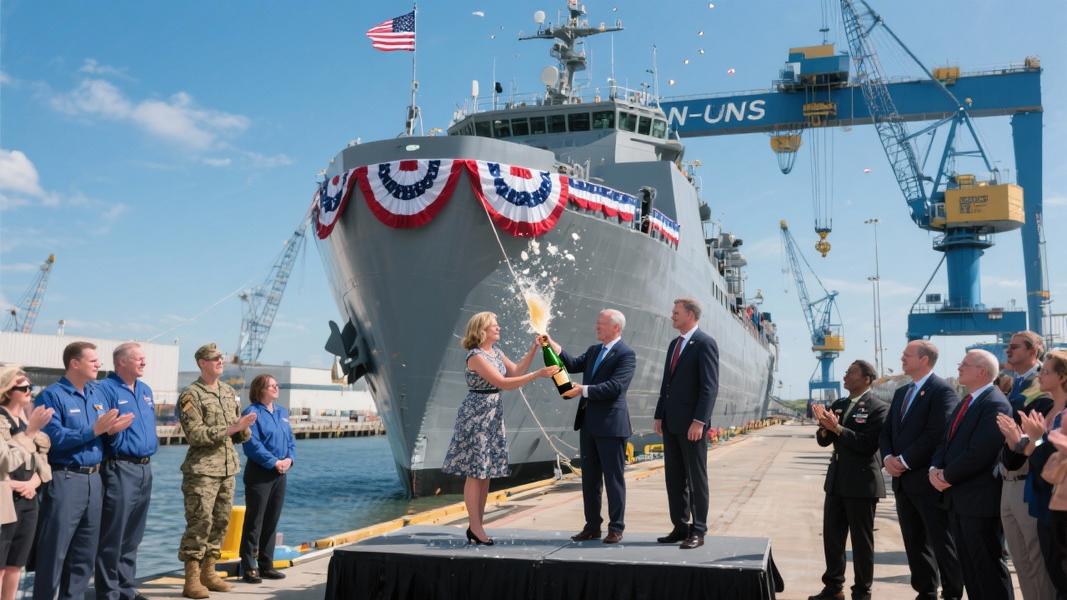
The U.S. Navy’s fleet is expanding with a new addition that promises enhanced capabilities for military operations. On September 6, the keel for USNS Lansing (EPF 16), a Spearhead-class Expeditionary Fast Transport, was laid at Austal USA’s shipyard in Mobile, Alabama, marking a significant milestone in the vessel’s construction.
USNS Lansing represents a new chapter for the Navy — it’s the first U.S. Navy ship to be named in honor of Michigan’s capital city, a manufacturing hub that has produced military supplies since the Civil War, according to officials. Michigan Governor Gretchen Whitmer is serving as the ship’s sponsor, with her initials now permanently etched into the keel plate during the traditional ceremony.
Enhanced Capabilities for Modern Missions
What makes these vessels particularly valuable to the Navy? The Lansing belongs to the Flight II variant of the Expeditionary Fast Transport class, featuring significant upgrades over its predecessors. The ship will stretch 337 feet long with a 93.5-foot beam and 12.5-foot draught, capable of reaching speeds up to an impressive 43 knots powered by four MTU 20V8000 M71L diesel engines, as detailed by maritime sources.
Unlike the Flight I EPFs, which can transport 600 short tons of military cargo, the Flight II vessels carry a reduced load of approximately 419 short tons due to engineering modifications. But they make up for this with enhanced medical capabilities, including two operating rooms and support for up to 147 patients — a crucial feature for humanitarian missions and combat support operations, reports indicate.
The ship will operate with a core crew complement of just 21 personnel, though it can accommodate more than 312 embarked forces with airline-style seating and fixed berthing for 146. Current specifications indicate the vessel will be crewed by 31 civilian mariners and capable of embarking up to 155 forces or an Expeditionary Medical Unit as required.
Operational Flexibility
“As we christen the future USNS Lansing, we celebrate another symbol of the unbreakable linkage that ties the workmanship of our shipyard workers to those of our American mariners who will man these ships,” said Under Secretary of the Navy Hung Cao. “This also marks the pivotal transition from construction to the rigorous test and trials phase to ensure these platforms are ready to answer the call.”
The Spearhead-class vessels have become increasingly important to the Navy’s operational flexibility. They can travel 1,200 nautical miles at an average speed of 33 knots in Sea State 3, according to Navy fact files. Flight II variants also include upgrades to support V-22 Osprey flight operations and enhanced capabilities for launching and recovering 11-meter rigid inflatable boats.
These improvements reflect the Navy’s evolving mission requirements, particularly in distributed maritime operations where rapid deployment of forces and medical support can prove decisive.
With the keel now laid, USNS Lansing moves into the next phase of construction. Though no specific timeline for completion has been announced, the vessel will eventually join the Military Sealift Command fleet, continuing a tradition of naval service now linked to the Michigan capital for the first time in U.S. naval history.
