
War Department Unveils Ambitious AI Strategy to Create “AI-First” Military Force
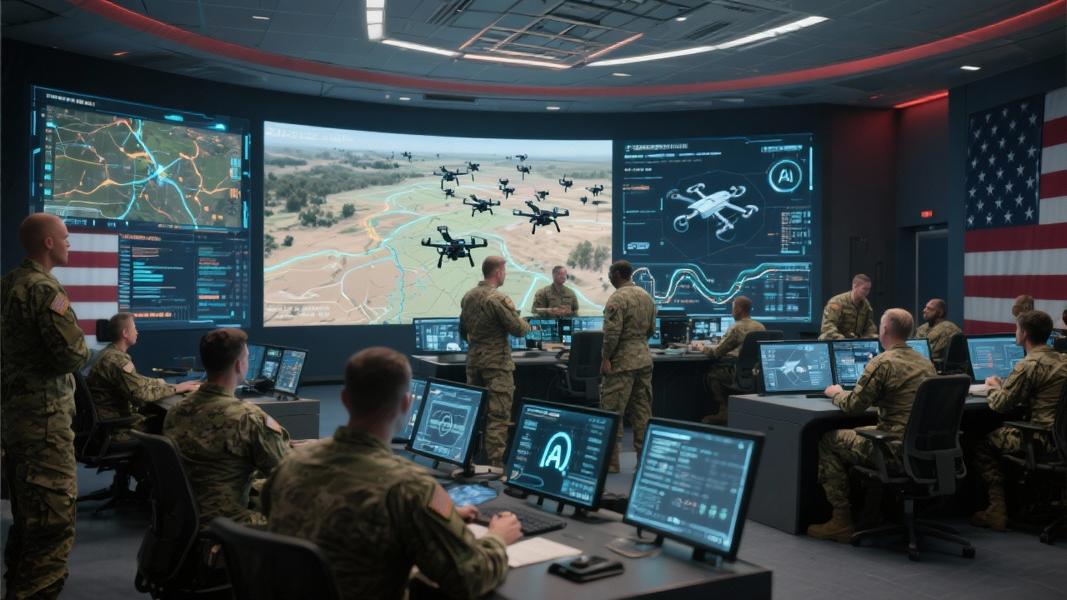
The U.S. War Department has launched a sweeping artificial intelligence initiative aimed at transforming America’s military into the world’s leading AI-enabled fighting force, embracing Silicon Valley-style speed and experimentation while jettisoning traditional Pentagon bureaucracy.
The AI Acceleration Strategy, unveiled on January 12, 2026, responds to a direct mandate from President Trump to establish American dominance in military AI applications. The plan centers on three core tenets — warfighting, intelligence, and enterprise operations — with seven “Pace-Setting Projects” designed to rapidly integrate frontier AI across all military domains.
Speed as the New Imperative
“We will unleash experimentation, eliminate bureaucratic barriers, focus our investments and demonstrate the execution approach needed to ensure we lead in military AI,” said Secretary of War Pete Hegseth at the strategy’s launch event. “We will become an ‘AI-first’ warfighting force across all domains.”
That focus on velocity represents a significant cultural shift for the typically deliberate military bureaucracy. Under Secretary of War for Research and Engineering Emil Michael emphasized this point, noting that “Speed defines victory in the AI era, and the War Department will match the velocity of America’s AI industry. We’re pulling in the best talent, the most cutting‑edge technology, and embedding the top frontier AI models into the workforce — all at a rapid wartime pace.”
What’s driving this urgency? The strategy comes amid intensifying global competition in military AI capabilities, with each of the seven Pace-Setting Projects (PSPs) assigned a single accountable leader and aggressive timelines intended to establish new standards for AI deployment.
Seven Projects to Reshape Military Operations
The seven PSPs span three categories. In warfighting, the department is pursuing Swarm Forge, Agent Network, and Ender’s Foundry. Intelligence efforts include Open Arsenal and Project Grant, while enterprise-level initiatives focus on GenAI.mil and Enterprise Agents. Each targets specific aspects of battlefield decision-making, intelligence processing, or workflow modernization for the department’s three million-plus personnel.
GenAI.mil stands out as perhaps the most immediately impactful project, providing department-wide access to frontier generative AI models, including Google’s Gemini, for personnel with appropriate security clearances (Impact Level 5 and above). The platform supports the White House’s broader AI Action Plan while fulfilling a 2025 presidential mandate for AI superiority.
Infrastructure and Funding
Behind these headline projects lies substantial infrastructure investment. The strategy outlines expanded AI compute capabilities, improved data access frameworks, and talent acquisition through the Office of Personnel Management’s Tech Force initiative.
Notably, the strategy explicitly calls for the “eradication of DEI from AI capabilities” to ensure mission-first systems — a controversial element that aligns with the administration’s broader policy shifts in diversity initiatives across government.
How will all this be funded? Congress has opened its wallet through what insiders are calling the “One Big Beautiful Bill” and the Joint Acceleration Reserve, with the Chief Digital and AI Office (CDAO) tasked with tracking all AI projects by speed and impact on a monthly basis.
These new initiatives join existing military AI programs like Project Maven, which focuses on applying AI and machine learning to intelligence analysis, and Advana, which serves as an enterprise data analytics hub.
Cultural Transformation
The most challenging aspect may not be technical but cultural. Military institutions typically prize caution and proven methods, while AI development thrives on rapid iteration and acceptable failure rates. This fundamental tension isn’t directly addressed in the strategy documents, but it looms as perhaps the greatest implementation challenge.
Still, the War Department appears committed to the transformation, describing the initiative as part of a broader effort to remake the defense innovation ecosystem and cement America’s technological advantage over potential adversaries.
As these projects begin to deliver results over the coming months, they’ll provide the first real test of whether a military bureaucracy can truly move at Silicon Valley speed — and whether AI can deliver the promised revolution in military affairs that strategists have long anticipated.
