
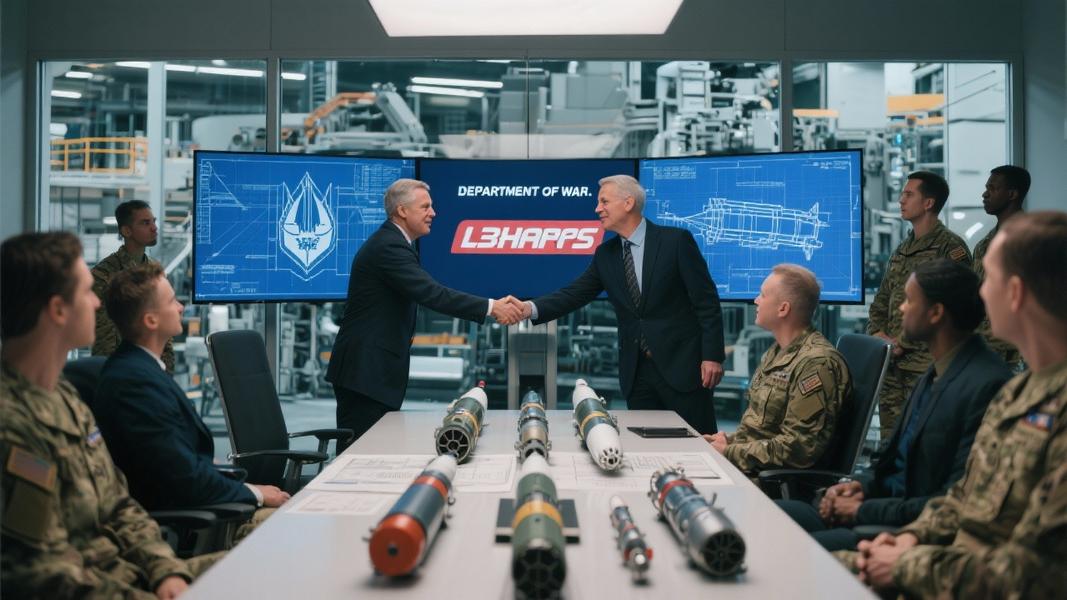
The Department of War is making an unprecedented move into the defense industrial base, investing $1 billion directly into L3Harris Technologies’ missile production capabilities as the government shifts strategy on securing critical munitions supply chains.
The investment, announced Monday, will take the form of convertible preferred equity in L3Harris’ soon-to-be-spun-off Missile Solutions business. The deal represents a significant departure from traditional defense procurement approaches and signals growing concerns about America’s ability to produce missiles at scale.
“We are fundamentally shifting our approach to securing our munitions supply chain,” said Michael Duffey, Under Secretary of War for Acquisition and Sustainment, in a statement that underscores the Pentagon’s urgency around production capacity.
Strategic Realignment
The investment comes as L3Harris undergoes major restructuring. The defense giant has also agreed to sell a controlling stake in its space propulsion and power systems business to AE Industrial Partners for $845 million while retaining a 40% ownership position — a transaction separate from the Missile Solutions spin-off.
Christopher Kubasik, chairman and CEO of L3Harris, emphasized the alignment with government priorities, saying, “L3Harris is strongly committed to the Department of War’s vision for a faster, more agile defense industrial base while remaining laser-focused on driving value for our shareholders and customers.”
What’s driving this unusual public-private partnership? Concerns over solid rocket motor production capacity have mounted in recent years amid increased global tensions and supply chain vulnerabilities exposed during the pandemic.
The Department’s $1 billion will come in the form of convertible preferred securities that will convert to common equity when the Missile Solutions business completes its planned IPO, expected in the second half of 2026.
Critical Defense Programs
L3Harris’ Missile Solutions business isn’t just any defense contractor. The unit provides propulsion systems for some of America’s most critical missile defense programs, including the PAC-3, THAAD, Tomahawk, and Standard Missile families — all cornerstones of U.S. and allied defense capabilities around the world.
According to company materials, L3Harris will retain a controlling interest in the business even after the planned IPO, though the exact ownership structure remains to be finalized.
The move has already sent ripples through financial markets. L3Harris stock jumped in pre-market trading after the announcement, with investors apparently viewing the government’s direct stake as both validation of the business model and a guarantee of future contracts. The news was first reported by several financial news outlets Monday morning.
Still, the unusual structure of the deal raises questions about the government’s role in private industry. The Department of War has historically preferred to maintain arm’s-length relationships with its suppliers, typically engaging through contracts rather than equity investments.
New Industrial Strategy
This investment appears to be part of a broader shift in defense industrial policy. A Department press release confirmed the announcement was part of a new “direct-to-supplier” investment strategy focused on securing critical supply chains.
The timing is notable. With the Missile Solutions IPO not expected until the second half of 2026, as indicated in financial filings, the government is getting in early — potentially influencing the structure and priorities of the new company before it faces public market pressures.
Financial analysts suggest this could be the first of several such investments across the defense industrial base. The Department of War has identified multiple areas of concern regarding production capacity, particularly for munitions and missiles that would be critical in any large-scale conflict.
L3Harris confirmed the investment details but declined to provide additional comments beyond the initial announcement when contacted by reporters.
The deal ultimately reflects a new reality: in an era of strategic competition and supply chain vulnerabilities, the line between government customer and corporate investor is increasingly blurred. Whether this represents a temporary intervention or the beginning of a new industrial policy may be one of the most consequential defense questions of the decade.
