
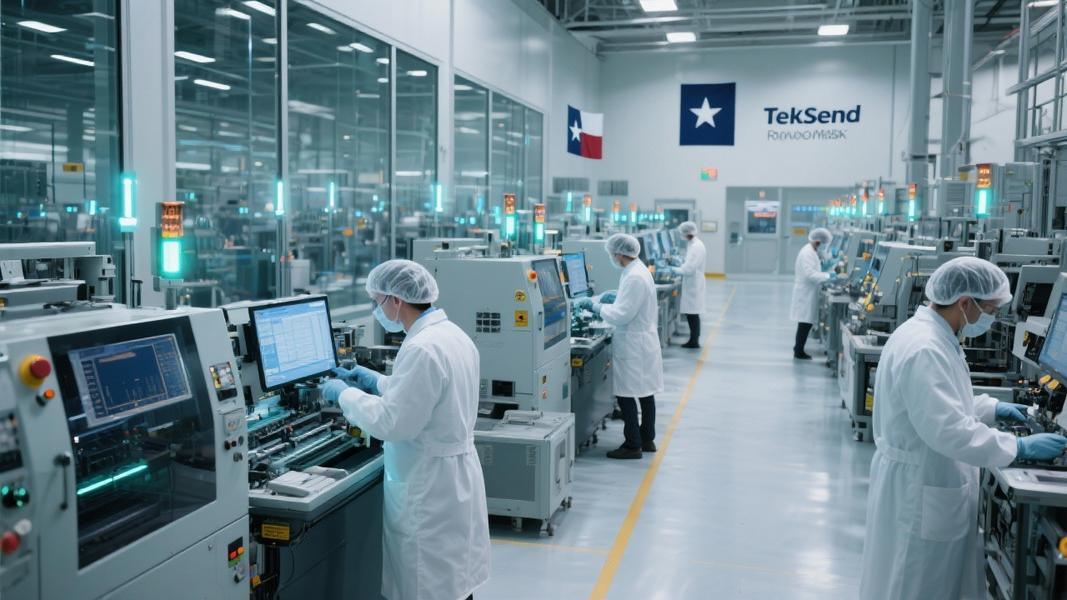
Texas is doubling down on its semiconductor ambitions with a major investment in Tekscend Photomask, signaling the state’s growing determination to position itself as America’s chip manufacturing heartland.
Governor Greg Abbott announced a $15.2 million grant from the Texas Semiconductor Innovation Fund (TSIF) to Tekscend Photomask Round Rock Inc., fueling an expansion that promises to create 50 new jobs and generate over $223 million in capital investment. The funding represents one of several strategic moves to strengthen Texas’ semiconductor ecosystem amid growing national concerns about chip supply chains.
“Texas is where the integrated circuit began and where the future of the semiconductor industry is being built,” Abbott stated during the announcement, highlighting the state’s historical connection to the industry.
Expanding Critical Photomask Production
The investment will boost Tekscend’s Round Rock facility capacity by more than 40%, modernizing equipment and extending technology capabilities to the 12nm node. These improvements will support production for AI, automotive, industrial, Bluetooth, Wi-Fi, microcontrollers, sensors, and other devices — components increasingly essential to modern technology.
“Since 1987, Tekscend Photomask has been proud to call Round Rock home, supporting the Texas and U.S. semiconductor industry with world-class photomask manufacturing,” said John Nykaza, Tekscend Photomask Round Rock President, who emphasized the company’s deep Texas roots.
What exactly are photomasks? They’re essentially the stencils used in semiconductor manufacturing — critical components that determine the patterns etched onto silicon wafers during chip production. Without these high-precision tools, modern chip manufacturing would grind to a halt.
Building a Semiconductor Ecosystem
The Tekscend funding is just one piece of Texas’ broader semiconductor strategy. In parallel moves, Abbott has approved a $4.8 million TSIF grant to the Texas Quantum Institute at UT Austin for QLab, a quantum-enhanced semiconductor metrology facility.
“Texas is the new frontier of innovation and UT Austin is where world-changing discoveries in quantum research and development are being made,” Abbott noted regarding the quantum research funding.
The state is also addressing the industry’s growing workforce needs. Texas State Technical College received over $3 million from the TSIF for semiconductor technician training programs scheduled to launch in fall 2026.
“It is crucial to us because of the expansion of Samsung in Taylor and the growth,” explained Kelly Coke, provost of TSTC’s Williamson County campus, pointing to the connection between education funding and industry expansion in the region.
Industry Recognition
Tekscend’s impact extends beyond manufacturing capacity. The company was recently named 2025 Local Employer of Excellence by Workforce Solutions Rural Capital Area for leadership in innovation and workforce development, according to a release from the organization.
That recognition underscores the company’s role not just in production but in building the skilled workforce needed for Texas’ semiconductor ambitions.
The state’s multi-pronged approach — supporting manufacturing expansion, research facilities, and workforce development simultaneously — reflects the complex ecosystem needed to compete globally in semiconductor production.
With Samsung’s massive expansion in nearby Taylor and these new investments, Central Texas is increasingly positioning itself as a critical node in America’s semiconductor strategy — a strategy that’s taken on new urgency amid global supply chain concerns and increasing competition from Asia.
For a state that once pioneered the integrated circuit at Texas Instruments decades ago, these investments represent both a return to roots and a bet on the future of American manufacturing.
