
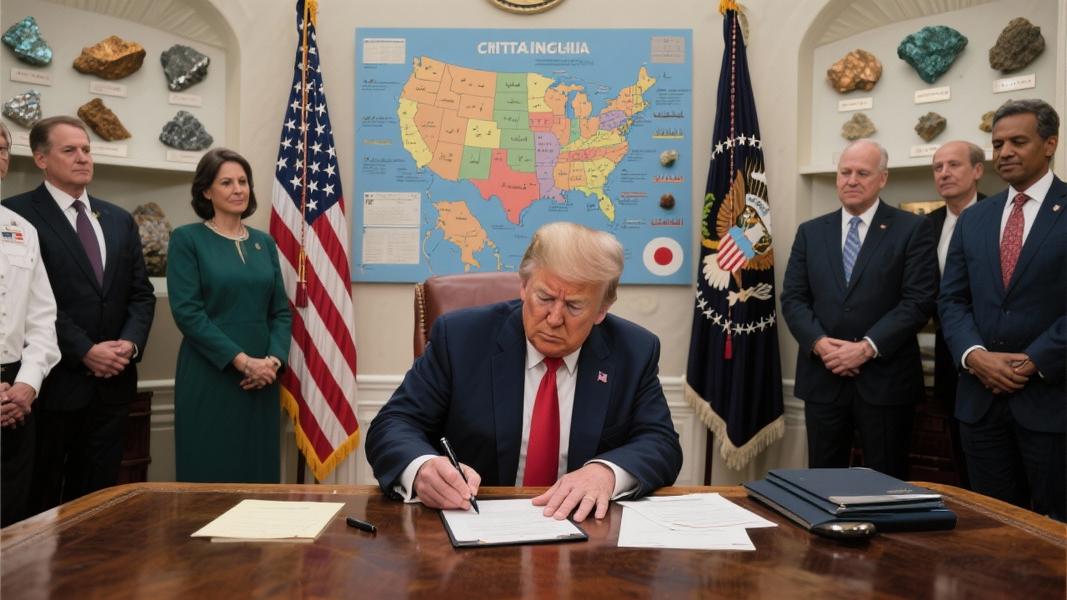
President Trump has taken a major step to secure America’s critical minerals supply chain, signing a proclamation that directs top officials to negotiate new agreements with trading partners amid growing concerns about national security threats.
The January 14, 2026, executive action, issued under Section 232 of the Trade Expansion Act of 1962, comes after months of review and targets processed critical minerals and their derivative products (PCMDPs) — materials essential for everything from electric vehicles to military equipment. The move represents a significant shift in how the U.S. approaches critical mineral dependencies, particularly those involving China.
A New Process for National Security
White House Staff Secretary Will Scharf explained the proclamation’s significance: “What it does is it sets up a mechanism, a process by which the United States will seek to secure its international supply chain of critical minerals and critical mineral derived products.” The statement underscores the administration’s view that this isn’t just about trade — it’s about security.
Behind the action lies a troubling reality: even minerals mined on American soil often leave the country for processing, only to return as imports. The U.S. ranks as the second-largest producer of mined rare earth oxides globally, yet lacks the domestic capacity to process these materials — a vulnerability that the Department of Commerce has now officially determined threatens national security.
Why does this matter? Critical minerals form the backbone of modern technology, from smartphones to defense systems. China’s dominance in processing these materials has long worried security experts, who see potential leverage that could be used against U.S. interests during a geopolitical crisis.
Coordinated Government Response
The proclamation didn’t emerge in isolation. Just days earlier, on January 12, Treasury Secretary Scott K.H. Bessent convened a meeting of Finance Ministers focused specifically on securing critical minerals supply chains, with particular emphasis on rare earth elements.
“Secretary Bessent expressed his optimism that nations will pursue prudent derisking over decoupling, and that they understand well the need to remedy current deficiencies in critical minerals supply chains,” according to a Treasury Department statement.
The administration’s approach reflects a delicate balancing act: addressing security concerns without completely severing economic ties with countries like China. “Derisking over decoupling” has become something of a mantra, suggesting targeted interventions rather than wholesale economic separation.
Part of a Broader Strategy
Critical minerals aren’t the only focus of the administration’s national security trade reviews. Similar Section 232 investigations are underway for semiconductors and pharmaceuticals — all potentially leading to new tariffs as part of heightened enforcement priorities.
The administration finalized its critical minerals list in late 2025, with a heavy emphasis on rare earth elements due to their vulnerability to supply disruptions. These 17 elements, despite their obscure names like neodymium and dysprosium, are essential for technologies ranging from wind turbines to precision-guided missiles.
What happens next? The proclamation puts the ball in the court of the Commerce Secretary and U.S. Trade Representative, who must now begin what will likely be complex negotiations with multiple countries. The order leaves open the possibility of tariffs if these negotiations don’t yield satisfactory results.
For industries dependent on these materials, uncertainty remains the watchword. While securing supply chains represents a widely shared goal, how exactly this will be accomplished — and at what cost — remains to be seen.
