
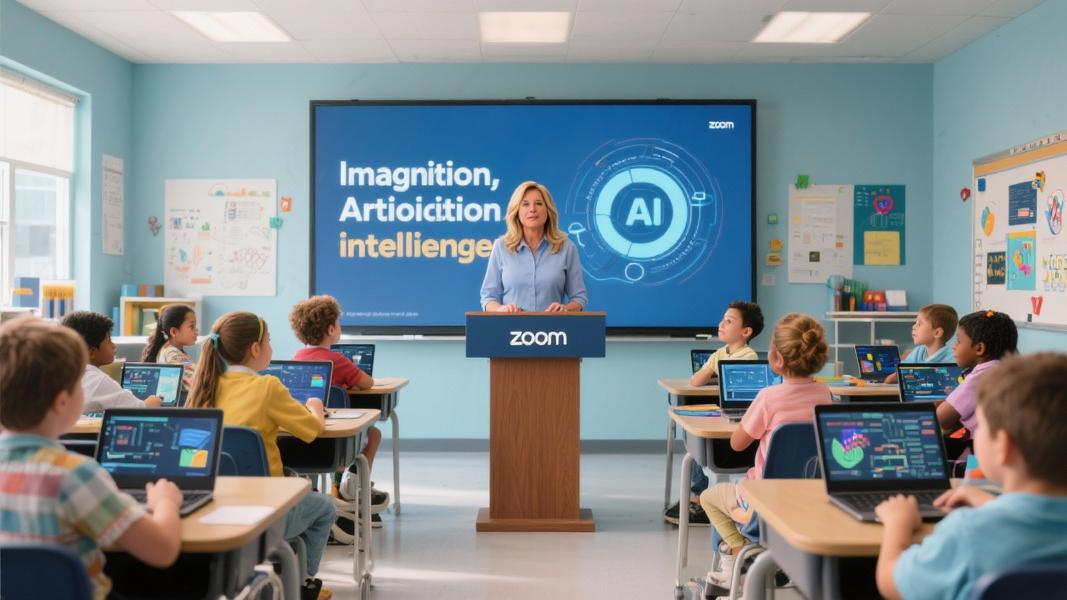
First Lady Melania Trump reached thousands of American classrooms last week with an ambitious virtual tour promoting artificial intelligence literacy, declaring that today’s students are living in what she calls “The Age of Imagination.”
The January 16 event, delivered via Zoom Communications to K-12 schools nationwide, marks the latest push in the Trump administration’s growing focus on AI education. “The Age of Imagination is a new era, powered by artificial intelligence, where one’s curiosity can be satisfied almost magically, in seconds,” the First Lady told students during the broadcast.
White House Makes AI Education a Priority
The virtual event builds on momentum that began last April when President Donald Trump signed Executive Order 14277, establishing the White House Task Force on AI Education and launching initiatives to prepare American students for an increasingly AI-driven economy.
Zoom founder and CEO Eric Yuan, whose company has committed $10 million over three years to AI education efforts, joined the First Lady during the broadcast. “AI is changing how we learn, work, and connect every day. That’s why it’s so important to help students and educators build AI literacy and feel confident using these tools in thoughtful, creative, and ethical ways,” Yuan stated.
Half of Zoom’s commitment — $5 million — is earmarked specifically for K-12 education programs. The company also signed the White House Pledge to America’s Youth, joining other tech firms promising resources for AI literacy.
Presidential AI Challenge Takes Shape
What’s driving this sudden White House focus on artificial intelligence in schools? The administration sees it as both an economic and national security imperative.
“American students and educators have a unique chance to get ahead by learning artificial intelligence before the rest of the world,” Mrs. Trump emphasized in a statement. “When effectively used, AI serves as a catalyst for human potential; enhancing the way we learn, create, and lead.”
Central to these efforts is the Presidential AI Challenge, announced last September, which encourages K-12 students to develop projects that use artificial intelligence to solve real-world problems. “We are living in a moment of wonder, and it is our responsibility to prepare children in America,” the First Lady remarked during a White House task force meeting. “We must ensure America’s talent—our workforce—is prepared to sustain AI’s progress.”
The challenge invites participation from even the youngest students. “The President’s National Artificial Intelligence Challenge invites every student in America—from kindergarten to 12th grade—to unleash their imagination and showcase the spirit of American innovation,” according to the official guidebook for the competition.
Balancing Enthusiasm with Caution
Despite the administration’s enthusiasm, Mrs. Trump has consistently emphasized responsible AI use. During her virtual address, she warned students against over-reliance on the technology.
“Although artificial intelligence can generate images and information, only humans can generate meaning and purpose,” she cautioned. “Choose to let your imagination drive your intellectual progress. But never use AI as a quick solution. Be intellectually honest with yourself – use AI as a tool – but do not let it replace your personal intelligence.”
The First Lady’s AI education initiative will continue expanding in the coming months. She plans to host the inaugural meeting of Fostering the Future Together at the White House this spring, following her call to the international community during the 2025 United Nations General Assembly to prioritize AI literacy globally.
For America’s students — many already using AI tools like chatbots for homework help — the administration’s message seems clear: artificial intelligence isn’t just coming; it’s already here, and their futures may depend on mastering it thoughtfully.
