
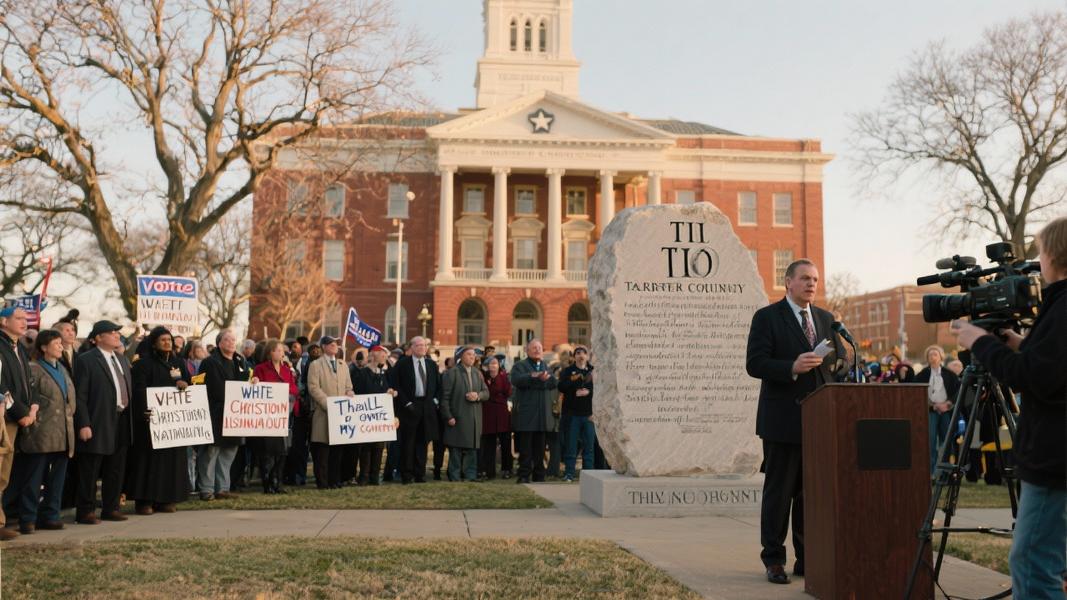
Tarrant County officials gathered Friday afternoon to unveil a new Ten Commandments monument on the courthouse grounds in downtown Fort Worth, capping months of debate over religious symbolism on government property and drawing both supporters and protesters to the dedication ceremony.
The stone monument, installed following a 3-1 vote by the County Commissioners Court earlier this year, stands as a near-replica of one that has adorned the Texas Capitol grounds in Austin for decades — a display the U.S. Supreme Court upheld in 2005 as constitutional.
“The Tarrant County Courthouse, constructed in 1895, is a landmark building in downtown Fort Worth. The Ten Commandments monument acknowledges the principles that shaped America’s history, making it a perfect addition to the courthouse grounds,” said Tarrant County Judge Tim O’Hare during the 2 p.m. ceremony.
Political Divide Over Religious Display
The monument didn’t arrive without controversy. The Commissioners Court vote split along party lines, with Republican commissioners supporting the installation while Democratic Commissioner Alisa Simmons cast the lone dissenting vote, citing concerns about separation of church and state. Commissioner Matt Krause, who added the proposal to the agenda, defended the monument’s placement on public grounds.
“I think those are all things, regardless of your religion or if you’re not religious or what you believe or don’t believe, those are all good reminders for us,” Krause said regarding the commandments.
The monument came as a private donation from the American History and Heritage Foundation, which will also handle its maintenance at no cost to taxpayers. First Liberty Institute, a conservative legal organization, has offered free legal representation should any challenges to the monument arise.
Supporters and Protesters Face Off
Is this just about history and heritage? Not according to the protesters who showed up Friday with signs denouncing what they called an inappropriate government endorsement of religion. Several clergy members, led by Pastor Ryon Price of Broadway Baptist Church, stood in opposition to the monument.
“We are of a very similar mind here with the Faith and Justice Coalition of Tarrant County that this monument is unnecessary and really violates the inclusive spirit of being a country where no religion is established or prejudiced,” Price said. “And so we are a number of clergy that believe that. And we’ve come out here today to bear witness to that fact.”
Some protesters carried signs reading “Vote White Christian Nationalism out of office” while others referenced the 2024 death of inmate Anthony Johnson Jr. in county custody — suggesting the county should focus on other issues.
Kelly Shackelford, president of First Liberty Institute, took a different view during the ceremony, emphasizing the monument’s connection to American legal tradition. “Displaying The Ten Commandments on public grounds in Texas is consistent with Supreme Court decisions that recognize our religious heritage and the best of the nation’s history and traditions,” Shackelford said. “The Ten Commandments are a symbol of law and moral conduct with both religious and secular significance for all Americans.”
Legal Precedent
Tarrant County’s monument was deliberately designed to mirror the one standing at the Texas Capitol, which survived a constitutional challenge when the Supreme Court ruled in Van Orden v. Perry that it did not violate the Establishment Clause. Supporters also point to the 2019 American Legion v. American Humanist Association decision, which gave governments more latitude in displaying religious symbols with historical significance.
The monument’s unveiling comes amid a broader national conversation about religious displays in public spaces, with similar debates playing out in courthouses and government buildings across the country.
As the small crowd dispersed Friday afternoon — some celebrating what they view as a victory for religious liberty, others lamenting what they see as an erosion of church-state separation — the stone tablets stood firmly planted on the courthouse lawn, a new focal point in Tarrant County’s ongoing cultural conversation about the proper place of religion in public life.
