
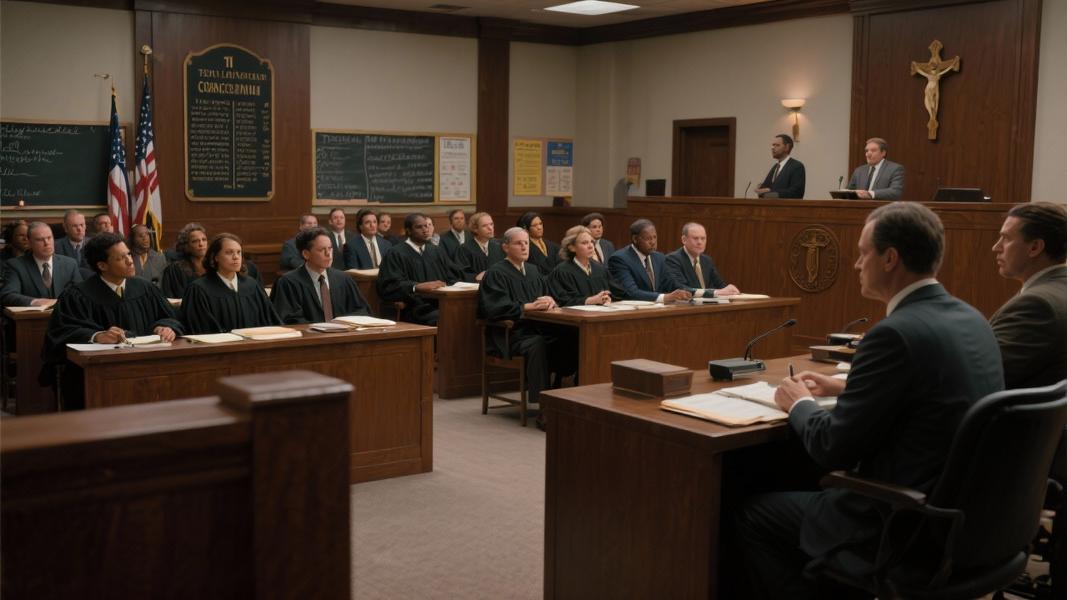
The Fifth Circuit Court of Appeals heard oral arguments Tuesday in a closely watched battle over Ten Commandments displays in public school classrooms, with laws in both Texas and Louisiana hanging in the balance as all 17 judges weighed constitutional questions that could eventually reach the nation’s highest court.
In an unusual move highlighting the significance of the case, the full court sat en banc to consider whether state laws requiring the biblical text be displayed in every classroom violate the separation of church and state. The hearing comes after U.S. District Judge Fred Biery issued a preliminary injunction in August 2025 blocking 11 Texas school districts from implementing Senate Bill 10, finding the law “improperly favors Christianity over other faiths.”
Religious Freedom Battle Intensifies
At the heart of the dispute are two nearly identical laws — Texas Senate Bill 10 and Louisiana House Bill 71 — that mandate the display of the Ten Commandments in every public school classroom. Sixteen families represented by the ACLU of Texas and other civil rights organizations have challenged the Texas law, arguing it subjects their children to “a state-imposed Protestant version of the Ten Commandments that many religious and nonreligious Texans do not recognize.”
Texas Attorney General Ken Paxton has aggressively defended the law, asking the 5th Circuit to overturn Judge Biery’s ruling and requesting all 17 active judges hear both the Texas and Louisiana cases together — a request that was granted, underscoring the constitutional significance of the dispute.
“Your honor, a school in Louisiana or elsewhere absolutely could post displays exactly as you outlined highlighting members in our nation’s history,” Texas Solicitor General William Peterson told the court during Tuesday’s arguments, suggesting schools could display other religious texts like the Quran if presented in historical context.
But does that argument hold water? Civil rights attorneys point to a 1980 U.S. Supreme Court ruling that found public school displays of the Ten Commandments unconstitutional — precedent they insist only the Supreme Court itself can overturn.
Multiple Legal Challenges
The litigation has expanded beyond the initial case. A separate ACLU lawsuit involves North Texas school districts including Fort Worth, Arlington, McKinney, Rockwall, and Mansfield ISDs, all challenging the controversial law.
Earlier this week, a federal judge sided with 15 families who sued to stop implementation, ordering several districts including Arlington, Fort Worth, and Frisco to remove Ten Commandments displays already installed in classrooms.
In a broader effort to halt the law’s implementation statewide, 18 multifaith and nonreligious Texas families have filed a class action lawsuit seeking to prevent all Texas public school districts not already involved in litigation from displaying the Ten Commandments in classrooms.
Looking Ahead
Legal experts watching Tuesday’s proceedings note the case likely won’t end with the 5th Circuit’s eventual ruling. Given the constitutional stakes and conflicting precedents, most observers expect the dispute will ultimately land before the U.S. Supreme Court, with potentially far-reaching implications for religious displays in public institutions.
The case represents a significant test of church-state separation principles during a time when the Supreme Court has shown increased willingness to revisit long-established precedents on religious expression in public spaces.
For now, families across Texas and Louisiana await the 5th Circuit’s decision in what has become one of the most closely watched First Amendment battles in recent years — a ruling that will either reinforce or potentially redefine the boundaries between religious expression and government neutrality in America’s public schools.
