
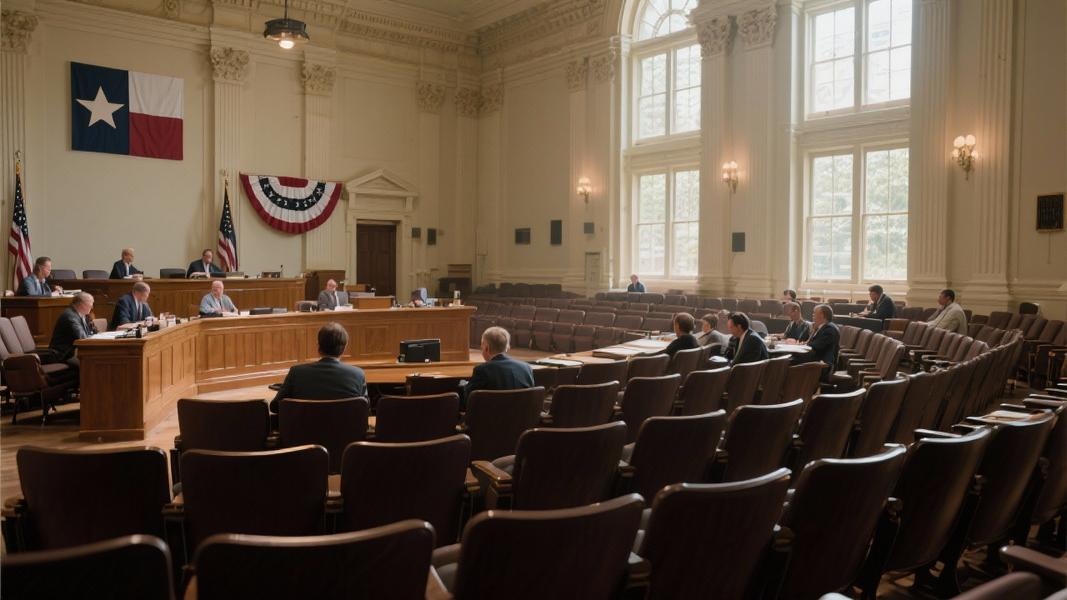
Texas House Democrats are facing hefty financial penalties after their attempt to block Republican redistricting efforts last summer, with each member being slapped with a fine of $9,354.25 for breaking quorum during a two-week period in August 2025.
The fines, announced Monday by House leadership, include a daily $500 penalty for the 14-day absence, totaling $7,000 per lawmaker. An additional $2,354.25 was added to each member’s tab to cover the $124,940.08 the House spent trying to compel their attendance, according to documents obtained by local media.
Breaking Quorum Comes at a Cost
At least 50 Democratic lawmakers left the state last summer in a coordinated effort to block what Minority Leader Gene Wu characterized as “an intentionally racist map designed to steal the voices of millions of Black and Latino Texans.” The Democrats were opposing a mid-decade congressional redistricting plan proposed by Gov. Greg Abbott that would have given Republicans five additional congressional seats, which critics say would disproportionately affect minority voters. Wu defended the action, stating, “Breaking quorum is a constitutional right, and we will use every tool available to challenge these fines.”
Despite the Democrats’ efforts, the redrawn Texas congressional maps were passed on August 20, 2025, in an 88-52 vote after Republicans secured enough members to conduct business. The U.S. Supreme Court has since allowed these Republican-drawn maps to stand for the 2026 elections, as reported by CBS News.
What makes these fines particularly painful? House rules established in 2023 specifically prohibit members from using campaign funds or fundraising to pay them, forcing lawmakers to reach into their own pockets. These rules were enacted after Texas House Democrats previously broke quorum for 38 days in 2021 to block GOP voting legislation, a move that prompted Republicans to tighten procedures against such tactics.
New Legislation Targets Quorum Breakers
The fines come in the wake of House Bill 18, signed into law in summer 2025, which takes aim at lawmakers who break quorum. The legislation bans members from raising money for themselves or their legislative caucuses if they break quorum and establishes penalties of up to $5,000 per infraction for violations.
The bill passed along strict party lines with an 86-46 vote after approximately four hours of debate and five unsuccessful attempts by Democrats to amend the legislation, as detailed by the Texas Tribune.
HB 18 also creates a specific legal process for contesting these accusations. Members can challenge fines in district court and appeal rulings to a recently established appeals court whose three Republican justices were all appointed by Governor Abbott – a detail that hasn’t gone unnoticed by Democrats crying foul over what they see as a stacked deck.
Republicans maintain that the fines are necessary to ensure the House can conduct its business without interruption. Democrats, however, view the penalties as political retribution for exercising what they consider a legitimate legislative tactic to oppose controversial legislation.
Next Steps
The affected Democrats have until 5 p.m. on Monday, February 9, to submit written appeals contesting the fines through due process procedures outlined in House rules. Many are expected to challenge the penalties, though the path to successful appeals remains unclear given the Republican-controlled appeals process established under the new law.
The total financial impact on the Democratic caucus is substantial – approaching half a million dollars if all fines stand. For individual lawmakers who typically earn modest legislative salaries in Texas, a $9,354.25 personal expense represents a significant financial burden.
This battle over redistricting and the subsequent fines highlights the increasingly partisan nature of Texas politics, where procedural maneuvers and their consequences have become as contentious as the policy issues themselves. As both parties dig in, the question remains whether these escalating penalties will deter future quorum breaks or simply further entrench political divisions in the Lone Star State.
