
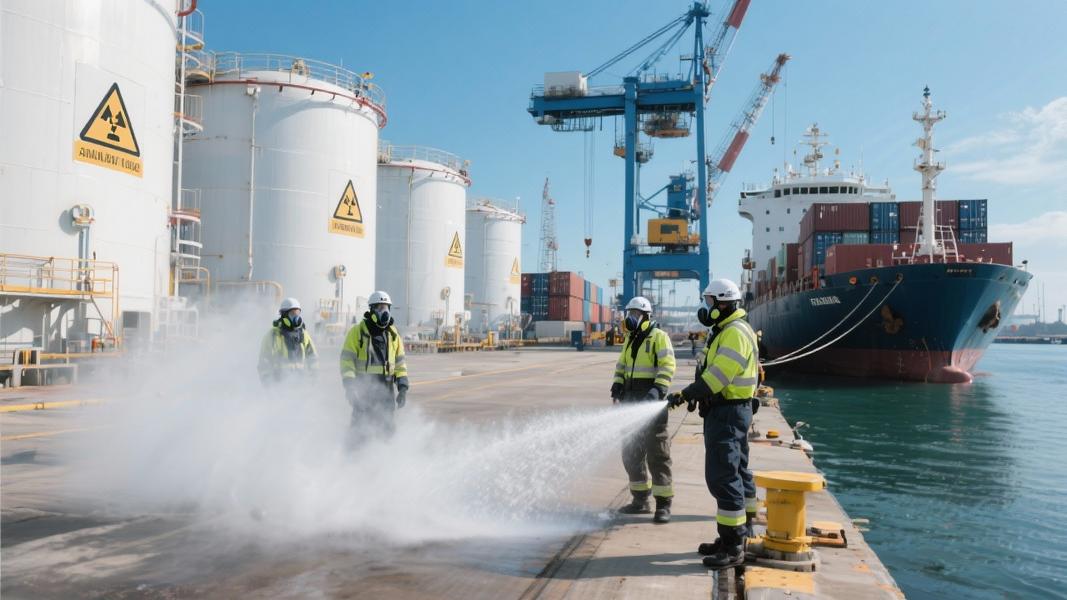
Federal researchers are racing to prepare U.S. ports for a potentially hazardous future: one where ammonia, increasingly popular as a maritime fuel, could pose significant safety risks along America’s vast coastline.
The Department of Homeland Security’s Science and Technology Directorate (S&T) has assembled a team of experts called the Ammonia Port Preparedness and Emergency Response (AmPPER) to tackle this emerging challenge. With global ammonia production exceeding 220 million tons annually and its applications expanding beyond traditional agricultural uses, the stakes couldn’t be higher for the nation’s 361 ports of entry spanning 95,000 miles of coastline and over 25,000 miles of waterways, according to a recent announcement from the agency.
The Ammonia Challenge
“Ports are preparing to handle increasing quantities of ammonia as a maritime fuel. Without this research, ports face a difficult choice: delay new fuel operations or move forward with safety protocols that weren’t designed for waterfront environments,” said S&T Program Manager Norman Speicher in a statement outlining the program’s importance.
While approximately 70-80% of ammonia has historically been used in fertilizers, its growing adoption as a cleaner maritime fuel alternative brings complex safety challenges to America’s busy ports. The colorless gas can cause severe respiratory damage and even death at high concentrations — a risk that increases in the confined spaces typical of port environments.
That’s where the AmPPER team comes in. Led by S&T’s Chemical Security Analysis Center (CSAC), the initiative brings together an impressive roster of federal agencies and research institutions, including the U.S. Army Combat Capabilities Development Command Chemical Biological Center, Battelle, CDC NIOSH National Personal Protective Technology Laboratory, and Savannah River National Laboratory.
Science-Based Solutions
“Ports are gearing up to support a large increase in demand for ammonia for use as a fertilizer and an energy source,” explained CSAC Lead Chemist Jessica Cox. “Large-scale release experimentation in an environment reflective of the conditions at these ports is needed to improve predictions and preparedness.”
What makes port environments particularly challenging for handling ammonia? “The port environment has harsh conditions with variable temperatures and humidity, high salinity, and sometimes unpredictable weather conditions,” Cox noted. “A complete understanding of the plume dynamics and ammonia interactions under the conditions seen at the ports is necessary to make scientifically supported risk reduction and mitigation strategy recommendations that will save lives when implemented.”
The research has already yielded valuable insights. AmPPER studies have determined optimal parameters for water curtains — a primary defense against ammonia releases — including the most efficient droplet size and nozzle characteristics. Researchers discovered that colder water with lower salinity enhances ammonia reduction, a crucial finding for coastal facilities. Additionally, they’ve validated the effectiveness of air purifying escape respirators like the ILC Dover Scape at high concentrations, providing emergency responders with life-saving equipment recommendations.
Congressional Support
The timing couldn’t be better. Congress appears to recognize the importance of such critical infrastructure research, with the Homeland Security Appropriations Act, 2026 providing $758.7 million for Science and Technology — $17 million above the previous year’s enacted level. This funding specifically supports Centers of Excellence and critical infrastructure-related research initiatives like AmPPER.
House Report 119-173 on the DHS Appropriations Bill further emphasizes the need for secure data infrastructure, such as the Administrative Data Research Facility, which supports homeland security research including emergency response protocols that would be essential during an ammonia release incident.
As ports across America prepare for an ammonia-fueled future, the work of these federal researchers may soon prove invaluable. Their findings won’t just inform policy — they could save lives when seconds matter most during a catastrophic release.
