
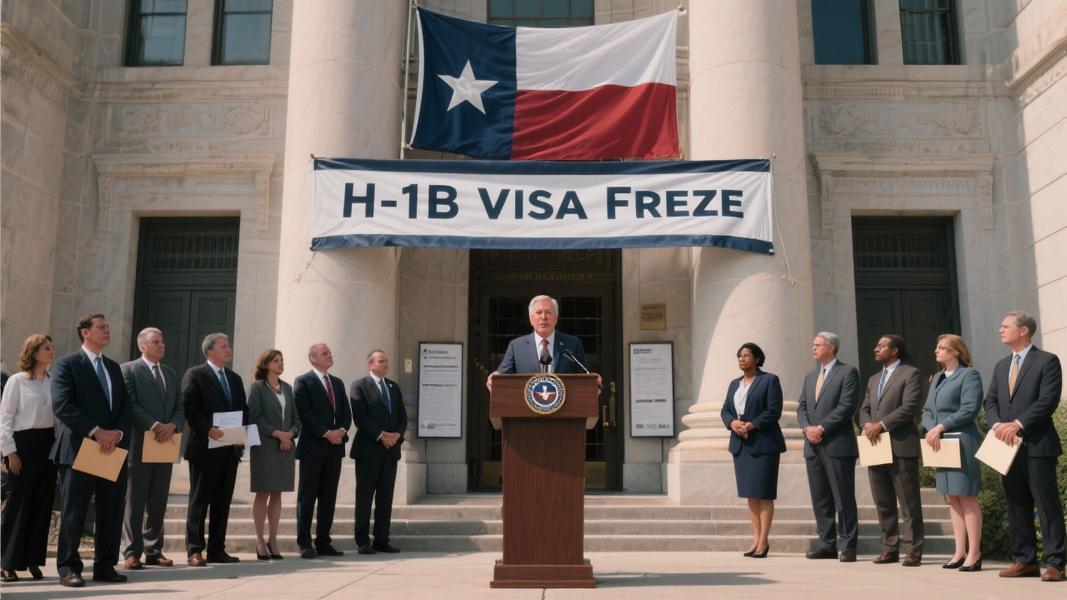
Texas Gov. Greg Abbott has ordered an immediate freeze on all new H-1B visa petitions from state agencies and public universities, a sweeping directive that will remain in effect for more than three years.
The executive action, announced this week, halts new visa applications through May 31, 2027 — the end of the Texas Legislature’s 90th regular session — unless special permission is granted by the Texas Workforce Commission. The move comes amid what Abbott described as “recent reports of abuse” in the federal visa program.
“State government must lead by example and ensure that employment opportunities, particularly those funded with taxpayer dollars, are filled by Texans first,” Abbott declared in his announcement.
The H-1B program, which allows U.S. employers to temporarily hire foreign workers in specialized occupations, has long been a lightning rod in immigration debates. Tech companies and universities have historically been among the program’s biggest users, often citing the need for specialized talent in fields like computer science, engineering, and medicine.
Beyond just freezing new applications, Abbott has also launched a comprehensive review of current H-1B visa holders employed across Texas state agencies and universities. The directive signals a significant shift in how Texas’s public sector will approach specialized foreign labor.
What’s behind the move?
In his letter to state agency heads, Abbott emphasized the need to prioritize the Texas economy for Texas workers, referencing concerns about the federal program’s administration. The governor cited “the federal government’s ongoing review” of the H-1B program as partial justification for the state-level action.
“In light of recent reports of abuse in the federal H-1B visa program, and amid the federal government’s ongoing review of that program to ensure American jobs are going to American workers, I am directing all state agencies to immediately freeze new H-1B visa petitions as outlined in this letter,” Abbott stated.
Critics of the H-1B program have long argued that it can be used to replace American workers with cheaper foreign labor. Supporters, however, contend that it’s vital for filling specialized positions where qualified domestic candidates are scarce.
The impact on Texas universities could be particularly significant. Many public institutions rely on international faculty and researchers, especially in STEM fields where competition for talent is fierce. Some academic leaders have privately expressed concern about how the freeze might affect ongoing research projects and faculty recruitment.
Still, Abbott’s order includes a provision for exceptions, allowing state entities to petition the Texas Workforce Commission for written permission to file new H-1B applications in cases where they can demonstrate necessity.
The governor’s office hasn’t released specific data on how many current H-1B holders are employed across Texas state agencies and universities, nor how many new applications might typically be filed during the three-year freeze period.
As Texas implements this policy, it positions itself at the forefront of a broader national conversation about immigration, specialized labor, and the role of foreign workers in public institutions — a conversation that shows no signs of cooling as the 2026 midterm elections approach.
