
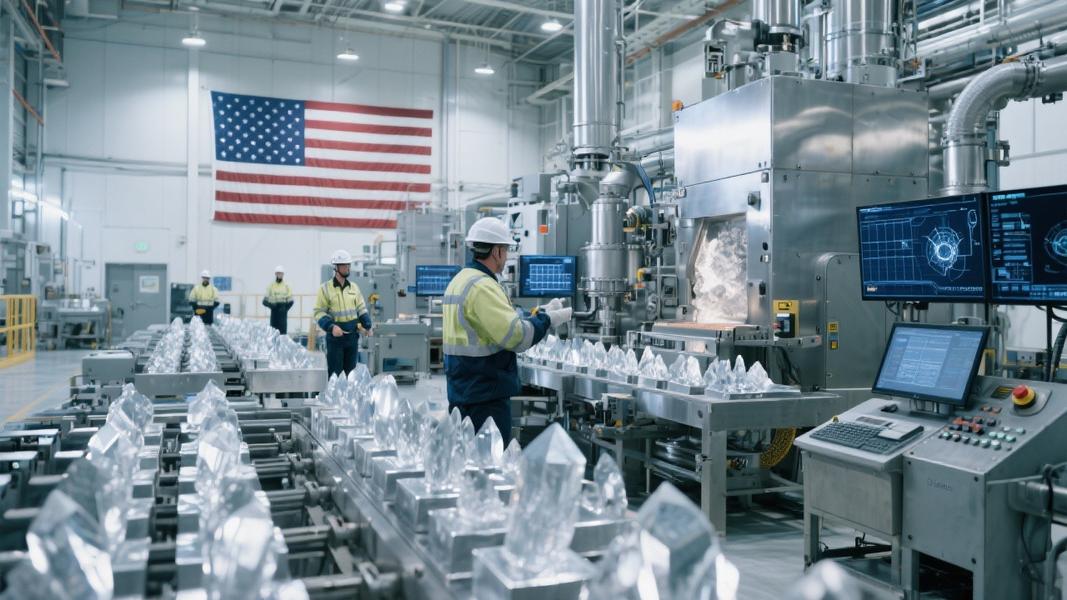
The U.S. Department of War is making bold moves to secure America’s supply of germanium, a critical mineral essential for military optics and targeting systems, with multiple multi-million dollar investments announced throughout 2025.
On December 15, the department invested $18.1 million in Defense Production Act funds to 5N Plus Inc., expanding germanium refining capacity at their Utah facility to over 20 metric tons annually. This follows a September investment of $18.5 million to Lattice Materials for increasing production of optical-grade germanium crystals, as revealed in contract documents.
Why germanium matters
“Our warfighters depend on next generation optics for surveillance, reconnaissance, and targeting, and germanium is a key element in their manufacture,” said Assistant Secretary of War for Industrial Base Policy Mike Cadenazzi. The mineral’s unique properties make it irreplaceable in infrared optics and certain semiconductor applications critical to military equipment.
But these investments are just the beginning. The real game-changer? A massive $6.6 billion partnership with Korea Zinc to build a state-of-the-art critical minerals smelter in Tennessee, announced earlier this year. The facility is expected to produce approximately 44 tons of germanium annually after operations begin in 2029.
Secretary of Commerce Howard Lutnick didn’t mince words about the significance: “Korea Zinc’s critical minerals project in Tennessee is a transformational deal for America.”
What’s driving this sudden rush to secure germanium supplies? In large part, it’s about reducing dependence on China, which has dominated the global market for critical minerals. The new FY26 National Defense Authorization Act explicitly prohibits acquisition of critical minerals including germanium from China and other adversary nations, as outlined in congressional documents.
Strategic independence
The push comes directly from the top. “President Trump has directed his Administration to prioritize critical minerals as essential to America’s defense and economic security,” said Deputy Secretary of War Steve Feinberg in a statement regarding the Korea Zinc project.
The Department of War isn’t just investing in raw material production. They’re thinking holistically about the supply chain. The September 2025 contract with Lattice Materials specifically includes establishing capability for germanium metal recovery from recycled materials, potentially creating a circular supply chain for this precious resource.
Jeffrey Frankston, Acting Deputy Assistant Secretary of War for Industrial Base Resilience, emphasized the urgency: “Optics are a pacing item for major weapons platforms across all the military Services.”
These investments align with a January 2026 White House directive on processed critical minerals, which identified germanium as essential to U.S. national security and the defense industrial base.
The flurry of investments represents a significant shift in U.S. industrial policy. After decades of allowing critical mineral supply chains to concentrate overseas, particularly in China, Washington is now spending billions to bring production back to American soil.
For communities like St. George, Utah, and the future site in Tennessee, these investments mean jobs and economic development. For the Pentagon, they represent something perhaps even more valuable in today’s geopolitical landscape: strategic independence.
