
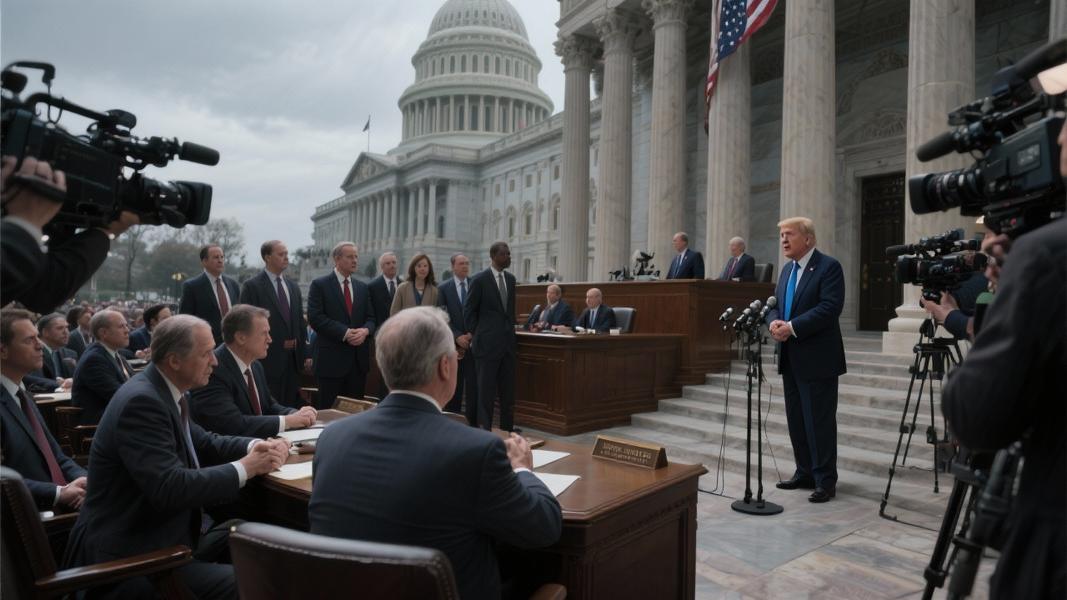
Senate leaders struck an eleventh-hour deal Thursday to avert a partial government shutdown, agreeing to separate the contentious Department of Homeland Security funding from a broader spending package while giving negotiators more time to hammer out immigration enforcement reforms.
The bipartisan agreement provides full-year funding for most federal agencies through September 30 but extends DHS funding at current levels for just two weeks — a compromise that breaks what had become a dangerous impasse with a shutdown deadline looming on January 30.
Breaking the Logjam
“This is a breakthrough,” a senior Senate aide involved in the negotiations confirmed. “I am told the White House has been part of this negotiating all along so we think the president is on board as well.”
The deal effectively removes the DHS appropriations bill from a broader package of six spending bills covering other parts of the government, allowing those other agencies to receive full funding while talks continue on the more contentious immigration issues. The Senate began consideration of the original appropriations package, which passed the House on January 22 and included funding for Defense, Labor, Health and Human Services, Education, Transportation, and Housing and Urban Development, according to congressional sources.
Why the special treatment for DHS? Immigration enforcement has become a political lightning rod, with Democrats and Republicans deeply divided over border policies and ICE operations. Rather than let those disagreements derail funding for the entire government, lawmakers opted to isolate the problem.
Negotiating the Clock
The length of the DHS extension proved to be one of the final sticking points. Democrats initially pushed for just a two-week extension, hoping for a quick resolution, while Republicans sought up to six weeks to craft a new funding measure with more substantial immigration reforms, sources familiar with the negotiations revealed.
In the end, the two-week timeframe prevailed, setting up another potential showdown in mid-February if the parties can’t reach agreement on DHS funding and immigration enforcement reforms.
Even former President Trump, who has made immigration a centerpiece of his political messaging, threw his support behind the deal. “Hopefully, both Republicans and Democrats will give a very much needed Bipartisan ‘YES’ Vote,” Trump wrote on Truth Social.
Shutdown Clock Was Ticking
The agreement comes just in time. Without congressional action, funding for six of the twelve appropriations bills would have expired on January 30, forcing a partial government shutdown that would have affected numerous agencies and their employees.
Government shutdowns have become increasingly common in Washington’s polarized environment, but they’re rarely popular with voters. A 2023 analysis by the Committee for Responsible Federal Budget estimated that shutdowns cost taxpayers billions in lost productivity and economic disruption.
The current deal doesn’t solve all the underlying problems, of course. It merely kicks the most contentious issue — immigration enforcement — slightly down the road. But it does prevent the immediate crisis of a government shutdown while providing certainty for most federal agencies through the end of the fiscal year.
As one Senate staffer put it: “Nobody gets everything they want, but nobody has to explain to their constituents why they let the government shut down. Sometimes that’s as good as it gets in this town.”
