
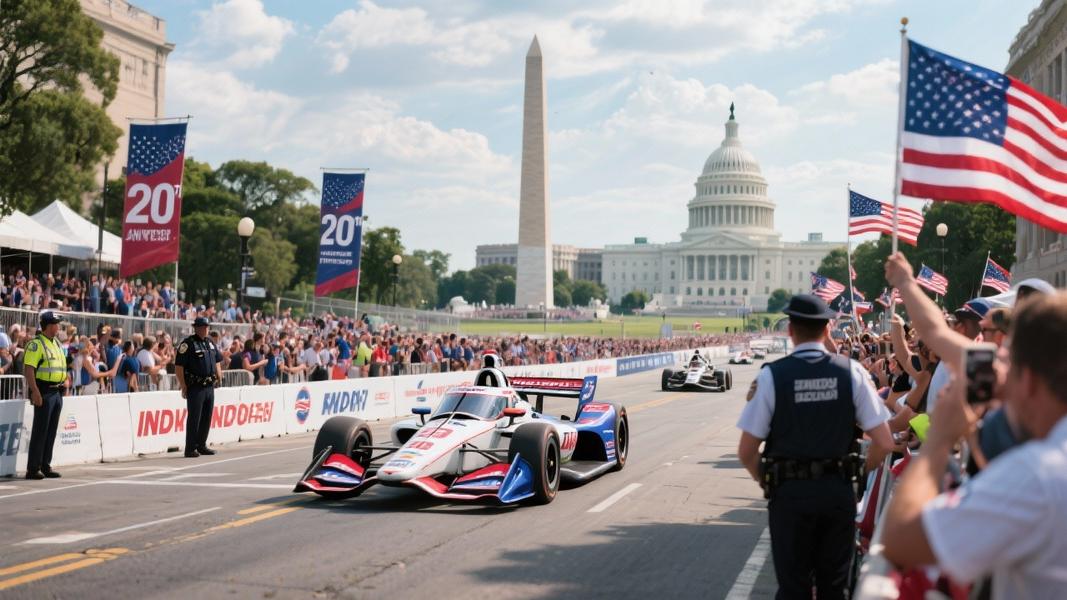
Racing fans, mark your calendars. The nation’s capital is about to get a whole lot louder.
President Donald Trump has signed an executive order establishing the Freedom 250 Grand Prix of Washington, D.C., the first-ever INDYCAR street race to zoom past the National Mall. The high-octane event, scheduled for August 21-23, 2026, will coincide with America’s 250th birthday celebrations.
“INDYCAR racing is a source of pride and entertainment for our Nation, which is why I am pleased to announce the Freedom 250 Grand Prix in Washington, D.C.,” Trump stated in the order. “This race, the first motor race ever to be held in our Nation’s capital near the National Mall, will showcase the majesty of our great city as drivers navigate a track around our iconic national monuments in celebration of America’s 250th birthday.”
Fast-Track Planning
The executive order doesn’t just announce the race — it puts the pedal to the metal on preparations. The Departments of Interior and Transportation have been directed to designate a suitable race route within just 14 days, one that will showcase Washington’s iconic monuments and landmarks.
Federal agencies are also instructed to expedite permits, allocate necessary funds, and coordinate with the Federal Aviation Administration to facilitate aerial photography of the event. But will D.C.’s infrastructure be ready for the strain of high-performance racing?
That’s where cooperation with local government comes in. The executive order specifically calls for coordination with the Mayor of the District of Columbia on infrastructure preparations, though details on potential road modifications remain sparse.
Racing Through History
The symbolism isn’t subtle. Sleek INDYCAR racers screaming past monuments to American democracy during the nation’s semiquincentennial celebration represents a distinctly American fusion of patriotism, spectacle, and speed.
INDYCAR will administer the race in partnership with federal departments and the D.C. Mayor’s office, according to official statements. While street races are nothing new for the racing series, the backdrop of the National Mall offers a uniquely American twist to the format.
Still, the tight timeline raises questions about logistics. Street circuits require significant modifications to public roadways, including barrier installations, surface treatments, and safety measures that typically take months of planning and execution.
Racing Against Time
With the race scheduled for August 2026, organizers have roughly two and a half years to transform D.C. streets into a professional-grade racing circuit — a challenging but achievable timeline by motorsport standards.
The executive order’s mandate for expedited permitting suggests the administration anticipates potential regulatory hurdles. Environmental assessments, traffic impact studies, and public safety reviews typically accompany projects of this scale.
What remains to be seen is how residents and local businesses will respond to the prospect of roaring engines echoing through the capital’s core. Street races in other cities have faced mixed reception, with some embracing the tourism boost while others lament the disruption.
As the wheels begin turning on this unprecedented event, one thing is clear: when America celebrates its 250th birthday, it will do so with the distinctly American soundtrack of high-performance engines echoing off the monuments to its history.
