
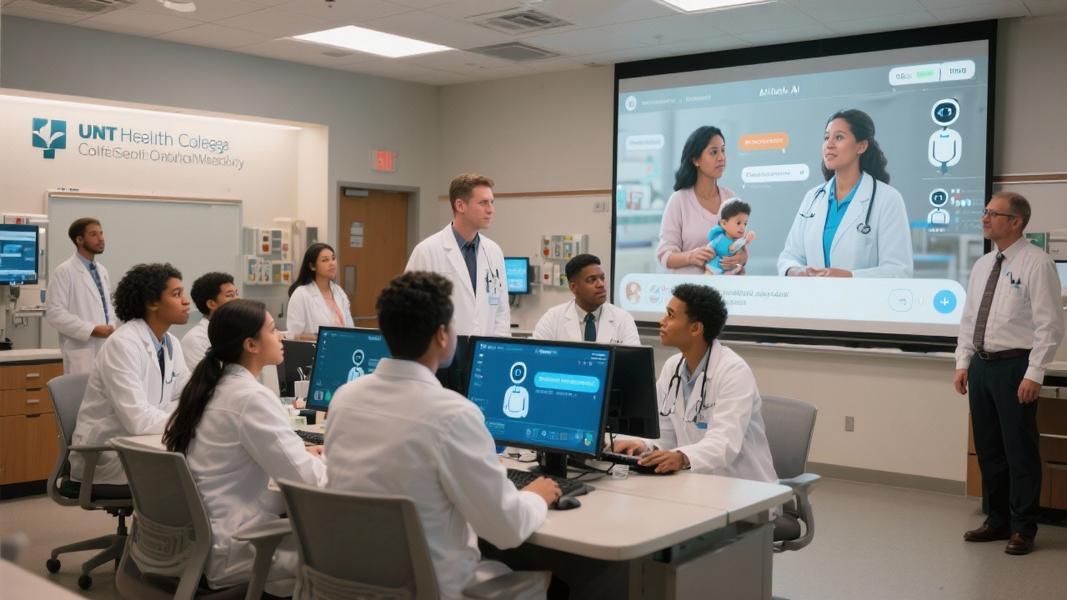
UNT Health Texas College of Osteopathic Medicine is pioneering the integration of artificial intelligence across all four years of its medical curriculum, positioning itself among the first institutions nationwide to make such a comprehensive commitment to AI education in healthcare training.
The Fort Worth-based medical school has embraced AI technology as a fundamental component of modern medical education, receiving support through an American Association of Colleges of Osteopathic Medicine (AACOM) grant specifically designed to develop advanced health informatics and AI coursework. This initiative comes as healthcare systems increasingly incorporate artificial intelligence tools for diagnostics, treatment planning, and administrative functions.
Building the Future of Medical Education
“We are thrilled to be supported by AACOM through this grant, which allows health systems science content to advance understanding of how AI and augmented intelligence will be part of our TCOM students’ osteopathic careers,” said faculty member Dr. Lieto, as noted in a university announcement.
The college’s commitment to technological advancement in medical education isn’t just theoretical. In 2022, UNT Health opened a 15,000 square-foot state-of-the-art simulation center equipped with cutting-edge AI and virtual reality resources, providing students with immersive learning environments that mimic real clinical scenarios. This facility has been recognized as a significant advancement in medical training infrastructure.
But what does AI-enhanced medical education actually look like in practice?
Students at the Texas College of Osteopathic Medicine engage with AI-powered simulations that respond realistically to their questions and treatment approaches, offering a safe space to develop clinical reasoning without risking patient safety. The pre-clinical curriculum already integrates systems-based courses with practical skills training, and now artificial intelligence adds another dimension to this comprehensive approach.
Teaching AI as a Tool, Not a Replacement
Dr. Sam Selvy, a pediatric emergency physician who works in the school’s simulation department, emphasizes that AI should enhance rather than replace fundamental medical training. “The tool itself is hopefully not replacing the skills the students have coming out of medical school,” he explains. “They need those cognitive skills, and they need to use AI as that tool and not a crutch.”
This balanced approach seems to be resonating with students. Shraddha Bhonsle, a medical student at the institution, described her experience with AI-powered patient simulations: “It was cool. We were able to ask any sort of question, and it was able to come up with a question that a parent would come up with. I definitely think it’s contributing to education if you use it for the right reasons. I think in classrooms it’s very helpful to have these simulations and be more interactive.”
The contrast between traditional medical education and today’s technology-enhanced approach is striking. Dr. Frank Filipetto reflects on the evolution he’s witnessed: “When I went to medical school back in 1986, this didn’t exist. The first patient I could practice on was a real patient,” he recalled. “This creates an environment where it creates some psychological safety. Students can make mistakes. It teaches communication skills, how we talk to a patient.”
That psychological safety may be one of the most valuable aspects of AI integration. Medical errors remain a significant concern in healthcare, and providing students with consequence-free opportunities to practice decision-making could potentially improve patient outcomes in the long run.
A Reputation for Excellence
The institution’s embrace of artificial intelligence builds on an already strong foundation. UNT Health Texas College of Osteopathic Medicine was granted a 10-year Accreditation with Exceptional Outcome in 2018 by the American Osteopathic Association’s Commission on Osteopathic College Accreditation, a distinction that reflects its commitment to educational excellence.
As AI continues to transform healthcare delivery, UNT Health’s approach may represent the future of medical education nationwide—where students graduate not only with traditional clinical skills but also with fluency in the digital tools that will increasingly shape their careers. For tomorrow’s doctors, understanding when to rely on artificial intelligence—and when to trust their own judgment—may prove just as important as memorizing anatomy or pharmacology.
