
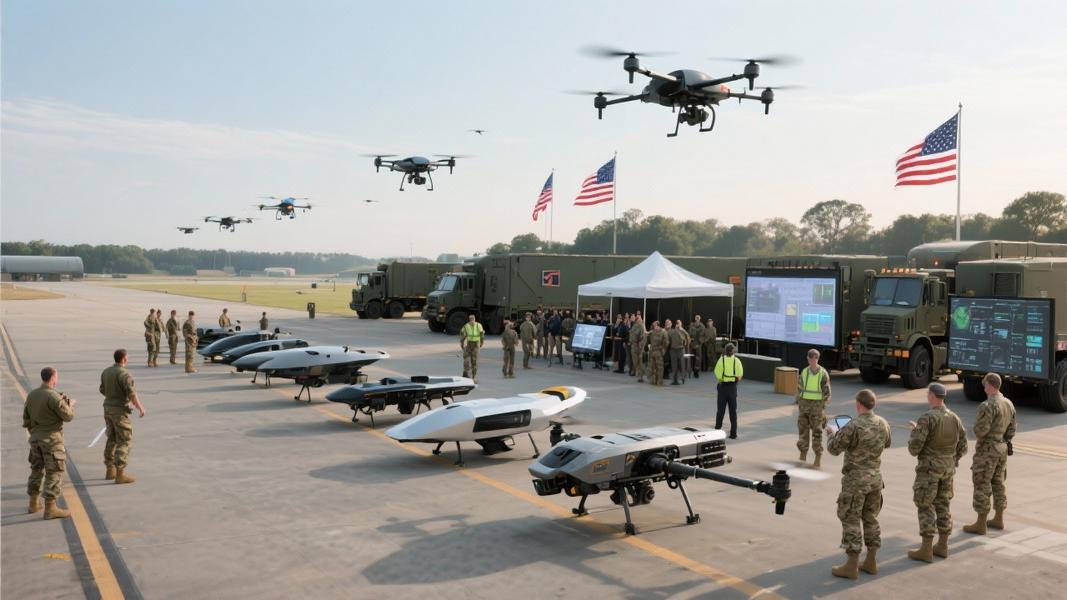
The Pentagon is betting big on small drones — more than 300,000 of them — in what might be the most aggressive unmanned systems acquisition program in military history.
On February 3, 2026, the War Department announced 25 vendors invited to compete in Phase I of the newly established Drone Dominance Program. The ambitious initiative, backed by $1.1 billion from the recently passed Big Beautiful Bill, aims to field hundreds of thousands of low-cost, one-way attack drones by early 2027.
The Gauntlet Begins
Starting February 18, selected companies will face what the Pentagon has dubbed “the Gauntlet” — an intensive evaluation at Fort Benning that will conclude in early March. The stakes? Approximately $150 million in initial prototype orders.
“Drone dominance is a process race as much as a technological race,” Secretary of War Pete Hegseth wrote in his July 2025 memorandum, signaling the department’s shift toward rapid acquisition of unmanned systems.
The program’s structure reveals the Pentagon’s urgency. Phase I alone will select roughly 12 vendors to produce 30,000 drones at $5,000 per unit by July 2026. But that’s just the beginning.
Scaling Up, Costs Down
Why such massive quantities? The War Department sees these expendable unmanned systems as game-changers for modern conflict. “The funding provided by the Big Beautiful Bill is ready to be used to mount an effective sprint to build combat power. We call it Drone Dominance,” Hegseth stated.
By January 2028, the Pentagon plans to have purchased a staggering 340,000 drones. Perhaps more impressive than the quantity is the projected cost curve — officials expect unit prices to drop from $5,000 in Phase I to just $2,300 by Phase IV.
“Drone dominance will do two things: drive costs down and capabilities up,” according to Hegseth.
Industrial Base Challenge
Can American industry deliver on such an aggressive timeline? That’s the trillion-dollar question hanging over the program.
The four-phase approach suggests the Pentagon is trying to balance urgency with realistic industrial capacity. Starting with 30,000 units in Phase I provides a significant but manageable production target, with each subsequent phase ramping up both quantity and complexity.
The competition beginning at Fort Benning next month represents more than just a procurement milestone — it’s the opening salvo in what defense analysts see as a fundamental shift in how America approaches unmanned warfare technology.
As drones continue to reshape battlefields from Ukraine to the Middle East, the War Department’s billion-dollar bet suggests they’re done playing catch-up. The race for drone dominance is officially on.
