
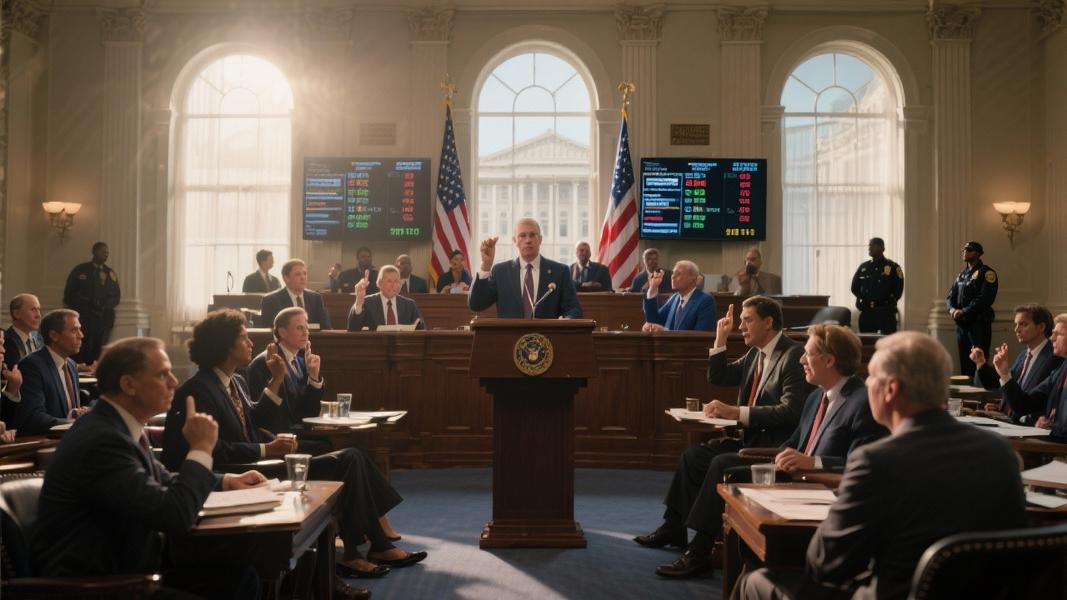
Rep. James Walkinshaw has introduced the True Shutdown Fairness Act, a bold measure aimed at ensuring federal employees and service members receive pay during government shutdowns — even as Congress just narrowly averted another fiscal crisis.
The legislation, unveiled February 2, comes on the heels of the House passing a $1.2 trillion spending package that ended a partial government shutdown that briefly began last Saturday. The package funds most federal agencies through September 30, temporarily defusing what has become an almost routine Washington standoff over government funding.
Protecting the Federal Workforce
“Federal workers and service members should never be used as leverage in Republicans’ shutdown standoffs, and the Trump administration should never be able to use a shutdown to inflict harm on our federal workforce, as we have seen,” Walkinshaw said when introducing the legislation alongside several colleagues.
The freshman congressman has quickly positioned himself as a champion for federal employees, particularly in Virginia’s 11th Congressional District, which is home to thousands of government workers. Since taking office, he’s introduced or cosponsored multiple bills aimed at safeguarding the civil service, including the Limit on Sweeping Executive Reorganization Act and the Saving the Civil Service Act.
But it’s not just about job security. Walkinshaw has also taken up the mantle on fair compensation, assuming lead sponsorship of the FAIR Act (H.R. 493), which would provide federal employees with a 4.3% pay increase in 2026. “This bipartisan bill would provide federal employees with a 4.3 percent pay increase in calendar year 2026,” Walkinshaw noted in a committee statement.
Why the push for higher wages? Federal employees currently earn nearly 25% less than their private-sector counterparts, according to 2024 data — a gap Walkinshaw and his allies are determined to close.
Competing Visions for Federal Employment
Not everyone in Congress shares Walkinshaw’s approach. The Federal Freeze Act (H.R.200) takes a markedly different tack, seeking to bar pay raises for federal employees for one year while requiring reductions in employee numbers across federal agencies.
Meanwhile, the Federal Employee Performance and Accountability Act of 2025 would establish a pilot program linking pay increases for GS-11 and above employees directly to performance evaluations, with potential adjustments of up to 10% in either direction.
These competing bills reflect a fundamental divide in how lawmakers view the federal workforce — as either a valuable asset deserving protection and fair compensation, or as a bloated bureaucracy in need of trimming and market-based incentives.
Carrying Forward a Legacy
For Walkinshaw, his advocacy represents more than just policy positions. He’s carrying forward four federal workforce bills originally authored by the late Rep. Gerry Connolly, who represented the same district before him. These measures aim to safeguard merit-based hiring, fair pay, retirement security, and IVF benefits for government employees.
“From administering Social Security checks to safeguarding our national security to delivering our mail, civil servants are the backbone of our federal government, providing the essential services that Americans rely on every day,” Walkinshaw has said of his commitment to the cause.
The congressman has identified H.R. 5249, the Limit on Sweeping Executive Reorganization Act, as his “first priority.” This legislation would require congressional approval for major executive branch reorganizations that cut federal employees or budgets.
What remains unclear is whether these workforce protection measures can gain traction in a deeply divided Congress. With shutdown threats becoming almost routine and partisan battles over government spending intensifying, federal workers may continue to find themselves caught in the crossfire — precisely the situation Walkinshaw’s legislation aims to prevent.
