
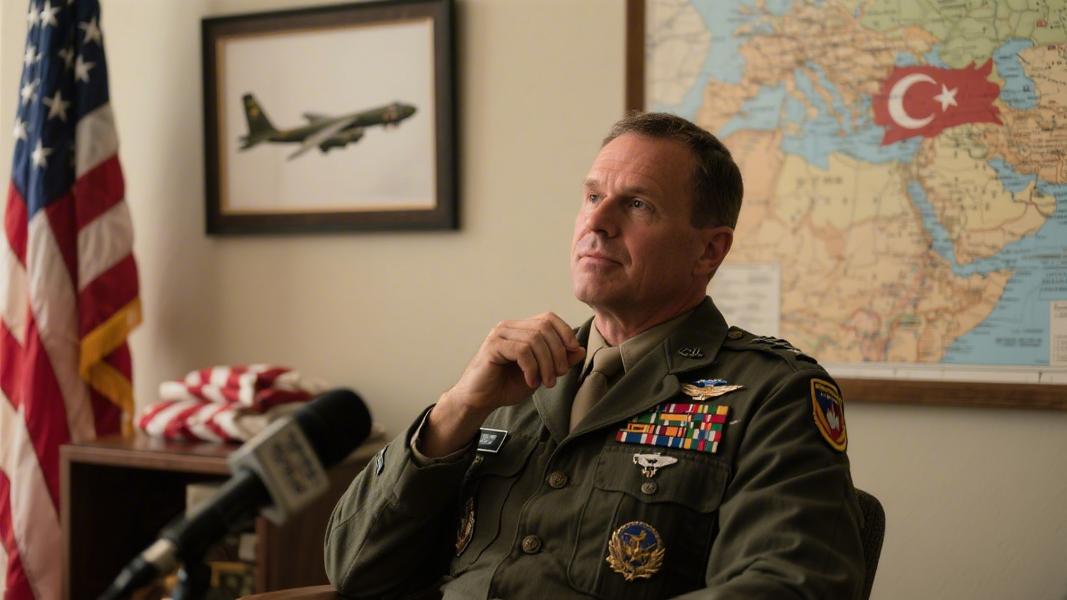
He wanted to fly into the fight. His boss said no — and never explained why.
That quiet frustration, sitting in Ankara while Desert Storm raged to the south, is just one thread in the life of Captain Bret Adams, a former U.S. Air Force officer whose oral history has been archived by the Texas General Land Office as part of its Voices of Veterans program. Adams’s story — spanning Cold War bomber bases, a Turkish posting during one of the most consequential conflicts in modern American history, and a difficult homecoming to civilian life — was featured on March 27, 2026.
From California to the Cold War Front
Adams’s path to the Air Force wasn’t a straight line — it rarely is. Born on the West Coast, he bounced through childhood in fits and starts: elementary school near Saint Louis, then the East Coast, then overseas, all of it driven by his father’s career as an aircraft engineer at McDonnell Douglas and General Dynamics. That kind of upbringing leaves a mark. “I think that traveling kind of sparked my interest,” Adams recalled, “and then being around him as an aircraft engineer, so that kind of rolled into being interested in the Air Force.”
He applied to the University of North Texas while living in Belgium, graduated, worked in Dallas for a stretch, and then enrolled in Officer Training School in San Antonio in 1985. Commissioned in August of that year, he reported to Minot, North Dakota — not exactly a glamorous first posting, but a strategically loaded one. Minot was a dual wing base, home to both a bomber wing and a missile wing, the kind of place that existed precisely because the Cold War demanded it.
“It was dual wing base,” Adams explained. “There was a bomber wing and a missile wing. The bombers were the B-52s that we had and […] tankers that supplied the fuel.” Alongside the bombers and tankers, the base housed a fighter squadron and an air rescue squadron — a full ecosystem of American airpower, quietly humming at the edge of the northern plains.
Turkey, Tension, and a War He Watched from the Sidelines
By 1989, Adams had moved to Ankara, Turkey, where he’d remain through 1991 — right through the Persian Gulf War. He described Turkey as a fascinating place, rich with history, good food, and warm people. But the backdrop was anything but leisurely. When hostilities escalated, so did the threat environment: routes were altered, uniforms were kept out of vehicles, and personnel checked under their cars every single day.
Still, Adams wanted more. He volunteered to deploy to Saudi Arabia. His commander refused, offering no reason. “I remember reading message traffic and trying to keep abreast of what was going on,” Adams said. “I wanted to get more involved. I even volunteered to go down to Saudi but my boss said no, he wanted me to stay there. He never told me why.” It’s the kind of moment that lodges itself permanently — the decision made above your head, the explanation that never comes.
That’s the nature of military service, of course. You don’t always get to know. But it doesn’t make the not-knowing any easier.
The Harder Battle: Coming Home
Adams left active duty around 1992, transitioning to a role as a training instructor with the Army and Air Force Exchange Service (AAFES). On paper, it made sense — a man with his background bringing expertise to a familiar institution. In practice, it stung. His colleagues were still in uniform. He was in a coat and tie.
“It wasn’t an easy transition for me,” he said. “I had every intention to stay in 20 years and work toward becoming a unit commander.” He’d mapped out a future — rank, command, purpose — and then life intervened, as it tends to do. The gap between the career you planned and the one you lived is something a lot of veterans know intimately. Adams is candid about it, which is part of what makes his account worth preserving.
A Record Worth Keeping
The Voices of Veterans oral history program, introduced by Texas Land Commissioner Dawn Buckingham, has now archived more than 500 stories from Texas veterans. The collection sits alongside historical documents tied to figures like Sam Houston — a reminder that the GLO has been in the business of preservation for a very long time, and that the stories of people like Bret Adams belong in the same archive as the state’s founding mythology.
Adams served from 1985 through 2009, eventually reaching the rank of captain. He saw the Cold War’s final years, participated in Operations Desert Shield and Desert Storm from a posting most Americans couldn’t have found on a map, and then navigated the unglamorous civilian aftermath that the Pentagon doesn’t put in the recruitment brochures.
He never did get to Saudi Arabia. His boss kept him in Turkey, reason unknown. Sometimes that’s just how the story goes — and sometimes, decades later, someone finally writes it down.
