
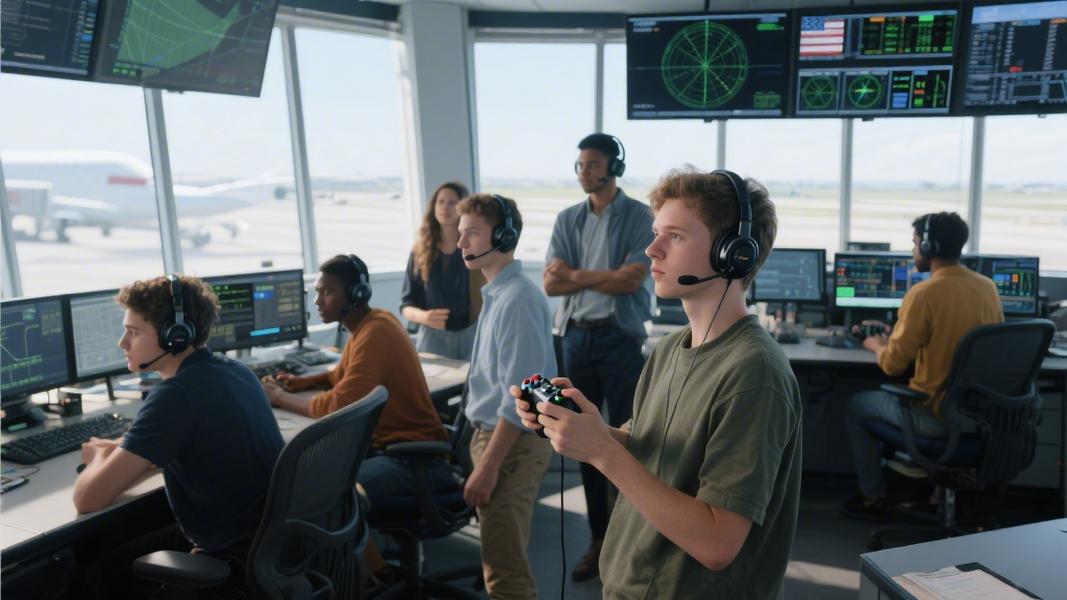
The federal government wants to fix America’s air traffic controller crisis — and it’s starting by recruiting gamers. That’s not a headline from a satirical website. That’s the plan.
Transportation Secretary Sean Duffy this week unveiled a campaign targeting the gaming community as a pipeline for the next generation of air traffic controllers, as the Federal Aviation Administration grapples with a staffing shortage that experts say has been decades in the making and is now straining the safety and reliability of the nation’s skies. The pitch: gamers already have the spatial reasoning, rapid decision-making, and multitasking instincts the job demands. Why not just find them where they live?
“To reach the next generation of air traffic controllers, we need to adapt,” Duffy said. “This campaign’s innovative communication style and focus on gaming taps into a growing demographic of young adults who have many of the hard skills it takes to be a successful controller.” It’s an unconventional pitch. Whether it’s enough is another question entirely.
How Bad Is the Shortage?
Bad. As of 2024, the U.S. had roughly 11,700 certified professional controllers and trainees — approximately 4,000 short of the FAA’s own staffing target. The agency has announced plans to hire at least 8,900 controllers through 2028, but that number is shadowed by a projected 7,000 departures over the same period. The math is uncomfortably tight.
Zoom out further and the picture gets grimmer. From 2010 to 2024, the number of working controllers dropped by 13%, even as flight traffic climbed 6.5% since 2013. The FAA employed 6% fewer controllers in fiscal year 2025 compared to 2015, despite U.S. flights increasing by 10% over that same stretch. More planes, fewer people watching them. That’s the equation nobody in Washington wants to explain out loud at a press conference.
By September 2024, more than 40% of the FAA’s 290 terminal facilities were operating below the agency’s own 85% staffing threshold — meaning 118 facilities were understaffed, according to data compiled by USAFacts. Only 172 met or exceeded the benchmark. On the worst staffing days, Secretary Duffy has noted, controller shortages contributed to roughly half of all flight delays — compared to a baseline of about 5% on normal days.
A Hole Decades in the Making
This didn’t happen overnight. From 2013 to 2023, the FAA hired only about two-thirds of the controllers it actually needed, a chronic underinvestment that has compounded year after year. The Brookings Institution has documented the slow bleed in detail, and the conclusion isn’t flattering: systemic underhiring, combined with an aging workforce and a grueling training pipeline, left the agency structurally unprepared for the demand it now faces.
Then came the government shutdown — and it made things measurably worse. A 44-day stretch without pay pushed experienced controllers out of the profession and poisoned the recruitment well at the same time. “The failure to pay air traffic controllers for 44 days created uncertainty, drove many experienced controllers out of the profession and harmed the recruitment pipeline,” a Department of Transportation spokesperson noted. The spokesperson didn’t mince words about what that signaled to potential recruits either: “No one wants to enter a job where their paycheck could be held hostage.”
That’s a recruiting pitch problem no gaming campaign can easily fix.
The Training Bottleneck
Even when candidates do sign up, getting them to the finish line is its own battle. The FAA Academy’s washout rate hovers around 30% — meaning nearly one in three students who start the program don’t complete it, according to reporting on the training pipeline. The curriculum is notoriously demanding, and the psychological and cognitive pressure of the work weeds out a significant chunk of every incoming class before they ever set foot in a control tower.
Still, the administration is pressing forward. The gaming recruitment campaign is part of a broader push by Secretary Duffy to modernize how the FAA attracts candidates — leaning into unconventional demographics rather than waiting for the traditional pipeline to fill itself back up. It’s a bet that the skills forged in competitive online gaming — split-second spatial decisions, managing multiple simultaneous inputs, staying calm under pressure — translate to the real thing.
Maybe they do. But between a 30% washout rate, a decade of underhiring, a workforce exodus triggered by an unpaid shutdown, and a math problem that requires hiring faster than people leave — the FAA’s staffing crisis is less a single broken gear and more a machine that’s been running on fumes for years. No amount of gamer recruitment, on its own, changes that. As one DOT spokesperson put it plainly: no one wants a job where the paycheck might not come. Fix that first, and the rest might follow.
