
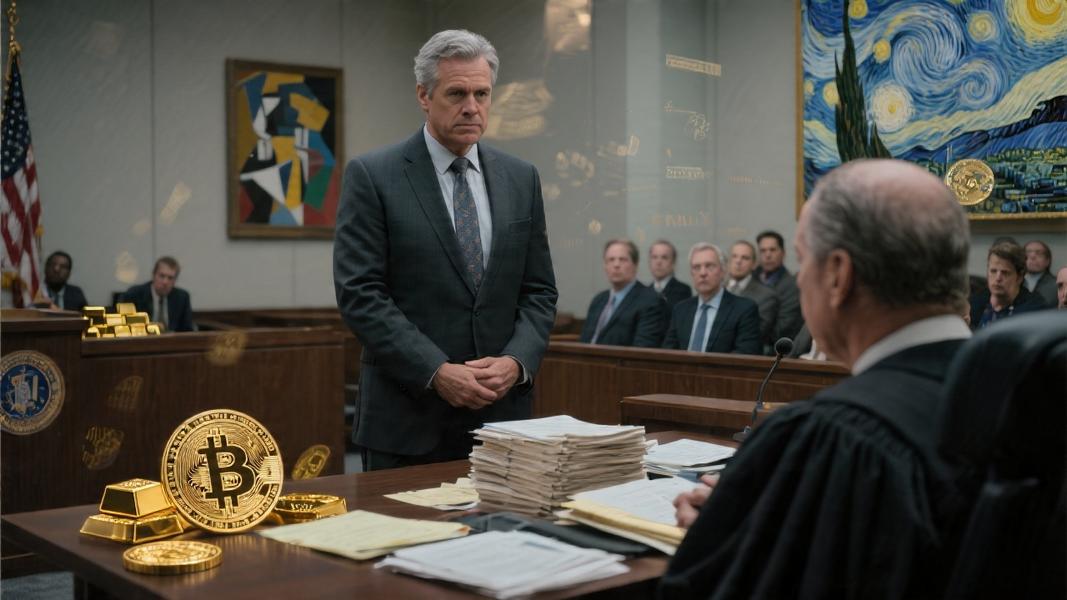
A Houston man who convinced nearly a thousand investors that his cryptocurrency was backed by Picassos and billions in gold has been handed a 23-year federal prison sentence — one of the stiffest penalties ever imposed in a U.S. cryptocurrency fraud case.
Robert Dunlap, 55, was sentenced by an Illinois federal judge after a jury found him guilty of orchestrating a sweeping digital currency scam that ran from 2018 to 2023 and drained more than $20 million from unsuspecting investors across the country. The vehicle for all of it was something called Meta-1 Coin — a cryptocurrency that, in reality, was worth about as much as the forged documents used to prop it up.
A Billion-Dollar Lie, Built on Canvas and Gold
Here’s the pitch Dunlap was selling: Meta-1 Coin wasn’t just another speculative token. According to him, it was anchored by a $1 billion art collection — works purportedly by Pablo Picasso, Salvador Dalí, and Vincent van Gogh — and, if that weren’t enough, $44 billion in gold reserves verified by a legitimate accounting firm. It was the kind of story that sounds almost too good. That was, of course, the point.
None of it was real. Federal prosecutors say Dunlap fabricated the asset claims entirely, using forged documents to lend the scheme a veneer of credibility. The gold audits were fake. The art collection, investigators confirmed, didn’t exist as described. And yet, close to 1,000 investors handed over their money — many of them ordinary people drawn in by the promise of a digitally revolutionary, asset-backed coin.
Conviction and Consequences
A federal jury in the Northern District of Illinois convicted Dunlap on mail fraud charges following a trial that laid out the full scope of the deception. The sentencing judge didn’t flinch. Twenty-three years. Dunlap was also ordered to pay restitution to his victims, though the road to recovering those losses — for people who trusted him with real money — is rarely as straightforward as a court order makes it sound.
Still, the length of the sentence is notable. Crypto fraud prosecutions have been ramping up in recent years, but a two-decade-plus term signals that federal courts are increasingly willing to treat large-scale digital currency schemes with the same gravity as traditional financial crimes. Dunlap’s case, detailed by legal observers following the verdict, may well become a reference point in future prosecutions.
The Broader Warning
What made Meta-1 Coin particularly insidious wasn’t just the scale — it was the sophistication of the lie. Invoking old masters and gold reserves tapped into something primal: the idea that a new, volatile asset class could be made safe by tethering it to the permanence of physical wealth. It’s a rhetorical trick as old as finance itself, just dressed up in blockchain language.
How many people paused to verify whether a Van Gogh or a Dalí actually sat in a vault somewhere, backstopping their investment? Probably not enough. That’s not entirely their fault — Dunlap went to considerable lengths to make the fraud look legitimate, and forged paperwork is designed specifically to defeat scrutiny.
The Justice Department’s pursuit of this case — spanning five years of alleged criminal activity — underscores a growing federal appetite for holding crypto fraudsters to account. Regulators and prosecutors have made no secret of their frustration with the ways digital currency markets have been exploited, and sentences like Dunlap’s are meant to send a message that reverberates well beyond one courtroom in Illinois.
For the nearly thousand investors who lost money to Meta-1 Coin, the sentence may offer some measure of justice. But as anyone who’s ever sat across from a fraud victim knows, a prison term doesn’t give anyone their savings back — and that’s the part that tends to linger long after the verdict is read.
