
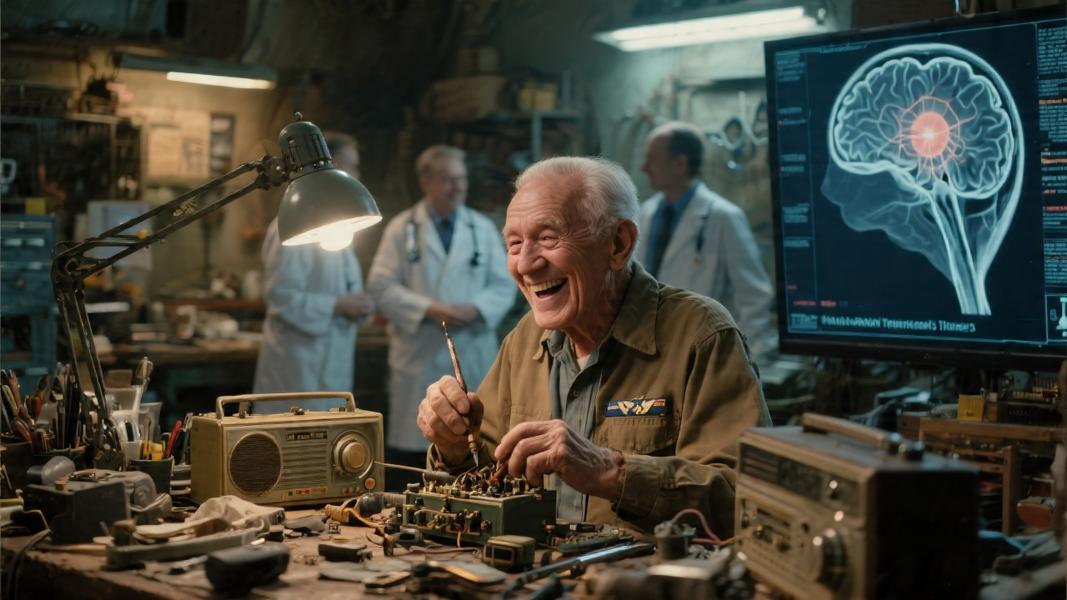
For Bud Levell, the warning came quietly — a decade before anything else did. He lost his sense of smell. That was it. No tremors yet, no diagnosis, just a strange absence that most people would brush off without a second thought.
“I lost my sense of smell 11 or 12 years ago,” the 72-year-old Arlington resident recalled. “That’s usually the first symptom.” Levell, a retired salesman and Air Force veteran, eventually got his diagnosis — and years later, he became one of the latest patients in North Texas to undergo a cutting-edge, incision-free procedure that’s quietly changing what’s possible for people living with Parkinson’s disease.
A New Option for a Very Old Problem
Levell received Magnetic Resonance-guided focused ultrasound treatment at UT Southwestern Medical Center — a procedure that requires no cuts, no implants, and no general anesthesia. The FDA recently expanded its approval of the technology to target a broader range of Parkinson’s symptoms, including not just tremors but also slowed movement, one of the condition’s most debilitating effects.
Dr. Bhavya R. Shah, who performed the procedure, described the mechanics in terms that are equal parts precise and unsettling. “We’re using a higher energy to destroy small tracts in the brain, or small bundles of nerves,” he explained. The idea — targeting and ablating specific neural pathways to interrupt faulty signals — isn’t new. But doing it without ever opening the skull is.
For patients like Levell, that distinction matters enormously. Traditional deep brain stimulation surgery, long considered the gold standard for advanced Parkinson’s, involves drilling into the skull and implanting electrodes. It works. But not everyone is a candidate, and not everyone wants it. This offers something different: a path forward for people who’ve run out of other options — or who simply aren’t ready to go under the knife.
The Scale of the Problem
How widespread is Parkinson’s, really? The numbers are striking. Nearly one million Americans are currently living with the disease, according to the Parkinson’s Foundation, with that figure projected to climb to 1.2 million by 2030. Roughly 90,000 new cases are diagnosed every year in the United States — though some estimates put that figure closer to 60,000, depending on the methodology. Either way, the trajectory is upward and it isn’t slowing down.
In North Texas alone, an estimated 15,000 people are living with the condition. That’s roughly the population of a small city — quietly navigating tremors, stiffness, and the slow erosion of motor control that defines the disease’s progression.
And it doesn’t only hit the elderly. About 4% of patients are diagnosed before the age of 50 — a figure that tends to surprise people who think of Parkinson’s as strictly a disease of old age. It’s not.
What’s Actually Happening in the Brain
Parkinson’s is, at its core, a loss. The brain’s dopamine-producing cells — the ones responsible for smooth, coordinated movement — begin to die off, and the body starts to betray the person living inside it. Movements slow. Limbs shake. Balance falters. It’s classified as the second most common age-related degenerative brain disease in the world, and the most common motor brain disease — full stop.
What causes it? That’s where the science gets complicated. Researchers believe it’s a combination of environmental and genetic factors — no single trigger, no clean answer. That complexity has made treatment difficult for decades. Medications can help manage symptoms, but they don’t stop the disease. They buy time.
Still, the pipeline is more active now than it’s been in years. Focused ultrasound is just one piece of a broader effort to find interventions that actually move the needle — or at least, give patients more of their lives back.
What It Meant for One Veteran
For Levell, the procedure wasn’t a cure. Parkinson’s doesn’t work that way — not yet. But relief from tremors, even partial relief, can mean the difference between independence and dependence. Between writing a check and needing someone else to do it. Between a meal eaten with dignity and one that isn’t.
The VA has long noted the particular burden Parkinson’s places on veterans, a population that faces elevated risk due to certain service-related exposures. Levell’s story — a veteran, an older man, someone who noticed something was wrong more than a decade before the tremors started — is, in many ways, a portrait of how the disease actually unfolds. Slowly. Quietly. Until it isn’t quiet anymore.
The Parkinson’s Foundation continues to track the disease’s growing footprint, and clinicians across the country are watching technologies like focused ultrasound with cautious optimism. The expanded FDA approval is a meaningful step. Whether it translates into broader access — for patients outside major academic medical centers, for people without the right insurance, for the 15,000 in North Texas who may never hear about it — remains an open question.
That’s usually how it goes with breakthroughs. The science moves. Then everything else tries to catch up.
