
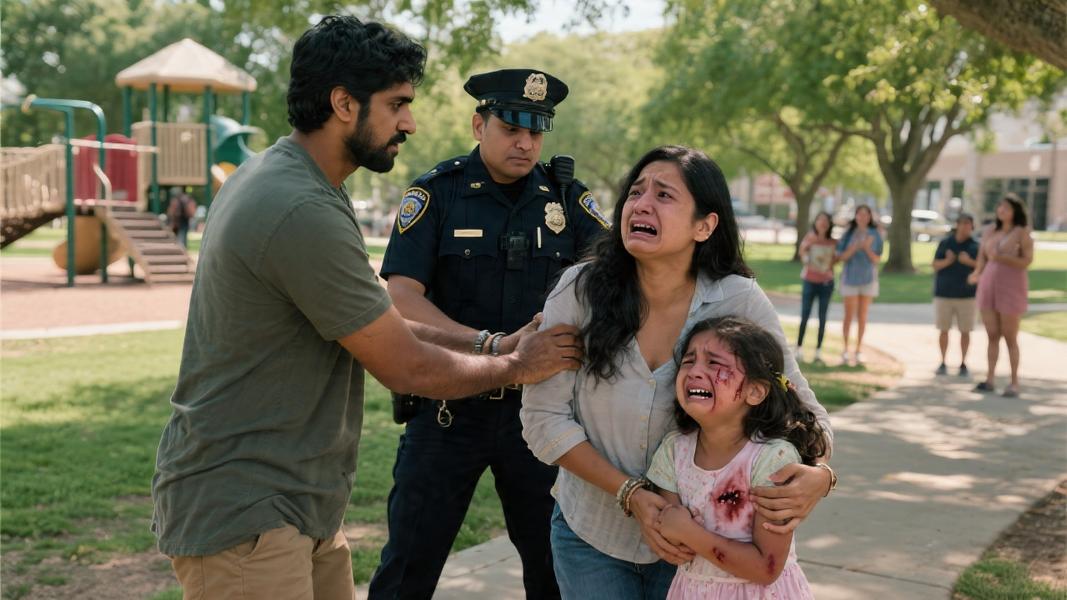
An Indian student is in federal custody after a brutal attack on a mother and her toddler in a San Antonio park. It’s the kind of case that cuts through the noise — and it’s landing in the middle of one of the most complicated immigration moments the country has seen in years.
Atharva Vyas, a 24-year-old Indian national, arrived in the United States on a student visa in August 2023. On April 18, 2026, authorities say he assaulted Gabriella Perez and her three-year-old daughter in a local park. ICE moved quickly — lodging a detainer and announcing enforcement action within days, calling the assault barbaric. The agency wasted no time making the case a headline.
But it’s not that simple. The Vyas case is a single thread in a much larger, messier tapestry of U.S.-India immigration tensions — one that involves smuggling networks, student visa crackdowns, wrongful detentions, and a federal government in India quietly scrambling to account for its own citizens abroad.
The Scale of the Crackdown
India’s Union Government has confirmed that 295 Indian immigrants currently in ICE custody with final removal orders are being verified for nationality — this after 388 Indians were already deported since January 2025. Those aren’t small numbers. For a country that sends more international students to American universities than almost anywhere else on earth, the political pressure back in New Delhi is real and growing.
Meanwhile, ICE has reportedly targeted roughly 4,700 students for deportation. Half of them, by some estimates, are Indian nationals. That’s a staggering proportion — and it’s rattling university towns from California to the Midwest, where Indian graduate students make up a significant chunk of STEM programs.
Then there’s the smuggling angle. In January, a 22-year-old Indian national identified as Shivam Lnu was indicted for allegedly conspiring to move Indian nationals illegally across the U.S.-Canada border between January and June 2025. It’s a reminder that not everyone caught up in enforcement actions arrived through official channels — and that the pipeline of irregular migration from India into the U.S. is more organized than many realize.
When Enforcement Goes Wrong
Here’s where it gets thornier. Not everyone swept up in this enforcement wave is who ICE thinks they are.
A federal judge in New Jersey found that ICE violated judicial orders in the case of an Indian immigrant named Jagpreet Singh — a case that drew sharp criticism and raised serious questions about due process in an era of accelerated deportations. Judicial rebukes of this kind are unusual. They don’t happen unless something went meaningfully wrong.
And the collateral damage isn’t limited to South Asian immigrants. Under the Trump administration’s aggressive enforcement posture, Native Americans have been detained based on appearance alone — stopped, questioned, and held despite being U.S. citizens whose families have lived on this continent for thousands of years. Tribes have begun advising members to carry Tribal IDs at all times. Think about that for a second.
The Native American Rights Fund has condemned what it describes as unlawful stops, abuse, and detention by ICE agents — a rebuke that underscores how blunt an instrument mass enforcement can be when deployed at speed and scale.
A System Under Strain
The Vyas case will likely be used as Exhibit A by those who argue ICE needs more authority and fewer restrictions. The Singh case will be used as Exhibit A by those who argue the opposite. Both are true at the same time. That’s the uncomfortable reality of immigration enforcement in 2026 — a system simultaneously failing to catch the right people and catching the wrong ones.
Still, the politics of this moment almost guarantee the crackdown continues. The administration has shown little appetite for nuance, and with deportation numbers climbing and bilateral pressure from India mounting, the pace isn’t likely to slow anytime soon.
For the students, the visa holders, the undocumented, and — somehow — even the tribal citizens just trying to walk through a park without being stopped: the rules of the road have changed. Whether the system can tell the difference between them may be the most important question nobody in Washington seems in a rush to answer.
