
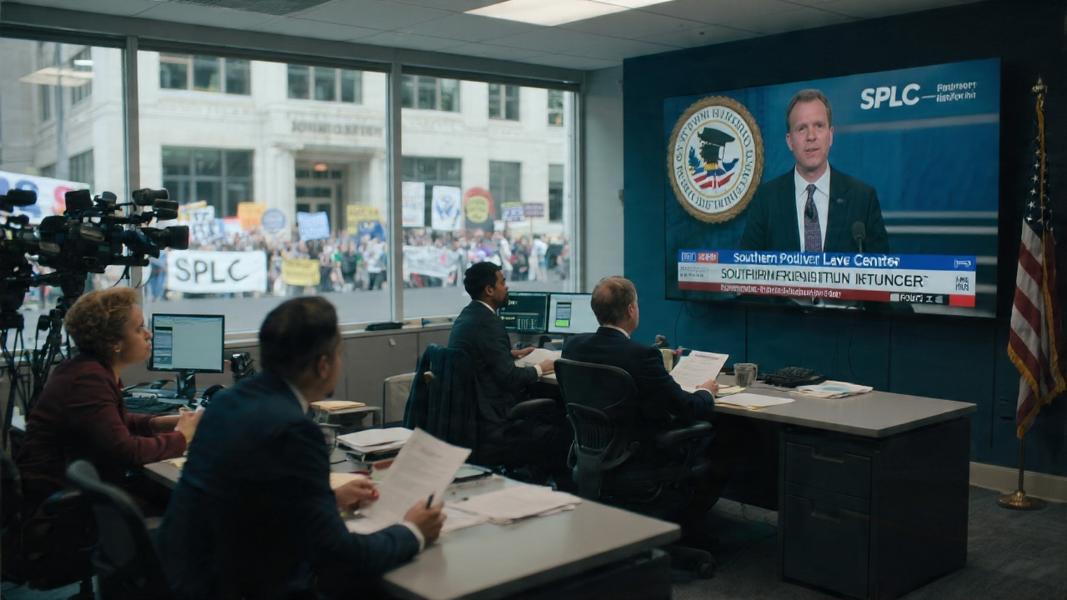
The Southern Poverty Law Center, one of the most recognizable — and most contested — civil rights organizations in America, is now squarely in the crosshairs of the federal government. And the questions being asked go well beyond a single allegation.
The Justice Department has launched a formal investigation into the SPLC, targeting the organization’s past use of paid confidential informants to infiltrate hate groups, according to multiple reports. The probe is being led by the U.S. Attorney’s Office for the Middle District of Alabama — the same state where the SPLC was founded more than five decades ago. As CBS News reported, “The focus appears to be on the SPLC’s prior use of paid confidential informants to gather credible intelligence on extremely violent groups.” Potential criminal charges, the organization’s own leadership has acknowledged, may follow.
An Organization Under Siege
The SPLC’s interim CEO broke the news internally before it spilled into public view, confirming the Justice Department probe and warning staff that the organization could face serious legal exposure. ABC News disclosed the full scope of those internal warnings. The use of paid informants — a practice not uncommon among investigative nonprofits and journalists tracking extremist movements — is now being treated as potential criminal conduct, a framing that has alarmed civil liberties advocates watching the case closely.
But it’s not that simple. The current investigation doesn’t exist in a vacuum. It’s the latest chapter in a years-long pattern of federal and congressional scrutiny directed at the Montgomery, Alabama-based nonprofit. Back in 2022, a House Judiciary subcommittee documented a push for a sweeping federal investigation into the SPLC’s finances, donor solicitation practices, and internal culture — including allegations of racial discrimination and sexual harassment within the organization itself. That document never led to a formal probe at the time. Now the climate has shifted considerably.
Congress Has Questions Too
On Capitol Hill, House Oversight Chairman James Comer has been running a parallel inquiry — one with a sharper ideological edge. Comer’s investigation centers on the SPLC’s outsized influence over federal employees through its widely cited “hate group” designations, which critics argue have been weaponized against mainstream conservative organizations rather than genuine extremist movements. His office noted that SPLC officials held at least eleven meetings at the White House over a three-year period — a level of access that Comer’s team found deeply troubling. “The SPLC has weaponized its designation of ‘hate group’ to target conservative persons, organizations, and non-profits who hold opposing viewpoints or policy positions,” Comer’s office charged.
That accusation has been a slow-burning controversy for years. The SPLC has labeled a number of prominent conservative legal and religious groups as hate organizations — designations that have real-world consequences, from deplatforming decisions by tech companies to the targeting of charitable giving programs. Defenders of the SPLC say those designations are rigorously researched. Critics — and there are many — say the bar has been stretched well past credibility.
A Storied History, A Complicated Present
Founded in 1971, the SPLC built its reputation through landmark civil rights litigation, winning cases that financially dismantled Ku Klux Klan chapters and other white supremacist organizations. For decades, it was considered an indispensable resource — sharing intelligence on domestic extremists with the FBI and other law enforcement agencies. That relationship, however, is now severed. FBI Director Kash Patel cut ties with the organization in October 2025, citing what he called its “hate map’s” role in defaming ordinary Americans. “Their so-called ‘hate map’ has been used to defame mainstream Americans and even inspired violence,” Patel stated.
How much of this is legitimate legal accountability — and how much of it is political retribution against an organization that has spent decades antagonizing the right — is a question that won’t be answered easily. Both things, of course, can be true simultaneously. Institutions can be genuinely flawed and genuinely targeted. The SPLC has faced credible internal criticism for years, including the abrupt resignation of its co-founder Morris Dees in 2019 amid misconduct allegations. The organization pledged reform. Whether it delivered is another matter.
Still, the timing and the breadth of the current federal scrutiny — a criminal investigation, a congressional probe, and a severed FBI relationship all converging at once — suggests something more coordinated than coincidence. The SPLC has not yet publicly commented in detail on the Justice Department investigation, and it’s unclear how aggressively the organization intends to fight back.
For an organization that built its identity on holding others accountable, the reckoning it now faces is, at the very least, a profound test of what it actually stands for.
