
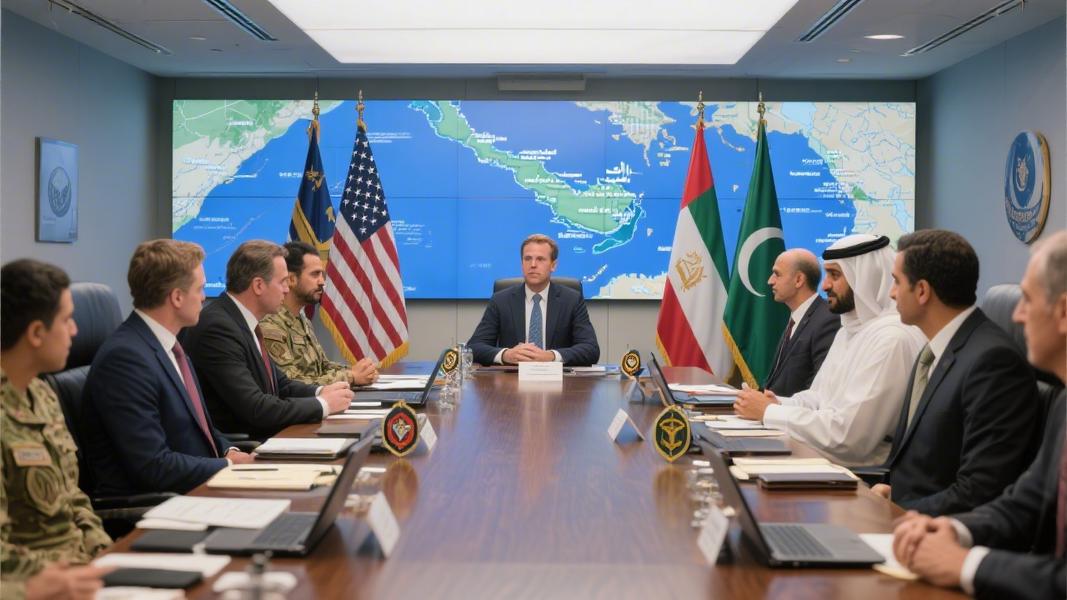
The Pentagon is tightening its grip on Gulf security — and it’s doing so by name. Operation Epic Fury is now the organizing framework for U.S. military coordination with its closest Arab partners, and Washington isn’t being quiet about it.
On March 19, 2026, Under Secretary of War for Policy Elbridge Colby convened a high-stakes meeting at the Department of War with ambassadors and defense attachés from the Gulf Cooperation Council — Saudi Arabia, the UAE, Qatar, Kuwait, Bahrain, and Oman — to align on the operation’s objectives. Chief Pentagon Spokesman Sean Parnell confirmed the meeting in a readout the following day. The message was deliberate: the U.S. is building a coalition architecture in the Gulf, and Iran is squarely in the crosshairs.
Layered Defenses, Shared Stakes
Colby didn’t mince words about what the GCC brings to the table. He stressed the critical importance of Gulf partners’ layered air and missile defense systems — infrastructure that has, in recent months, proven essential in intercepting what U.S. officials describe as Iran’s indiscriminate attacks across the region. These aren’t token contributions. They’re the kind of battlefield integration that takes years to build and minutes to need.
The Department of War made clear it intends to sustain that integration. In a statement outlining its posture, the department said it would maintain “close, continuing cooperation” with GCC partners — with particular attention to freedom of navigation in the Strait of Hormuz, the narrow waterway through which roughly a fifth of the world’s oil supply passes. Lose that, and the conversation about energy markets gets very uncomfortable, very fast.
Iran, Israel, and the Broader Picture
Still, the Gulf isn’t the only front in Colby’s strategic calculus. In congressional testimony, he was explicit: “In the Middle East, we are working with our model ally Israel and other regional partners to address the threat of Iran and terrorism.” That framing — Israel as a “model ally” — is notable. It signals not just a security relationship but a doctrinal one, where Israel’s posture toward Iran serves as something of a template for how Washington wants the broader coalition to operate.
Burden sharing is the throughline. Colby has made no secret of his belief that U.S. partners need to carry more of the operational and financial weight. The GCC meeting, in that sense, wasn’t just a briefing — it was a renegotiation of expectations, wrapped in the language of partnership.
The NATO Backdrop
How did we get here? Some of the groundwork was laid weeks earlier, in Brussels. On February 12, 2026, Colby appeared before NATO allies, where Secretary General Mark Rutte opened by saying, “I am really happy that Undersecretary of War, Elbridge Colby, is here today” — a warm reception that underscored the transatlantic interest in how America is reorienting its Middle East strategy. NATO’s concern isn’t abstract. Instability in the Gulf ripples directly into European energy security and migration dynamics.
That said, the NATO visit and the GCC meeting are two different conversations happening in the same breath. One is about reassuring traditional allies. The other is about operationalizing a new coalition structure in a region that has historically resisted being organized into anything clean or predictable.
What Comes Next
Operation Epic Fury is, for now, more framework than finished product. The details of its scope — how many assets, what rules of engagement, what triggers escalation — remain closely held. But the diplomatic signaling is loud enough. Colby is moving fast, meeting with allies on multiple continents within weeks, and attaching a proper operational name to what might previously have been called “enhanced deterrence” or some other bureaucratic euphemism.
Tehran, for its part, has not publicly responded to the operation by name. But Iran’s leadership has watched American coalition-building in the Gulf before. They know what it looks like — and they know what it’s for.
The question isn’t whether the U.S. is serious this time. The question is whether its partners are ready to be, too — and whether an operation with a name like Epic Fury can deliver on the audacity it implies.
