
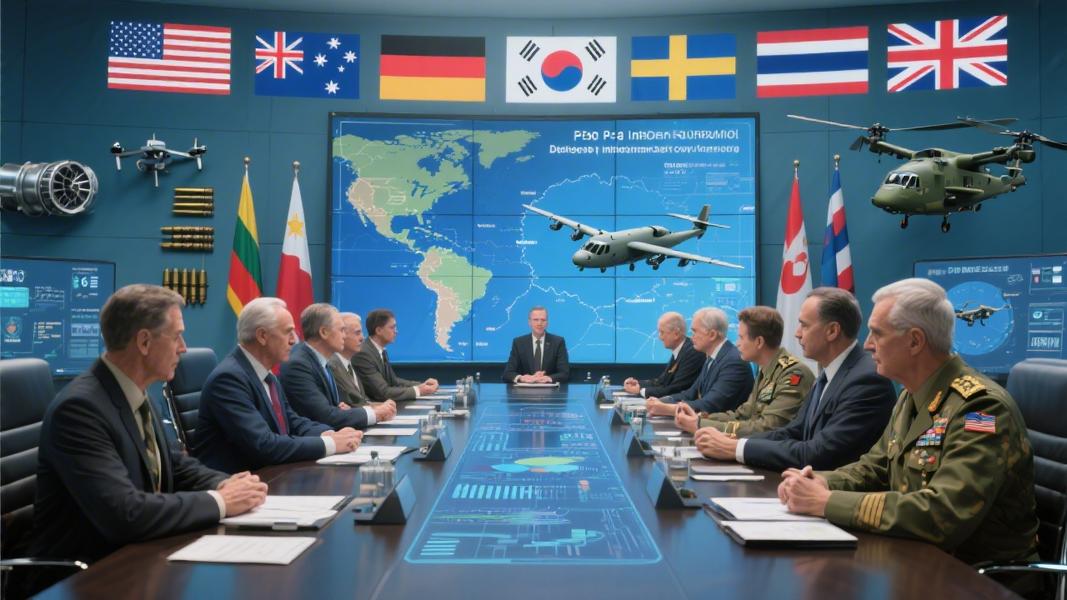
A new multilateral defense initiative is quietly reshaping how the United States and its allies think about warfighting — not just on the battlefield, but on the factory floor.
The Partnership for Indo-Pacific Industrial Resilience, known as PIPIR, brings together 14 partner nations to strengthen supply chains, advance co-production efforts, and accelerate the repair and deployment of critical technologies. It’s an ambitious bet that the next major conflict won’t be won or lost by soldiers alone — but by the industrial networks behind them. As the Atlantic Council has noted, U.S. defense industrial partnerships in the Indo-Pacific go far deeper than headline-grabbing programs like AUKUS submarines.
Built for a Different Kind of Competition
Launched in May 2024 under the Biden administration, PIPIR wasn’t born out of optimism. It was born out of hard lessons. Years of watching supply chain fragility expose vulnerabilities — from semiconductor shortages to ammunition stockpile gaps — pushed defense planners toward a blunt conclusion: the United States can’t sustain a high-intensity conflict in the Pacific alone. The Department of Defense has outlined how the partnership has since progressed to identify concrete opportunities that enhance combined lethality, leverage shared capabilities, and strengthen the defense industrial base.
That’s not diplomatic boilerplate. It reflects a genuine strategic pivot. The initiative was part of a broader cluster of 2024 policy moves — including the National Defense Industrial Strategy and the Regional Sustainment Framework — that, as Pacific Forum has described, marked a deliberate effort to embed key allies into defense production and sustainment networks. Not just as customers. As co-manufacturers.
What PIPIR Actually Does
So what does that look like in practice? Concrete. Specific. Sometimes unglamorous. PIPIR’s work includes expanding in-theater ship repair — critical for keeping naval assets operational closer to potential flashpoints — as well as cooperation with Australia to produce artillery shells and guided missiles. There’s also a co-production arrangement with India focused on, as one source has reported, “equipment needed to deter aggression.” Vague language, yes — but the intent is pointed directly at China.
Still, the initiative’s architects knew that hardware alone wouldn’t cut it. Building a resilient defense industrial base across the Indo-Pacific also requires people — engineers, procurement officials, armaments specialists — who understand how to work across borders, bureaucracies, and legal frameworks. That’s a harder problem than building a missile.
The MARS Program: Training the Next Generation of Alliance Builders
Enter the Multinational Armaments Resilience Seminar, or MARS. A key component of PIPIR, the program spans four weeks — two in the United States, two hosted by rotating Indo-Pacific partners — and is designed to build the human infrastructure behind the industrial one. The Daniel K. Inouye Asia-Pacific Center for Security Studies has highlighted that the inaugural MARS program demonstrated “a clear path forward for strengthening alliances and partnerships and working on shared challenges together.” It’s the kind of low-profile initiative that rarely makes front pages — but the kind that quietly determines whether alliances hold under pressure.
Wicked Problems, Real Stakes
The challenges PIPIR is trying to solve aren’t new. They’re stubborn. National Defense Magazine has characterized the initiative as designed to tackle “some of the wicked challenges impeding defense industrial cooperation and eroding resilience” — a phrase that captures just how tangled the problem really is. Export control laws, differing procurement standards, political sensitivities around technology transfer, incompatible logistics systems. Any one of those could stall a co-production deal. All of them together? That’s the environment PIPIR is operating in.
That said, momentum appears real. A whitepaper outlining PIPIR’s framework underscores how the 14-nation coalition is structured not just around shared threat perceptions, but around shared production capacity — a more durable foundation than diplomatic goodwill alone.
The Bigger Picture
It’s worth stepping back. PIPIR doesn’t get the attention of aircraft carrier deployments or missile tests. It doesn’t generate the kind of imagery that drives cable news cycles. But in many ways, it’s doing something more foundational — trying to ensure that if deterrence fails, the alliance can actually fight, sustain, and resupply at scale across thousands of miles of open ocean.
Whether 14 nations with divergent interests, legal systems, and industrial capacities can actually pull that off remains an open question. But as any defense planner will tell you, the time to build the factory is before the war starts — not during it.
