
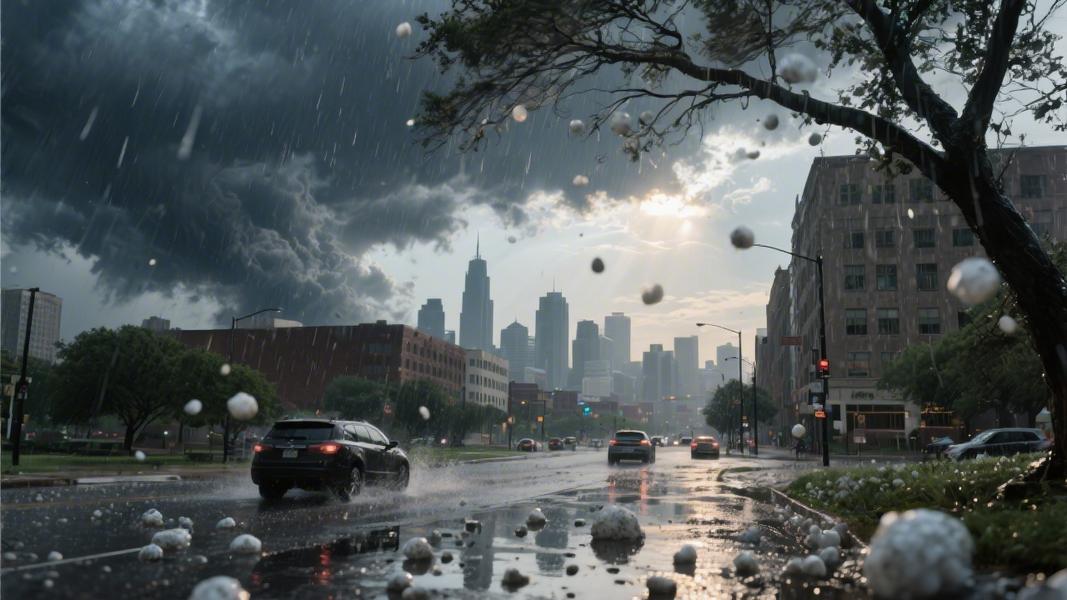
The skies over the central United States are shaping up to tell a dangerous story this spring — and forecasters want everyone paying attention before the first sirens wail.
Spring 2026 is on track to be one of the most active severe weather seasons in recent memory across Tornado Alley, with meteorologists flagging an elevated risk for tornadoes, large hail, and damaging winds stretching from northern Texas all the way into the Ohio Valley. The threat isn’t hypothetical. It’s already taking shape in the atmospheric data, and the window is narrowing fast for communities to prepare.
A Season Already in Motion
Global ensemble models have been trending wetter across the region, with a renewed window for organized severe thunderstorm activity expected in early April — roughly the 10th through the 13th — running from Texas up into the Midwest. Two major climate drivers are fueling this: a transitioning La Niña pattern and shifting Madden-Julian Oscillation phases, both of which historically prime the atmosphere for explosive storm development.
The Climate Prediction Center has already flagged a slight risk of heavy precipitation for portions of the Southern and Central Plains, including Texas, during that April 10–12 stretch, along with a slight risk of high winds across the Plains from Thursday through Monday, April 9–13. “Slight risk” is government-speak for “pay attention.” In the right conditions, slight risks become major headlines by nightfall.
Where the Bullseye Falls
So where, exactly, is the danger concentrated? The core threat corridor runs from northeast Texas through Arkansas, Missouri, Illinois, Indiana, Ohio, and Kentucky — a swath that lights up reliably during La Niña springs. Separately, the highest hail risk in 2026 is expected to arc from Texas to Alabama, a belt that encompasses some of the most densely populated and economically vulnerable communities in the South.
That’s the catch, really. It doesn’t take a record-breaking season to produce a catastrophic one. It takes one storm hitting the wrong place at the wrong time.
AccuWeather meteorologist Duffus put it plainly, and it’s worth reading twice: “Do not let your guard down this severe weather season,” he warned. “Flash floods and damaging wind gusts can be just as destructive as tornadoes and often impact a much larger area. Tornado reports may trend lower than last year, but it only takes one storm striking a densely populated or vulnerable community to make this a devastating season.” It’s a sobering reminder that headline metrics — tornado counts, damage totals — don’t always capture what a season actually costs people on the ground.
Not All of Texas Is Bracing for Rain
Here’s an irony that doesn’t get enough attention: while much of Texas faces a heightened flood and severe weather threat this spring, Deep South Texas and the Rio Grande Valley are locked in a brutal drought that isn’t going anywhere soon. Conditions ranging from D2 Severe Drought to D4 Exceptional Drought are projected to persist well into the April–June outlook period. The same state, at the same time, dealing with too much water in one corner and desperately too little in another.
That kind of split-personality weather pattern is increasingly common, and it complicates emergency management in ways that straight-line thinking doesn’t easily accommodate. Drought-hardened soil, for instance, doesn’t absorb rainfall well — meaning when storms do push south, flash flooding risk spikes even in areas that haven’t seen meaningful rain in months.
What Comes Next
Forecasters have been signaling this elevated risk profile for weeks now, and the early April timeframe is shaping up as the first major test of the season. Communities from the Texas Panhandle to the lower Mississippi Valley should already be refreshing their emergency plans, checking shelter locations, and — if they haven’t already — downloading weather alert apps that can push warnings in real time.
Still, there’s a limit to what any forecast can tell you. The atmosphere doesn’t read models. It does what it wants, when it wants, and the margin between a near-miss and a tragedy is sometimes measured in city blocks or minutes. That’s not fatalism — it’s meteorology.
As Duffus put it: it only takes one storm. History has a way of making that point the hard way.
