
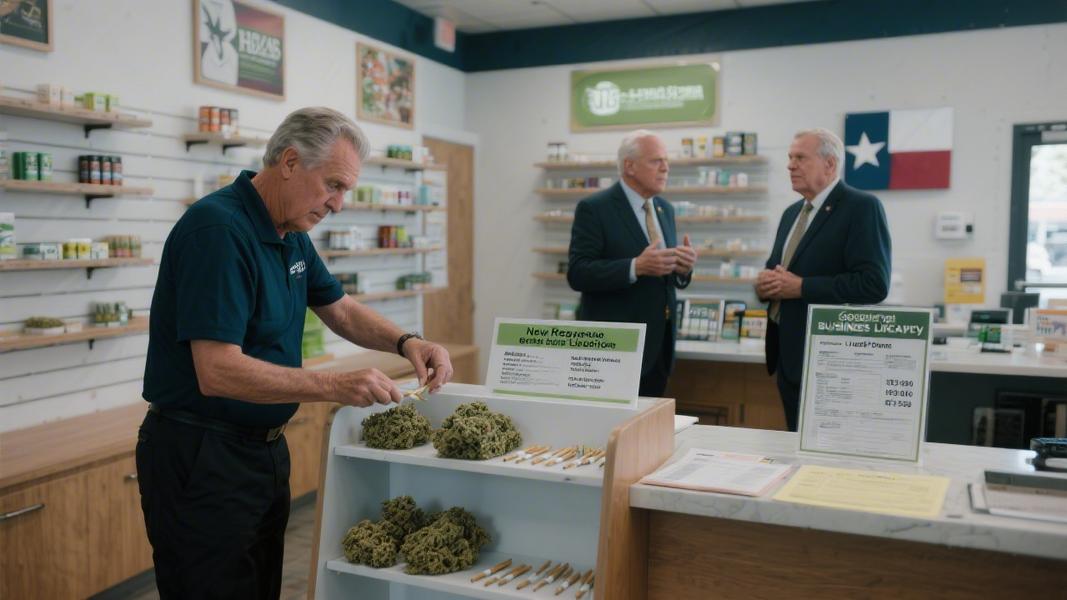
Texas hemp retailers have one week to figure out what to do with half their inventory — and for many of them, there’s no good answer.
New regulations from the Texas Department of State Health Services take effect on March 31, 2026, reshaping the state’s hemp industry in ways that critics say amount to a backdoor prohibition. The rules impose a 0.3% total THC cap on consumable hemp products, effectively wiping smokable hemp flower, pre-rolled joints, and other inhalable products off store shelves entirely. For an industry that supports tens of thousands of jobs and generates an estimated $4.3 billion in annual revenue, the timing couldn’t feel more brutal.
What the Rules Actually Do
It’s not just the THC cap causing alarm. The new regulations also include child-resistant packaging requirements, updated labeling and testing standards, revised bookkeeping obligations, and a minimum purchasing age of 21. Those provisions, on their own, might be digestible for a maturing industry. But the fee increases are a different story entirely.
Manufacturing licenses — which previously cost $258 per facility — will now run $10,000 per facility per year. Retail registrations jump from $155 to $5,000 per location. Industry leaders aren’t mincing words about what that means. As Lukas Gilkey, CEO of Austin-based hemp company Hometown Hero, told reporters: “They did a ban with their own regulatory scheme. The way they wrote the rules, it’s going to eliminate a lot of products that are fully legal and fully fine and not harmed anyone.”
That’s the catch. None of this required the Legislature to formally pass a prohibition — and in fact, it didn’t. Lawmakers did vote to ban hemp-derived THC products outright, driven largely by concern that intoxicating products were consistently reaching children. But Governor Greg Abbott vetoed that legislation last summer, then directed the Texas Alcoholic Beverage Commission and DSHS to tighten regulations instead. The result, retailers argue, achieves the same end through a different door.
The THCA Question Nobody Saw Coming
Buried inside the technical language of the new rules is a change that’s gotten less attention than it deserves. Previous regulations counted only delta-9 THC when determining a product’s compliance. The new framework includes tetrahydrocannabinolic acid, or THCA, in that total calculation — and that distinction is enormous.
THCA is the raw, acidic precursor to THC found naturally in the hemp plant. It converts to delta-9 THC when heated — which is, of course, exactly what happens when someone smokes it. Including THCA in the total THC count isn’t a bureaucratic footnote. As one analysis put it, “It represents a meaningful shift in how the state approaches the regulation of hemp-derived products.” In practical terms, virtually every smokable hemp flower on the market today fails the new standard. There’s no reformulating your way out of it. The plant is what it is.
Shelves Must Be Cleared — Now
So what happens on March 31? The deadline isn’t soft. Retailers must physically remove any smokable hemp flower, pre-rolls, or inhalable products that exceed the total THC threshold from their shelves — full stop. For shops where those products represent more than half of total inventory, that’s not a compliance challenge. It’s an existential one.
Still, the state has framed the broader regulatory overhaul as a necessary step toward consumer safety and accountability — particularly around keeping products away from minors. It’s hard to argue against child-resistant packaging or age verification requirements. The industry itself hasn’t really tried to. What’s drawing fire is the combination: strip the most popular products, then price out the businesses that remain.
An Industry Caught in the Middle
How did Texas get here? The short version: a legal gray zone that grew faster than anyone anticipated. The 2018 federal Farm Bill legalized hemp and hemp-derived products nationwide, touching off a boom in CBD shops, hemp dispensaries, and cannabinoid retailers across Texas. The industry expanded rapidly, often with minimal oversight — and the products got stronger, more varied, and more widely available along the way.
Lawmakers and regulators eventually took notice. By the time the Legislature moved to act, the market had already embedded itself into strip malls, small towns, and urban neighborhoods across the state. Banning it outright proved politically complicated enough that the governor stepped in. What followed was a regulatory rulemaking process that critics say was designed to accomplish legislatively what couldn’t pass a floor vote.
Whether that characterization is fair depends heavily on who you ask. Supporters of the new rules point to real concerns: inconsistent product labeling, minors accessing intoxicating products, and a market that operated for years with remarkably little accountability. Those aren’t imaginary problems.
But for the shop owner sitting on thousands of dollars in smokable hemp inventory with a week left on the clock — that context offers cold comfort.
The rules take effect Monday. Whatever Texas’s hemp industry looks like on Tuesday, it won’t look anything like it did before.
