
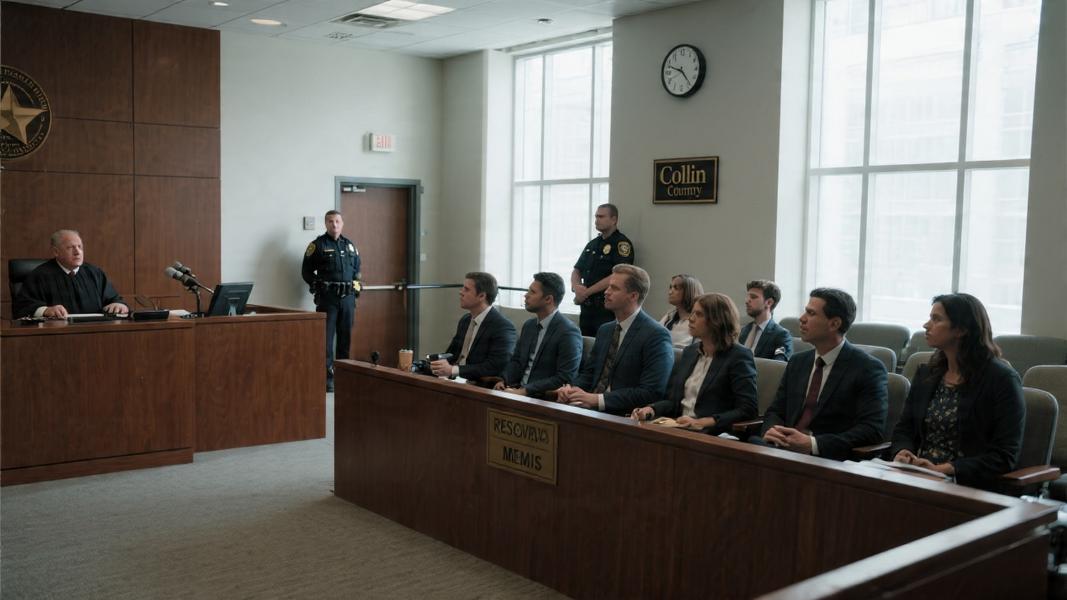
A Texas judge isn’t taking any chances. With one of the most closely watched murder trials in the state set to begin in just months, a Collin County court has moved swiftly to lock down everything from camera placement to courtroom conduct — and the rules are strict.
296th District Court Judge John Roach Jr. signed a sweeping order on Friday governing media access, courtroom security, and procedural conduct ahead of the trial of Karmelo Anthony, the teenager accused of fatally stabbing Austin Metcalf at a Frisco ISD track meet. The case has drawn intense national attention, and the judge clearly wants to make sure that pressure doesn’t bleed into the courtroom. Trial is scheduled to begin Monday, June 1, 2026, at 9:00 a.m.
Why the Tight Grip?
It’s not hard to understand the judge’s caution. In his order, Roach cited the intense public interest surrounding the case and the need to protect jurors, witnesses, and — critically — the defendant’s constitutional right to a fair proceeding. That last part matters. High-profile cases have a way of becoming spectacles, and the courts, whatever their pace, tend to know when they’re sitting on something combustible.
A county grand jury previously indicted Anthony — who was 17 at the time of the incident and is now 18 — on a charge of first-degree murder. He’s accused of stabbing 17-year-old Austin Metcalf during a Frisco ISD track event, a setting so ordinary that the violence still feels jarring in context. The indictment, as one source noted, formalized what had already become a deeply polarizing public conversation about race, youth, and self-defense in Texas.
The Self-Defense Question
That’s the crux of it, really. Anthony reportedly acknowledged the stabbing after being taken into custody — and then, according to reporting, asked officers whether the act might be considered self-defense. It’s a detail that defense attorneys are almost certainly building their strategy around, even if prosecutors appear confident it won’t hold up.
And the prosecution seems to believe it has the upper hand. One legal analyst framed the state’s position bluntly, suggesting the prosecution has “a very high prospect — almost to the level of legal certainty — of disproving every one of the required elements of self-defense beyond any reasonable doubt.” That’s a bold claim, but it tracks with the questions investigators have been raising publicly.
Still, self-defense in Texas isn’t always as clean as the law makes it sound. The key legal question, as one investigator put it, is whether Anthony had “a reasonable perception of an unlawful, imminent deadly force threat” from Metcalf. That’s the standard. And right now, the answer to that question — at least according to those scrutinizing the evidence — appears to be far from obvious in Anthony’s favor. “Where’s the deadly force threat?” one analyst asked pointedly, a question that’s likely to echo throughout the trial.
The Video and What It Shows
There is footage. Frisco ISD made a video of the fatal incident available for viewing, though under tight conditions — no recording allowed. It’s a controlled disclosure, the kind that signals the district is walking a careful line between transparency and what it doesn’t want viral on social media before a jury is even seated. Whether that footage ultimately becomes central evidence at trial remains to be seen, but its existence — and the restrictions around it — have only added to the public’s appetite for answers.
A Courtroom Under Wraps
Judge Roach’s order, meanwhile, puts a firm lid on how the press can operate. Media access is restricted, security protocols are elevated, and a strict gag order is in place — meaning the attorneys aren’t going to be doing much talking outside the courtroom walls between now and June. For a case that’s already been litigated extensively in the court of public opinion, that silence might be the loudest thing about it.
What’s unfolding here isn’t just a murder trial. It’s a test of whether Texas courts can keep proceedings grounded when the rest of the country has already picked sides. The judge seems to understand that. Whether the courtroom can hold that line is another question entirely.
