
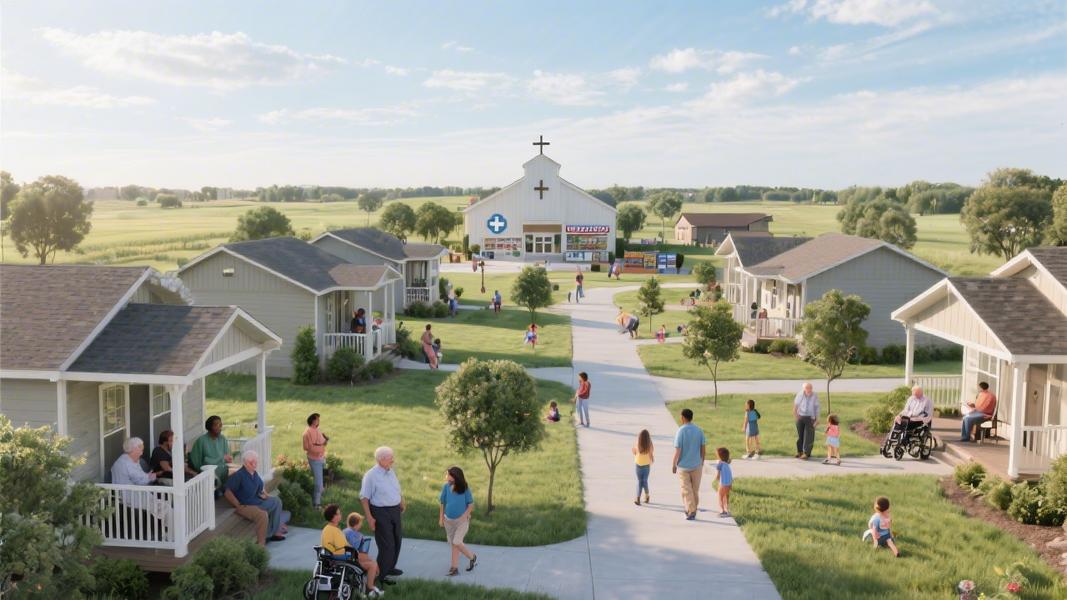
On 280 acres of Ellis County soil, something that rarely happens in the world of homelessness policy is actually happening: a permanent home is being built — and it’s almost ready.
OurCommunity, a sprawling development situated just outside Ferris, Texas, is designed to give elderly, disabled, and chronically homeless individuals something most of them haven’t had in years, or ever — a place to age with dignity. Phase I of the project, which includes 25 fully furnished tiny homes, is expected to be complete by late Fall 2025, funded entirely by $15 million in private donations. It’s a faith-driven, donor-backed bet that the answer to long-term homelessness isn’t a shelter bed — it’s a front door with a ramp and a key.
Holy Ground, Literally
Wayne Walker, the driving force behind OurCalling — the Dallas-based nonprofit behind the development — doesn’t talk about this project the way a developer talks about square footage. Standing on the site recently, he told visitors, said, “If I was a little bit more informal, I would tell you to take your shoes off. Because where you’re standing is holy ground. We’ve seen God do a miracle here.” That kind of language might raise eyebrows in a city council chamber. On this particular patch of North Texas prairie, it’s hard to argue with the sentiment.
The first 25 homes — each roughly 390 square feet, fully furnished, and equipped with wheelchair ramps — are modest by any measure. But for the people they’re designed to serve, modest is transformational. Phase One is specifically targeting homeless individuals with the most acute physical needs: those in wheelchairs, those with terminal conditions, and those whose cognitive or physical challenges have made traditional shelter systems a poor fit at best, a revolving door at worst. As Juliana Williams, OurCalling’s chief advancement officer, put it plainly: “This project is going to serve really our most vulnerable homeless neighbors.”
What Gets Built When the Money Comes In
Phase I is just the beginning — and when you look at the full vision, the scale becomes something else entirely. When fully developed, OurCommunity is slated to feature 500 tiny homes organized into clusters of 25, each neighborhood sharing communal gardens, pet parks, and a clubhouse. At the center of the development, a Community Service Building will anchor the whole operation, housing a chapel, a medical clinic, a café, a mental health clinic, counseling services, and 21 essential services in total. There will also be 24-hour security on site.
Of the 280 acres, only about 120 will be developed with buildings and infrastructure. The rest — trees, cattle, ponds — stays natural. It’s a detail that says something about the philosophy baked into this place: the goal isn’t density, it’s livability.
The total projected cost for the full build-out exceeds $70 million. Phase I’s $15 million has already been raised and committed through private donors. That’s no small thing — especially for a project that doesn’t rely on government funding to get off the ground.
Who It’s For — and Why That Matters
So who exactly is OurCommunity built for? The target population is residents of Dallas and Ellis Counties — elderly and disabled homeless individuals who, in the language of social services, are often described as having “nowhere appropriate to go.” They’re too medically complex for a standard shelter. Too old or too sick to work toward transitional housing. And, in far too many cases, left to cycle through emergency rooms and sidewalks until something breaks.
OurCommunity is designed to stop that cycle — not temporarily, but permanently. This isn’t transitional housing with a 90-day clock. It’s a place where residents can stay, age, and be cared for. That distinction alone separates it from the vast majority of homeless housing solutions currently operating in Texas.
Still, Questions Linger
Still, $70 million doesn’t raise itself, and 475 homes don’t get built on goodwill alone. The gap between Phase I’s 25 homes and the full 500-home vision is enormous — financially, logistically, and politically. OurCalling hasn’t announced a specific timeline for subsequent phases, and the road from groundbreaking to a fully realized community of this scope is rarely straight.
That said, the fact that 25 homes are nearly finished, fully funded, and ready to welcome residents before 2026 is itself a kind of proof of concept. In a policy landscape littered with proposals that never leave the whiteboard, OurCommunity has concrete poured and ramps installed.
Sometimes holy ground looks exactly like what it is: a foundation.
