
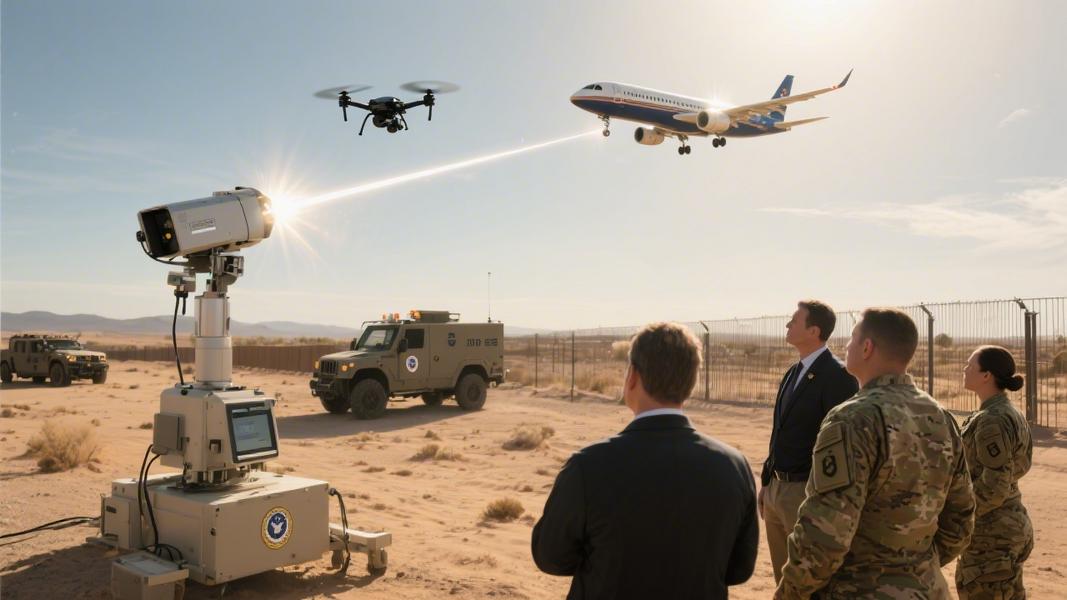
The U.S. military is now pointing lasers at drones along the southern border — and one of those lasers already took out a federal government drone by mistake. Washington is scrambling to make sure it doesn’t happen again.
In a landmark agreement signed April 10, 2026, the Federal Aviation Administration and the Department of War completed a formal safety assessment of a high-energy laser counter-drone system deployed near the U.S.-Mexico border, validating that proper safety controls are in place and that the system poses no undue risk to passenger aircraft. It sounds reassuring. But the agreement comes weeks after the Pentagon reportedly fired that very laser at a Customs and Border Protection drone — a friendly-fire incident that rattled federal agencies and briefly shut down Texas airspace.
A Laser, a Friendly Drone, and a Very Awkward Conversation
The incident unfolded in late February near Fort Hancock, Texas. The FAA issued a Temporary Flight Restriction on February 26, 2026, citing special security reasons amid ongoing counter-drone activities along the border. Then came word that the military’s high-energy laser system had struck a CBP drone operating within what the Pentagon considered its own airspace. The FAA quickly restricted the surrounding Texas airspace as officials worked to understand exactly what had happened.
It wasn’t a one-off. According to reporting at the time, the Fort Hancock firing was actually the second laser deployment in two weeks in the region. The scale of the drone threat the military is responding to is genuinely staggering — lawmakers noted that more than 27,000 drones were detected within 1,600 feet of the southern border over just one summer. That’s not a nuisance. That’s a full-scale airspace problem.
Who Actually Controls the Sky?
That’s the question nobody seems to have fully answered yet. The FAA is the nation’s primary authority over civilian airspace. The Department of Defense controls military airspace. CBP flies federal drones. And now the military is deploying directed-energy weapons in areas where all three overlap. The jurisdictional tangle is real, and the February incident exposed just how badly the agencies needed a formal framework — fast.
That’s precisely what the new FAA-DOW agreement is meant to address. The safety assessment reportedly verified that the laser system includes adequate controls to prevent interference with commercial aviation. Still, critics will note that the agreement arrived after a government drone had already been shot down — not exactly the sequence you’d draw up in a planning meeting.
A Darker Backdrop
None of this is happening in a vacuum. The FAA is simultaneously dealing with one of the most sobering aviation disasters in recent memory. Earlier this year, the agency tightened safety rules for helicopters and planes operating in congested airspace around major airports — a direct response to the collision between a U.S. Army Black Hawk helicopter and an American Airlines jet that killed 67 people. The FAA suspended visual separation procedures between helicopters and commercial aircraft in the wake of that crash.
The juxtaposition is uncomfortable. An agency still absorbing the lessons of a deadly mid-air collision is now also being asked to co-sign a framework for military laser systems firing in active airspace. The agency’s plate, to put it mildly, is full.
What the Agreement Actually Does
Details of the safety accord remain limited. The FAA’s website confirmed the April 10 announcement and characterized it as a landmark step toward protecting the southern border while maintaining aviation safety standards. The assessment reportedly confirmed no undue risk to passenger aircraft — though the language is careful, bureaucratic, and notably short on specifics about what happens if a commercial pilot suddenly finds a high-energy laser in their flight path.
But it’s not that simple to dismiss. The drone threat along the border is real, documented, and growing. The military needed a legal and operational framework to act. The FAA needed assurances that commercial aviation wouldn’t be caught in the crossfire. On paper, both agencies got what they needed. Whether the agreement holds up the next time a laser fires and something unexpected is in the way — that’s the part nobody’s quite ready to guarantee.
Somewhere over southern Texas, the sky is simultaneously a border security battleground, a federal airspace jurisdiction dispute, and a commercial flight corridor. Welcome to 2026.
