
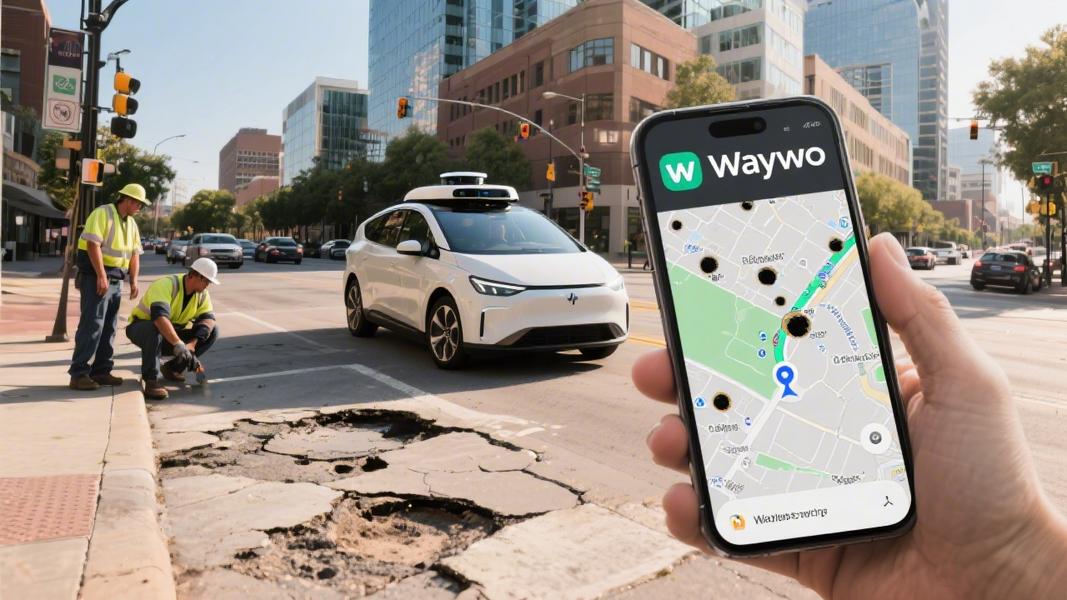
Waymo’s self-driving cars have a new side hustle: hunting potholes. The robotaxi company announced a partnership with navigation giant Waze to share road damage data detected by its vehicles’ onboard systems — and funnel that information directly to city and state transportation departments before the next car loses a tire.
The program, which launched this month, uses Waymo’s existing perception and physical feedback systems to identify potholes in real time. That data flows through the Waze for Cities platform, where municipal officials can access it — and where ordinary Waze users can view and verify reported damage for accuracy. It’s citizen science, essentially, but with a fleet of autonomous vehicles doing the heavy lifting.
Five Cities, One Big Idea
The pilot kicks off in Austin, San Francisco, Los Angeles, Phoenix, and Atlanta, with expansion to more markets planned. Already, Waymo’s vehicles have flagged roughly 500 potholes in the San Francisco Bay Area alone — a figure that hints at just how much road damage slips through the cracks of traditional inspection methods. Manual surveys and citizen reports, Waymo argues, paint an incomplete picture. A car that drives the same streets hundreds of times a week? That’s a different kind of data collection entirely.
“Waymo is already making roads safer where we operate,” said Arielle Fleisher, Policy Development and Research Manager at Waymo. “We want to build on the safety benefits of our service by partnering with organizations and city officials to help improve the infrastructure we all depend on.”
Transportation researchers seem genuinely encouraged. Sarah Kaufman, director of the NYU Rudin Center for Transportation, put it plainly: “Waymo is showing the good neighbor principle in action — sharing data that helps cities fix problems faster and make streets safer for everyone.” That’s a notable endorsement from a corner of academia that doesn’t always cheer for Silicon Valley’s urban ambitions.
Not Everywhere. Not Yet.
That said, not every Waymo city makes the cut — at least not immediately. Waymo now operates across 10 U.S. metro areas, including a February 2026 expansion into North Texas covering Dallas-Fort Worth, Houston, and San Antonio. But Dallas-Fort Worth isn’t part of the initial pothole pilot, even as the company has been vocal about its broader Texas ambitions.
At an earlier announcement, Waymo co-CEO Tekedra Mawakana pointed to Texas and Florida as linchpins of the company’s long-range strategy. “Dallas, Houston, San Antonio, and Orlando are critical to our plans, as we lay groundwork for service in 20+ cities,” she said. “Each community has its own unique charm and transportation needs, and we’re eager to provide a safe, reliable, and magical way for locals and visitors to travel.” Whether pothole detection follows close behind that expansion remains to be seen.
A Fleet That Pays Attention
So what makes Waymo’s approach different from, say, a 311 app? Scale, mostly — and consistency. A human driver notices a pothole once, maybe reports it, maybe doesn’t. Waymo’s vehicles traverse the same corridors repeatedly, building a kind of rolling audit of road conditions that no inspection crew could realistically replicate. The perception systems originally designed to keep passengers safe are now, in a sense, doing double duty as infrastructure surveyors.
It’s a clever reframing of the data these vehicles generate constantly anyway. Every sensor reading, every bump logged — none of that has to stay siloed inside a company’s internal systems. Routing it to public agencies costs Waymo relatively little. The goodwill it generates? Probably worth quite a bit more, especially as the company pushes into new markets where regulators and city councils still hold the keys.
Whether cities can actually act on the data fast enough to matter is a separate question entirely — one that depends far less on Waymo’s technology than on municipal budgets, road crews, and the slow machinery of local government. The robots can find the potholes. Filling them is still very much a human problem.
