
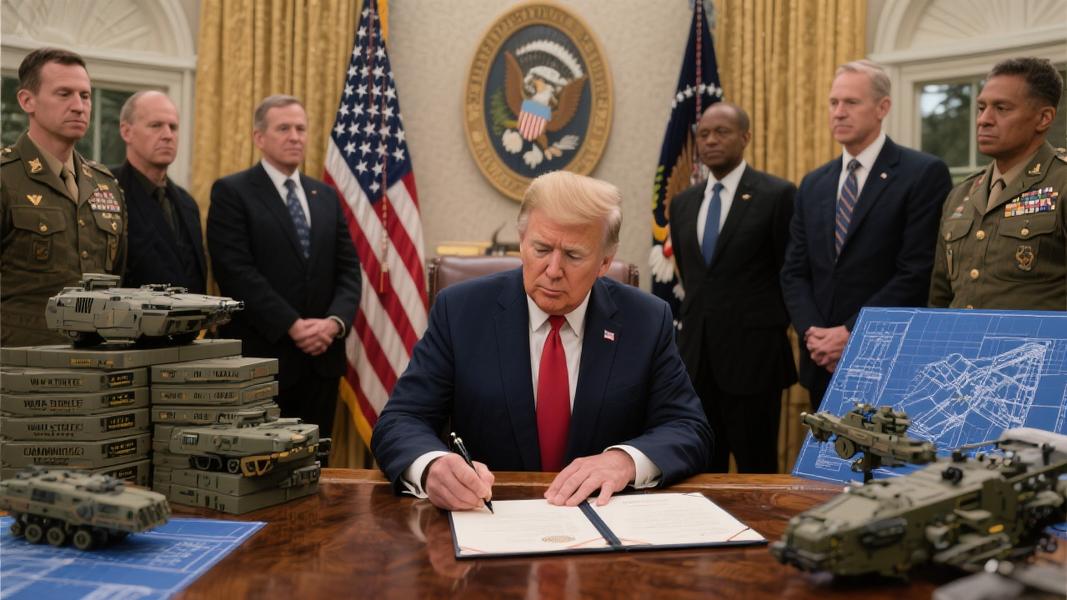
In a dramatic shift for America’s global arms strategy, President Donald Trump has signed an executive order establishing what the administration is calling an “America First Arms Transfer Strategy,” leveraging the nation’s massive defense export industry to rebuild domestic manufacturing while strategic nuclear limitations with Russia have simultaneously expired for the first time in over five decades.
A New Era for U.S. Defense Policy
The executive order, signed on February 6, 2026, aims to transform how the United States approaches weapons sales abroad by explicitly tying foreign arms purchases to the expansion of American industrial capacity. The strategy establishes a framework that prioritizes U.S. economic interests alongside traditional security considerations.
“This isn’t just about selling weapons anymore,” a senior defense official told reporters on condition of anonymity. “It’s about rebuilding American manufacturing might through our defense relationships.”
The timing couldn’t be more significant. Just two days earlier, the New START treaty between the United States and Russia expired, removing caps on strategic nuclear weapons for both nations. This marks the first time since 1972 that the two nuclear superpowers have operated without formal limitations on their strategic arsenals, which had previously been capped at 1,550 warheads and 700 deployed launchers per side.
According to White House documents, the new arms transfer strategy will leverage over $300 billion in annual defense sales to “reindustrialize the United States” while delivering weapons systems to partners intended to bolster deterrence capabilities against shared adversaries.
Burden-Sharing and Industrial Rebuilding
The arms strategy aligns closely with the administration’s broader 2026 National Defense Strategy, which defense analysts have characterized as a significant departure from previous approaches. The NDS prioritizes four key elements: defending the U.S. homeland, deterring Chinese aggression, increasing burden-sharing with allies, and dramatically expanding the defense industrial base.
What exactly does “burden-sharing” mean in practice? Essentially, the administration is pushing allies to take on more responsibility for their own defense while simultaneously making them more dependent on American weapons systems. Defense industry observers note that the strategy emphasizes re-shoring critical industries to enable scaled-up production of everything from ammunition to advanced fighter jets.
This recalibration of U.S. defense priorities comes as nuclear arms control faces an uncertain future. The New START treaty’s expiration on February 4 has created what arms control experts call a “verification vacuum” where neither side has formal inspection rights to monitor the other’s nuclear forces.
Global Trade Implications
Beyond weapons sales, the administration’s broader international trade approach appears to be shifting as well. Earlier this month, President Trump indicated that a forthcoming U.S.-India trade deal would include reduced aspects related to international trade, suggesting a continued preference for bilateral arrangements over multilateral frameworks.
Critics worry that tying arms sales so explicitly to domestic economic interests could undermine traditional security considerations. “There’s always been an economic component to defense sales, but making it this explicit raises questions about whether we’ll be selling to the right partners for the right reasons,” said a former Pentagon official who requested anonymity to speak candidly.
Supporters counter that the strategy simply acknowledges what has long been true: defense sales are as much about economics as security.
As global tensions rise and traditional arms control frameworks collapse, the administration’s gamble on an “America First” approach to weapons sales will test whether economic priorities and security imperatives can be successfully balanced in an increasingly unstable world.
