
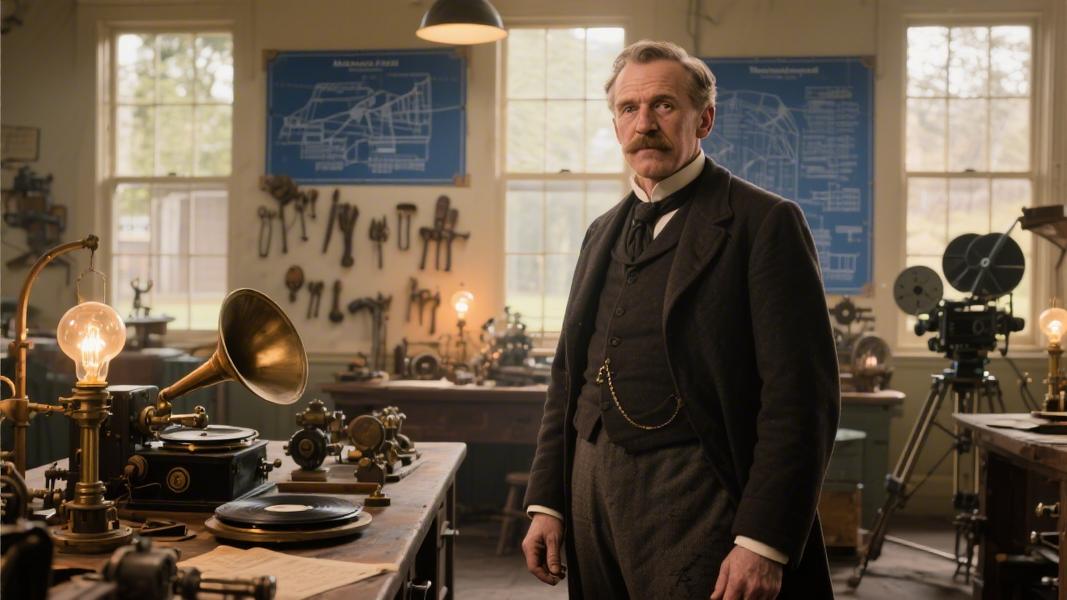
Thomas Edison’s legacy of innovation continues to power American ingenuity more than a century after his most groundbreaking discoveries. The inventor, who held a staggering 1,093 U.S. patents in his lifetime, transformed modern life through creations that range from the incandescent light bulb to the motion picture camera.
“I never did anything worth doing entirely by accident and none of my inventions came about totally by accident. They came about by hard work,” Edison once remarked, capturing the essence of his methodical approach to innovation.
America’s Greatest Inventor
Born in 1847 in Milan, Ohio, Edison’s early life gave little indication of his future impact. Largely self-educated after just three months of formal schooling, he developed a voracious appetite for knowledge through independent reading and experimentation. This autodidactic approach would later define his career as America’s most prolific inventor.
Edison’s breakthroughs weren’t merely technological achievements—they fundamentally altered how Americans lived. The phonograph, which he developed in 1877, was the first device to both record and reproduce sound. “To invent, you need a good imagination and a pile of junk,” he reportedly said, demonstrating his practical approach to innovation.
What separated Edison from other inventors of his era? Perhaps it was his unique combination of scientific curiosity and business acumen. His Menlo Park laboratory—America’s first industrial research facility—employed dozens of researchers working collaboratively on various projects, pioneering the modern corporate research and development model still used by tech giants today.
Perseverance Through Failure
The road to Edison’s successes was paved with countless failures. His development of the practical incandescent light bulb reportedly required testing more than 6,000 plant materials before finding suitable filament material. Rather than viewing these as setbacks, Edison famously embraced each unsuccessful attempt as progress.
“The three great essentials to achieve anything worthwhile are: hard work, stick-to-itiveness, and common sense,” Edison observed. This philosophy of persistent experimentation became the foundation of his approach to innovation.
Beyond lighting homes, Edison’s influence extended to communications, entertainment, and industrial processes. His work on storage batteries proved particularly consequential, laying groundwork for technologies that would eventually power everything from cars to portable electronics.
Edison’s Enduring Influence
Could Edison have imagined how his inventions would evolve? The phonograph eventually gave way to streaming music services, while his early motion picture experiments blossomed into a global entertainment industry worth billions.
His approach to innovation—combining methodical experimentation with practical application—continues to inspire entrepreneurs and inventors. “Many of life’s failures are people who did not realize how close they were to success when they gave up,” he once noted, a sentiment that resonates with modern startup culture.
Edison’s legacy extends beyond specific inventions to encompass a distinctly American approach to innovation: pragmatic, persistent, and ultimately transformative. In today’s rapidly evolving technological landscape, his example of turning scientific discovery into practical applications that improve everyday life remains as relevant as ever.
