
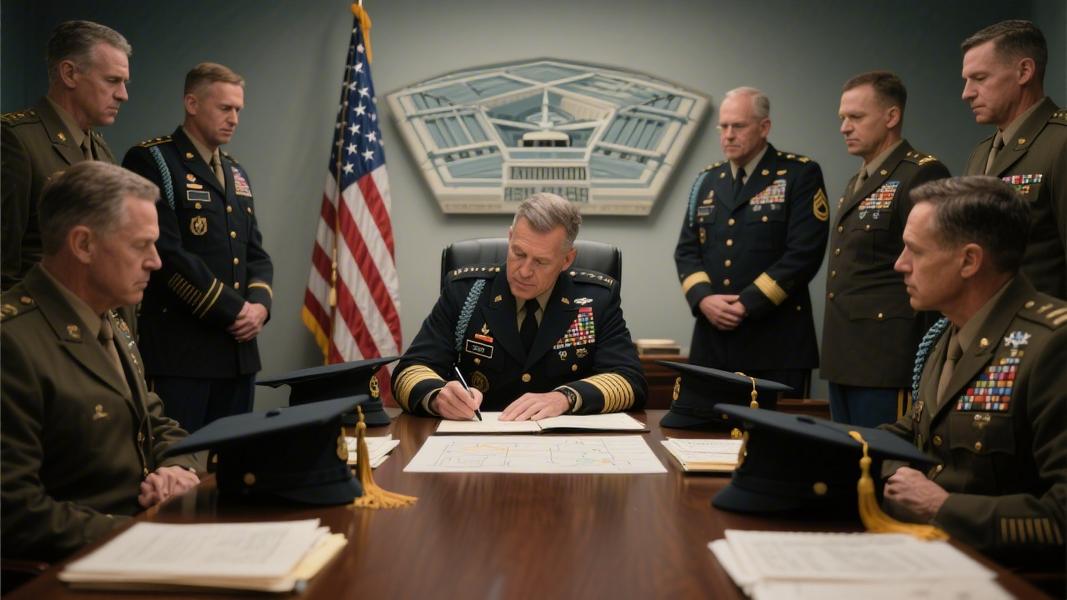
The Pentagon is reshaping where America’s military officers go to school — and some of the country’s most prestigious universities are no longer on the approved list.
In a sweeping series of directives issued in early 2026, the Department of Defense moved to sever or restrict longstanding educational ties with Harvard University and several other elite institutions, while simultaneously inserting itself into a state-level governance dispute over the Virginia Military Institute. Taken together, the moves signal a broader effort by Pentagon leadership to realign military education with what officials are calling “American values” — a phrase that’s doing a lot of heavy lifting these days.
Harvard First, But Not Harvard Only
On February 27, 2026, the Secretary of War signed a memorandum titled “Aligning Senior Service College Opportunities with American Values,” directing the department to discontinue selected graduate-level Professional Military Education fellowships and certificate programs at Harvard — along with a broader set of legacy Senior Service College fellowships — beginning with the 2026–2027 academic year. The move was announced by chief Pentagon spokesman Sean Parnell, who framed it as a matter of institutional integrity.
But it’s not just Harvard. The Pentagon is barring troops from attending a wider range of Ivy League schools and other top-tier universities as part of the fellowship discontinuations. The scope is broader than initial reports suggested, raising questions about which institutions — if any — in that academic tier will remain accessible to officers seeking advanced civilian education on the government’s dime.
That’s the catch. For decades, these fellowships were considered a mark of distinction — a way to expose senior military officers to diverse intellectual environments and build bridges between the armed forces and civilian academia. Now, the Pentagon seems to view at least some of those bridges as liabilities.
A Fight Over VMI’s Future
Meanwhile, roughly 300 miles south of the Pentagon, a separate but thematically connected battle is unfolding in Virginia’s state legislature. Virginia House Bill 1374 proposes dissolving the VMI Board of Visitors and transferring governance of the storied military institute to Virginia State University. For most observers, this would read as a state-level governance dispute. The Pentagon is not treating it that way.
Parnell issued a stark warning, saying the department “reserves the right to take extraordinary measures to protect the integrity” of VMI. He didn’t specify what those measures might look like. He didn’t need to. The implication was clear enough.
The department’s position is that VMI is a “vital source of commissioned officers for the Armed Forces,” and that its “proven leadership pipeline” makes any proposed restructuring a matter of “direct national security interest” — a framing that, depending on your perspective, is either a principled defense of a critical institution or a federal overreach into state governance. Probably worth watching how Virginia’s legislature responds.
Merit, Admissions, and a New Baseline
Separate from the fellowship fight, the Secretary of Defense has directed all Military Departments to certify that Military Service Academy admissions are — quote — race-, ethnicity-, and sex-blind, based exclusively on merit, starting with the 2026 admissions cycle. The directive applies going forward and leaves little ambiguity about the administration’s intent to restructure how the next generation of officers is selected.
Still, the practical details of implementation remain murky. What counts as merit? Who certifies compliance, and what happens if they don’t? Those questions don’t yet have public answers.
The Bigger Picture
Zoom out, and a pattern emerges. Whether it’s pulling fellowships from elite universities, threatening intervention in a state school’s governance, or mandating identity-blind admissions at the academies, the Pentagon under current leadership is actively redrawing the boundaries of military education — who gets it, where, and on whose terms.
Whether that amounts to a long-overdue correction or a politically motivated purge of institutions the administration finds ideologically inconvenient is, for now, in the eye of the beholder. But the pace of these moves suggests the department isn’t waiting around for a consensus to form.
After all, it’s a lot easier to discontinue a fellowship than it is to rebuild one.
