
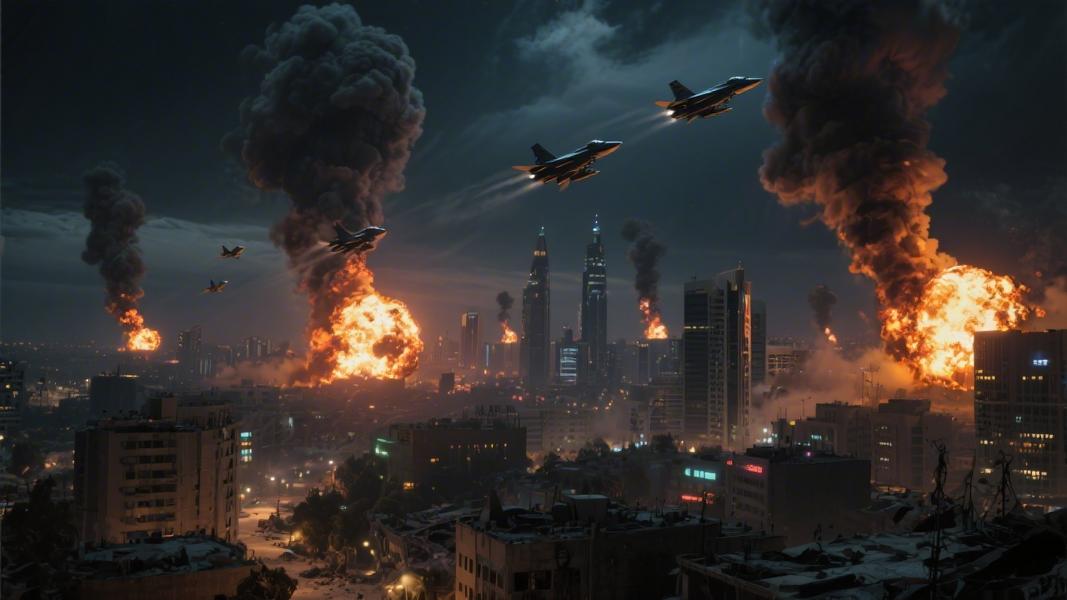
The United States and Israel struck Iran on Saturday — hard, and apparently without much hesitation. What began as months of escalating diplomatic brinkmanship ended, at least in its opening chapter, with missiles over Tehran.
In the early hours of February 28, 2026, American and Israeli forces launched coordinated military strikes against multiple sites across Iran, hitting Tehran, Isfahan, Qom, Karaj, and Kermanshah in a sweeping offensive that officials on both sides had codenamed — with characteristic flair — “Operation Epic Fury” for the U.S. and “Roaring Lion” for Israel. The assault employed a combination of missiles, drones, and fighter jets, according to reports detailing the operation’s scope. It is, by any measure, one of the most consequential military actions in the Middle East in decades.
What Washington Says It Wants
President Donald Trump formally declared the commencement of operations, framing the campaign around a cluster of stated objectives: blocking Iran from ever acquiring nuclear capabilities, dismantling its ballistic missile program, neutralizing Iranian naval forces, and — broadly — safeguarding what the administration describes as core U.S. national interests. That’s a wide mandate. Critics would say dangerously wide. But the White House, at least publicly, appears confident in both the mission and the moment, as documented in early assessments of the strikes.
Still, the military objectives — however ambitious — aren’t even the most striking part of this story. Buried beneath the language of nonproliferation and regional security is something far more blunt: the stated goal of regime change in Tehran. That’s not a whispered subtext. It’s official policy now, a dramatic shift from the careful hedging that has characterized U.S. Iran strategy for the better part of thirty years.
A Message to the Iranian People
How do you tell an entire nation that its government is the target, not its people? Apparently, like this. Trump addressed Iranians directly, saying the country “will be yours to take,” and adding — with a sense of finality that few heads of state would dare deploy so openly — “This will be probably your only chance for generations.” That quote, analyzed by foreign policy experts in the hours after the strikes began, landed like a thunderclap. It’s the kind of statement that doesn’t leave much room for diplomatic backpedaling.
Whether Iranians interpret that as liberation or provocation — or both — remains an open and urgent question. The Islamic Republic has survived sanctions, assassinations, internal protests, and proxy wars. It has, in other words, seen pressure before. But not quite like this. A simultaneous American and Israeli air campaign striking the capital and several major cities is a different category of event entirely.
The Broader Stakes
The regional implications are difficult to overstate. Iran’s network of allied militias — spread across Iraq, Syria, Lebanon, and Yemen — now faces a moment of reckoning. Do they retaliate? How? Against whom? The answers to those questions will shape the next phase of this conflict as much as anything that happened on February 28th. And make no mistake: there will be a next phase.
That’s the catch. Military strikes, even highly successful ones, rarely end the story. They tend to start a new chapter — often messier than the one before. The Trump administration is betting that the sheer scale of Operation Epic Fury changes the calculus inside Iran so fundamentally that the regime either falls or capitulates. It’s a high-stakes wager, and the entire Middle East is the table.
For now, the bombs have spoken. The question is what answers come back.
