
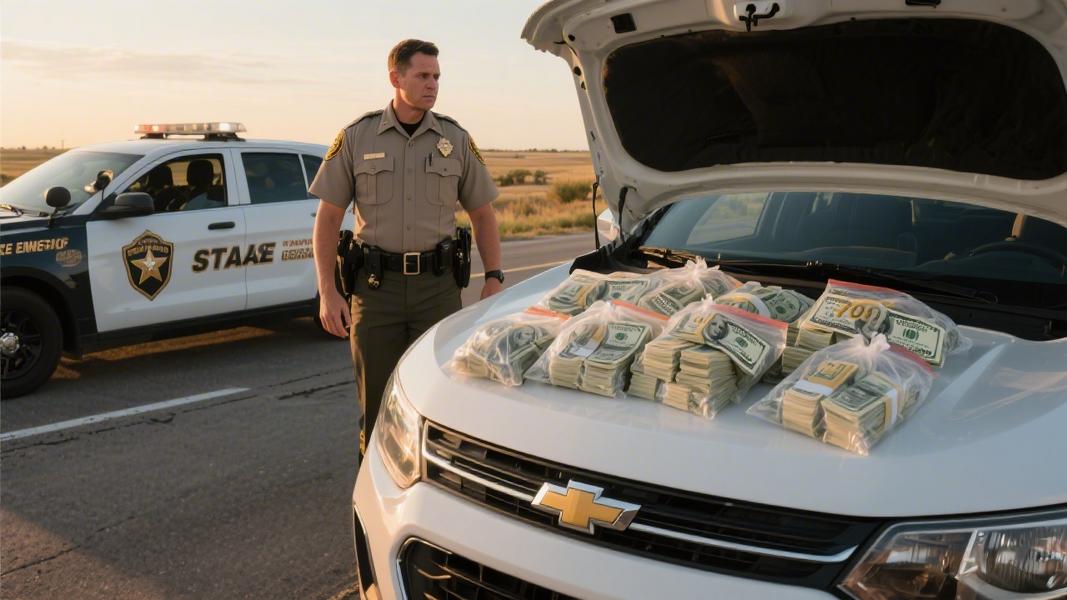
Tens of millions of dollars in drugs and hundreds of thousands in hidden cash. That’s what federal and state law enforcement have been pulling out of South Texas — and it isn’t slowing down.
Along the Rio Grande Valley corridor, a stretch of highway and international bridge crossings that connects the United States to Mexico, authorities have recorded a string of significant seizures that paint a stark picture of the contraband pipeline running through Hidalgo County. Cash stuffed into car panels. Cocaine buried inside tractor trailers. Currency smuggled out in five separate packages at once. The sheer variety of methods tells you something: this isn’t amateur hour.
Cash on the Move
In June 2021, a Texas Highway Patrol Trooper working Operation Lone Star pulled over a vehicle on IH-69C in Edinburg. A K-9 unit alerted on the car — and what followed was the discovery of $147,490 in cash. The Texas Department of Public Safety confirmed the stop, noting it was part of the state’s broader border security initiative. It’s the kind of seizure that barely makes a dent in the larger flow — but it’s a reminder that the money has to move somehow, and it usually moves by road.
Then there’s what happened at Hidalgo International Bridge, where U.S. Customs and Border Protection officers conducting an outbound examination found $79,392 in unreported currency concealed inside a vehicle — split across five separate packages, as if someone had done the math and figured smaller bundles were harder to spot. They weren’t. CBP announced the September seizure without much fanfare, but the details matter.
Here’s the thing people often get wrong: carrying large amounts of cash across the border isn’t inherently illegal. But there’s a catch — and it’s a federal one. As customs law experts have noted, “It is not a crime to carry more than $10,000, but it is a federal offense not to declare currency or monetary instruments totaling $10,000 or more to a CBP officer upon entry or exit from the U.S. or to conceal it with intent to evade reporting requirements.” That distinction — declare it or lose it — is one that smugglers keep betting they can avoid. They keep losing that bet.
The Drugs Tell a Different Story
How bad is the narcotics side of this? Consider Easter Sunday. While most of South Texas was otherwise occupied, CBP officers at Hidalgo International Bridge were pulling apart a vehicle and finding 24 packages of alleged cocaine weighing 63.80 pounds — valued at roughly $850,000. The holiday timing was either bold or oblivious. Possibly both. Texas Border Business detailed the discovery, which came after a physical inspection of the vehicle turned up the concealed bundles.
Still, even that pales against what officers found at the Pharr cargo lot on October 11, during a secondary inspection of a tractor trailer at the Hidalgo Port of Entry. Nearly 300 pounds of alleged cocaine — packed into 119 separate packages — with an estimated street value of $4,003,296. Four million dollars. Hidden inside a commercial conveyance that, on any other day, might have rolled right through. The report on the bust underscored just how much product can move inside a single truck — and how much depends on inspectors catching what they’re not supposed to see.
A Corridor Under Pressure
What emerges from these cases, taken together, isn’t a surprise — but it’s a number worth sitting with. In just a handful of documented incidents, law enforcement in and around Hidalgo County intercepted nearly $5 million in narcotics and more than $226,000 in suspicious currency. And that’s only what got caught.
The Rio Grande Valley has long been one of the busiest and most scrutinized stretches of the southern border. Federal agents, state troopers, and local officers operate in overlapping jurisdictions, running operations like Lone Star alongside CBP’s own inspection protocols. The infrastructure is real. So is the pressure on both sides of it.
Smugglers keep adapting — smaller packages, commercial vehicles, holiday travel windows. Law enforcement keeps adjusting. It’s a slow, expensive, and occasionally lethal game of catch, played out in traffic stops and secondary inspection lanes, one K-9 alert at a time. And if the seizures say anything at all, it’s this: the pipeline is still open, and somebody out there is still betting it’ll stay that way.
