
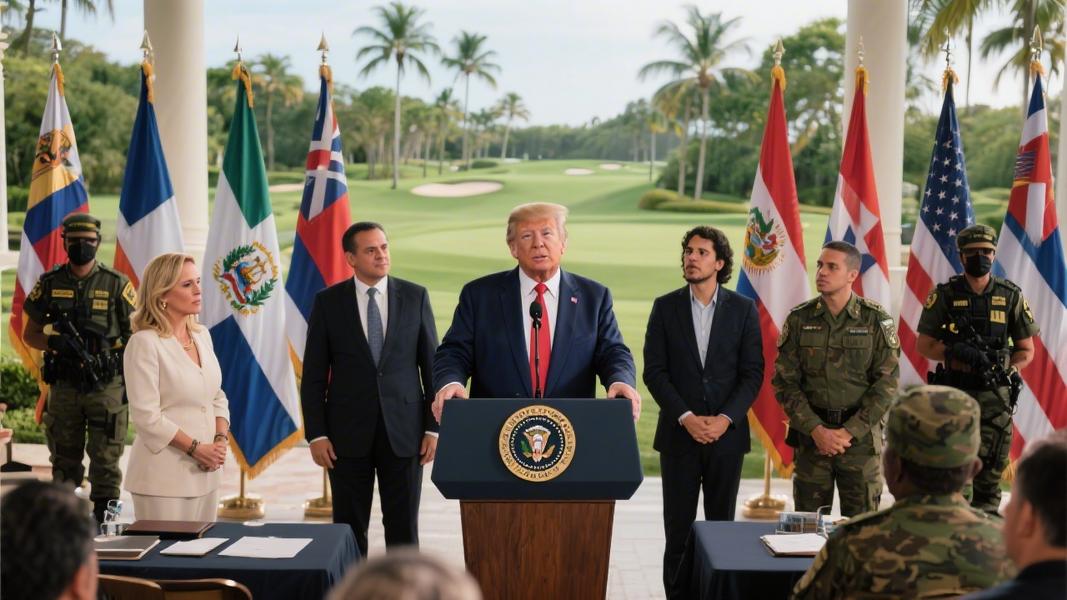
President Trump gathered more than a dozen Latin American leaders at his Doral, Florida golf resort Saturday for a security summit that’s part diplomatic offensive, part ideological statement — and, critics say, part spectacle.
The Shield of the Americas summit, held March 7, 2026, at Trump National Doral in Miami, brings together pro-Washington governments across the Western Hemisphere to confront drug cartels, criminal trafficking networks, illegal migration, and what the administration describes as dangerous foreign interference in the region. It’s the most ambitious multilateral security push Trump has launched in his second term — and a clear signal that his administration views Latin America as a frontline in a broader geopolitical contest, particularly against China.
A New Coalition — With Conspicuous Absences
Leaders from Argentina, Bolivia, Chile, Costa Rica, the Dominican Republic, Ecuador, El Salvador, Guyana, Honduras, Panama, Paraguay, and Trinidad and Tobago attended the summit. That’s a notable list. But so is who didn’t show up: Brazil, Mexico, Colombia, and Cuba were all absent — a gap that underscores the limits of Washington’s current reach across a politically divided hemisphere.
The State Department framed the initiative in sweeping terms. “The United States will welcome our strongest likeminded allies in our hemisphere to promote freedom, security, and prosperity in our region,” the department stated. “This historic coalition of nations will work together to advance strategies that stop foreign interference in our hemisphere, criminal and narco-terrorist gangs and cartels, and illegal and mass immigration.” Secretary of State Marco Rubio co-hosted the event alongside Trump.
The summit effectively replaces a long-postponed Summit of the Americas, analysts note, reframing Trump’s Latin America agenda around security coalitions rather than traditional hemispheric diplomacy.
Trump’s Message: Unleash the Militaries
Trump didn’t mince words about what he thinks it’ll take. “The only way to defeat these enemies is by unleashing the power of our militaries,” he told the assembled leaders. “We have to use our military. You have to use your military.” It was a blunt call to action — and a preview of the administration’s posture heading into what it clearly sees as an escalating regional conflict with organized crime.
Defense Secretary Pete Hegseth had set the tone just days earlier. Speaking at the Americas Counter Cartel Conference at U.S. Southern Command on Thursday, Hegseth urged Latin American governments to take a far more aggressive approach against drug cartels — with a pointed warning attached. If they don’t, the Trump administration would be compelled to act on its own. He invoked the Monroe Doctrine explicitly, signaling a return to hemispheric defense postures not commonly heard since the Cold War.
Noem Out at DHS, Into a New Role
Then came the personnel news that nobody quite saw coming — or maybe they did. Hours before the summit, Trump announced that Kristi Noem would be leaving her post as Secretary of Homeland Security and transitioning to a newly created position: Special Envoy for the Shield of the Americas.
“The current Secretary, Kristi Noem, who has served us well, and has had numerous and spectacular results (especially on the Border!), will be moving to be Special Envoy for The Shield of the Americas,” Trump announced. “I thank Kristi for her service at ‘Homeland.'”
Noem, for her part, embraced the reassignment enthusiastically. In a statement, she thanked Trump and praised Rubio and Hegseth as “incredible leaders,” adding that she looks forward to working with them “to dismantle cartels that have poured drugs into our nation and killed our children and grandchildren.” She rattled off a long list of what she called historic DHS accomplishments: “the MOST secure border in American history, 3 million illegal aliens have left the U.S., we have located 145,000 children, FEMA delivered disaster relief at a 100% faster rate, we ushered in the golden age of travel, saved the American taxpayer $13 billion and revitalized the U.S. Coast Guard.” Whether those claims hold up to independent scrutiny is a separate matter — but the messaging was unmistakably triumphant.
Counter-China Strategy, Dressed in Security Language
Underneath the cartel-fighting rhetoric, there’s a harder geopolitical edge. The summit builds directly on the administration’s 2025 National Security Strategy, and analysts at the Center for Strategic and International Studies describe it as a deliberate effort to construct a robust counter-China architecture across the Western Hemisphere. Choosing Doral — a resort that doubles as a statement of brand and power — as the venue rather than a traditional diplomatic setting isn’t lost on anyone watching.
Critics aren’t buying the framing. Jake Johnston, director of international research at the Center for Economic and Policy Research, called the gathering something closer to theater. “This summit is … an opportunity for Trump to play out a moment of imperial fantasy in front of fans in South Florida,” Johnston told Democracy Now. He and others point to what they’re calling a “Donroe Doctrine” — a portmanteau of Donald Trump and the Monroe Doctrine — suggesting the administration is asserting levels of U.S. interventionism in the region not seen since the Reagan era.
That’s the tension at the heart of this summit. Is it a genuine multilateral security initiative, built on shared interests and mutual threat assessments? Or is it a curated audience of ideologically aligned governments gathered to validate an American agenda that was going to happen with or without them?
Probably some of both. That’s usually how these things work.
Still, the stakes are real. Cartels are devastating communities on both sides of the border. China’s economic and political footprint in Latin America is expanding. And the absence of Mexico, Brazil, and Colombia — three of the most consequential countries in any serious hemispheric security strategy — is a structural problem no summit at a golf resort can paper over, no matter how many flags line the stage.
As Noem heads into her new envoy role, the real test won’t be the speeches at Doral. It’ll be whether the coalition assembled there can hold together once the cameras leave — and whether the countries that didn’t show up ever decide they have a reason to.
