
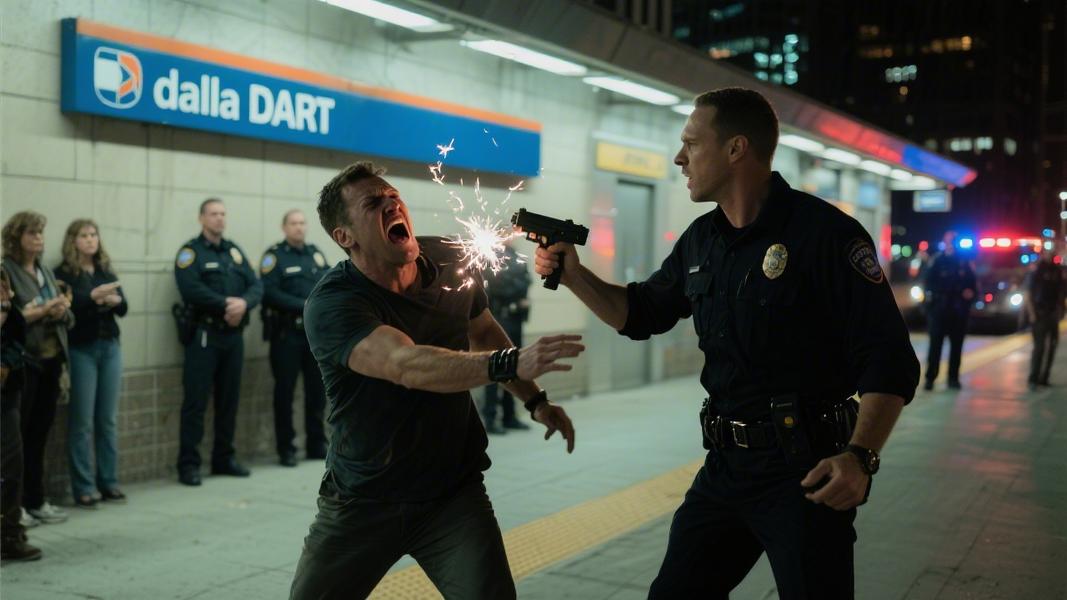
A routine Tuesday afternoon on Dallas’s public transit system turned anything but routine when a fellow passenger pulled out a stun gun — and the man on the receiving end turned out to be carrying PCP.
Stacey Bell, 52, was arrested on March 4, 2026, at the West End DART Station in downtown Dallas after another rider deployed a personal taser against him in what authorities later confirmed was an act of self-defense. Bell was subsequently charged with narcotics possession — and the passenger who zapped him won’t face so much as a citation.
It’s the kind of story that cuts through the noise. A crowded transit station, an erratic man, a passenger forced to make a split-second decision, and a drug arrest that peeled back a long criminal history. But the incident also lands in the middle of a much bigger conversation about safety on Dallas’s rail and bus network — one that’s threatening to pull the entire system apart.
What Happened on the Platform
Witnesses say Bell wasn’t exactly blending in. Marquinn Hollins, who was at the station when the confrontation unfolded, described the scene to a local reporter: “He was kind of like dancing, walking down the street. So I knew he had to be on something.” Bell later admitted to smoking PCP, and officers with the Dallas Area Rapid Transit Police didn’t have to look far — they found PCP on him at the scene.
The passenger who used the stun gun cooperated fully with investigators. DART Police reviewed the circumstances and determined the use of force was justified. No charges were filed against the rider. That’s not always how these calls go, and it’s worth noting: the system worked, at least in that narrow sense.
Bell, meanwhile, isn’t walking free anytime soon. He’s being held without bond on a probation violation tied to a prior charge of terroristic threat against a family or household member. And that prior charge is far from the only one. Court records show Bell has accumulated 13 criminal cases in Dallas County dating back to 1995 — a track record that raises its own uncomfortable questions about what, if anything, interrupted that pattern along the way.
DART’s Safety Numbers: Progress, With an Asterisk
How bad is it, really? That depends on which numbers you’re reading — and how charitably you read them.
DART has been pushing back hard against the perception that its system is a haven for crime. The agency highlighted figures showing crimes against persons down 39% year over year, and property crimes down 22%. In 2023, the agency brought on 100 new security officers and has since grown its police force by 250 officers. Those aren’t trivial investments.
Still, there’s a catch buried in the data. Crimes against society — think drug offenses, disorderly conduct, the kind of low-level disorder that makes riders feel unsafe even when they’re technically not in danger — are up 48%. DART attributes that spike to a zero-tolerance enforcement policy, arguing that more arrests reflect more policing, not more crime. It’s a reasonable explanation. It’s also exactly what every transit agency says when the numbers look complicated.
A System Under Political Pressure
The Bell incident doesn’t exist in a vacuum. DART is fighting on multiple fronts right now, and the political ground is shifting fast beneath it.
Several member cities have been weighing whether to cut ties with the regional transit authority altogether. Plano and Farmers Branch pulled back from withdrawal elections — for now. But Addison, University Park, and Highland Park are still moving forward with votes scheduled for May. Dallas, clearly alarmed by the prospect of a fractured regional system, has endorsed new governance reforms in an effort to keep those cities at the table.
Whether a restructured board and better crime statistics are enough to change minds in Highland Park is, to put it gently, uncertain. These aren’t cities that rely heavily on light rail. Their residents largely drive. The calculus for staying in DART is different — and the patience for incidents like the one at West End Station is thinner.
The Bigger Picture
Stacey Bell will likely become a footnote — one arrest in a system that handles millions of trips a year. But incidents like this have a way of sticking in the public imagination long after the statistics are updated. A man high on PCP, dancing on a platform, getting tased by a fellow rider. It’s visceral in a way that a 39% crime reduction figure simply isn’t.
DART is doing more than it was. The numbers, mostly, back that up. But in the court of public opinion — and apparently in the council chambers of at least three member cities — the work isn’t done. And on a Wednesday morning at West End Station, one passenger decided they weren’t going to wait around for the institution to catch up.
Sometimes the most revealing thing about a system isn’t the policy. It’s who’s left to enforce it when no one official is watching.
