
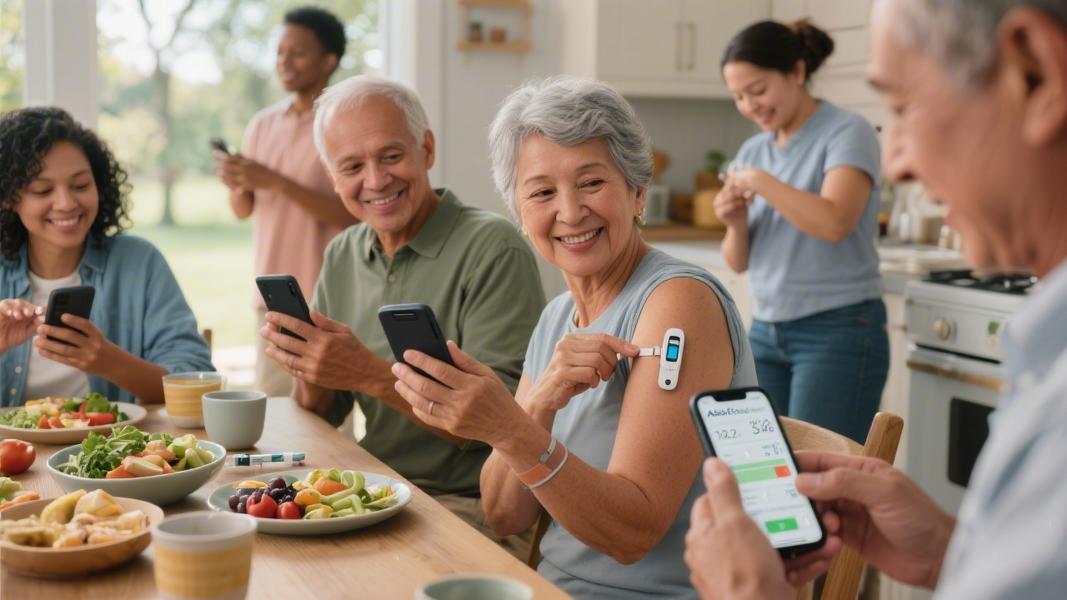
A small sensor worn on the arm is quietly reshaping how millions of people manage one of the world’s most burdensome chronic diseases — and a new wave of clinical trials is putting the numbers behind the hype.
Continuous glucose monitoring technology, long associated with Type 1 diabetes care, is now being rigorously tested in adults with Type 2 diabetes — a far larger patient population that has, until recently, been left largely dependent on finger-prick testing. The results emerging from these studies could redefine standard-of-care protocols for a condition affecting hundreds of millions globally.
The Trial at the Center of It All
The FreeDM2 randomized controlled trial, conducted across 24 clinical centres in the United Kingdom, is among the most comprehensive efforts yet to evaluate Abbott’s FreeStyle Libre 3 system in this patient group. The study targets adults with Type 2 diabetes who are on basal-only insulin regimens alongside SGLT-2 inhibitors and/or GLP-1 agonists — a combination that’s become increasingly common as clinicians stack therapies to hit glycemic targets. Participants were randomized in a 2:1 ratio, comparing continuous glucose monitoring directly against traditional self-monitoring of blood glucose, or SMBG.
What makes FreeDM2 particularly notable isn’t just its scale. It’s the breadth of what it’s measuring. The primary endpoint — mean change in HbA1c at 16 weeks — is the headline number, but the trial’s secondary outcomes paint a much richer picture. Researchers are also tracking HbA1c at 32 weeks, CGM-based metrics like time in range (defined as glucose levels between 3.9 and 10.0 mmol/L), therapy changes, physical activity levels, and psychosocial outcomes. That last category matters more than it might sound. Living with diabetes is exhausting in ways that don’t always show up in bloodwork, and the study’s design reflects that reality.
Not the Only Game in Town
Across the Atlantic, a separate registered trial — NCT04926623 — is examining FreeStyle Libre outcomes in Type 2 diabetes patients on multiple daily insulin regimens, a population with even more complex management needs. That study’s structure is notably layered: after randomization, the FreeStyle Libre system is applied to the test group and one control group for 24 weeks, while another control group performs standard SMBG for 22 weeks alongside blind CGM monitoring. Endpoints include HbA1c changes, time spent in hypoglycemia at various glucose thresholds, mean glucose, and glucose variability — all tracked at both 12 and 24 weeks.
That’s a lot of data points. But given how differently patients respond to insulin regimens — and how dangerous hypoglycemia can be — the granularity is warranted.
What the Numbers Already Show
It’s worth stepping back and asking: does this technology actually work? The existing evidence is, frankly, compelling. Previous FreeStyle Libre clinical trials have documented a 0.9% reduction in A1C within three to six months among patients treated with basal-bolus insulin. More striking still, patients with suboptimal glycemic control — arguably the group that needs intervention most — saw a 1.5% A1C reduction at six months. In the world of diabetes management, where moving the needle even half a percentage point can meaningfully reduce the risk of complications, those figures carry real weight.
Still, clinical trial results and real-world outcomes don’t always rhyme. That’s a caveat worth holding onto as the FreeDM2 data matures.
A Market That’s Already Moved
Abbott isn’t waiting around for academic validation to roll out the welcome mat. The company has already built what amounts to a global infrastructure around the Libre portfolio. Approximately 8 million people across more than 60 countries are currently using FreeStyle Libre systems, and the technology has secured full or partial reimbursement in more than 40 countries — a commercial milestone that reflects both clinical confidence and the relentless lobbying of patient advocacy groups who pushed insurers and national health systems to pay for it.
That kind of adoption doesn’t happen by accident. It happens when clinicians start seeing patients come in with better data, better-managed glucose curves, and — critically — a greater sense of agency over their own condition.
What Comes Next
The FreeDM2 trial’s full dataset, particularly its 32-week HbA1c and psychosocial findings, will be closely watched by endocrinologists, health economists, and policymakers alike. If the results hold up, they could accelerate reimbursement decisions in countries that have so far covered CGM only for insulin-intensive Type 1 patients — leaving Type 2 patients to pay out of pocket or rely on less informative finger-prick methods.
But it’s not that simple. Scaling CGM access to the full Type 2 population — which dwarfs Type 1 in sheer numbers — raises questions about cost, health system capacity, and whether the technology’s benefits are evenly distributed across different socioeconomic groups. A sensor that works brilliantly in a clinical trial can still fail the patients who need it most if the infrastructure to support it isn’t there.
The data is accumulating. The momentum is real. Whether the healthcare systems of the world can actually keep up is, perhaps, the more important question still waiting to be answered.
